

Acrylic Painting Mediums Explained: The Artist’s Guide to Texture and Finish
Water is the most common tool artists use to change the consistency of their paint, yet it is often the very thing causing your colours to lose their brilliance and your textures to sink. Having acrylic painting mediums …Water is the most common tool artists use to change the consistency of their paint, yet it is often the very thing causing your colours to lose their brilliance and your textures to sink. Having acrylic painting mediums explained helps you understand why technical additives are superior to water for maintaining the archival bond of your pigment. When you thin professional acrylics like Matisse Structure with too much water, you dilute the acrylic binder, which can lead to a dull finish or poor adhesion over time.
We understand the frustration of a perfect blend drying mid-stroke in the Australian heat or a thick impasto peak flattening out as the moisture evaporates. It is a common hurdle that can make even the most experienced artist feel like they are fighting their materials. You shouldn't have to compromise on the physical depth of your work just because the paint is drying too quickly or losing its lustre. Learning to manipulate the physics of your paint allows you to focus on the art itself.
This guide covers how to use gels, glazes, and additives to transform the texture and sheen of your work while ensuring every layer remains archival. You will learn the technical reasons why different mediums behave the way they do and how to select the right tools to achieve professional results. We will preview the specific uses for fluid mediums, heavy gels, and drying retarders to help you master your craft.
Key Takeaways
- Understand the technical difference between mediums and additives to ensure your paint maintains a strong, flexible bond on the canvas.
- Discover how fluid mediums can adjust the sheen and transparency of your paint for professional glazing and smooth colour transitions.
- Having acrylic painting mediums explained allows you to use gels and impasto to build rich textures that hold their shape even after the moisture evaporates.
- Learn how to manage the "open time" of your palette using retarders, making it easier to blend paint in warm Australian conditions.
- Master the use of technical tools like Matisse Acrylic Paint Structure alongside mediums to achieve specific finishes without compromising on archival quality.
Understanding Acrylic Mediums: The Difference Between Mediums and Additives
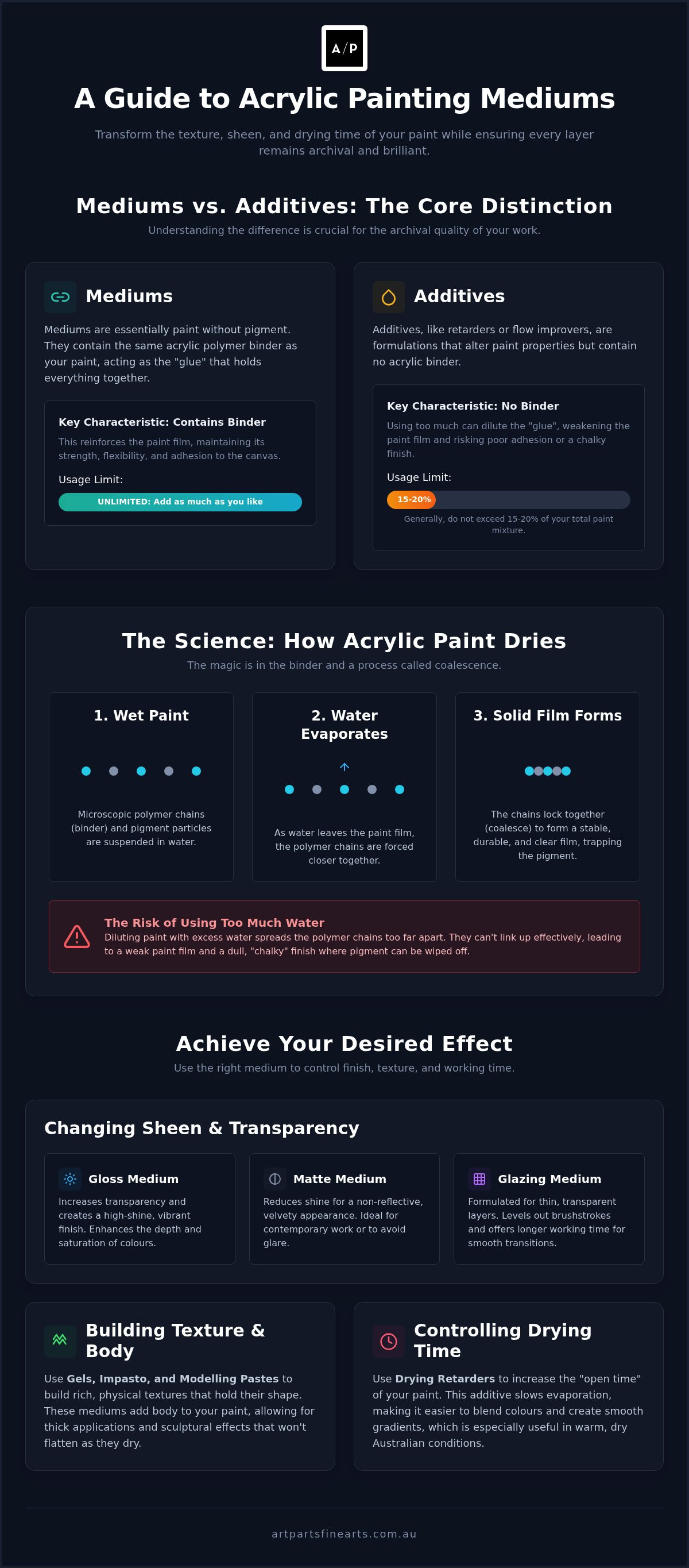
When you're first getting acrylic painting mediums explained, the most vital distinction to make is between a medium and an additive. An acrylic medium is essentially paint without the colour. It's a liquid or gel made of acrylic polymer binder that ensures your work stays put on the canvas. Additives like retarders or flow improvers are different because they contain no binder at all.
Think of the medium as the "glue" of your painting. It maintains the flexibility and adhesion of the paint film. If you use too much of an additive without enough binder, you risk "under-binding" the paint. This can lead to the paint becoming fragile or even rubbing off the surface once it's dry. Professional ranges like Matisse are designed to work harmoniously with these tools to keep your work archival.
- Mediums: These contain acrylic resin. You can add as much as you like to your paint because they reinforce the paint film.
- Additives: These lack resin. They should generally make up no more than fifteen to twenty per cent of your mix to avoid weakening the paint structure.
The Role of the Acrylic Binder
Acrylic paint relies on a chemical process called coalescence. As the water in the paint evaporates, the microscopic polymer chains lock together to form a clear, solid film. This film traps the pigment particles and bonds them to your support, whether you're using a standard cotton canvas or a heavy-duty 500gsm linen. In the art world, gsm stands for grams per square metre, which is a standard measurement used to indicate the weight and thickness of the fabric.
Many artists rely solely on water to thin their paint, but this can cause long-term issues. If you dilute your paint with too much water, the polymer chains can't link up effectively. This leads to "chalking," where the pigment isn't properly sealed and can be wiped away with a finger once dry. Using a dedicated medium allows you to achieve extreme transparency or fluid washes while keeping that archival bond rock-solid for the life of the painting.
Changing Sheen and Transparency: Fluid Mediums for Glazing and Blending
Fluid mediums are the go-to for artists wanting to change the flow and finish of their paint without losing pigment stability. Unlike the thicker gels used for texture, these have a liquid consistency. They allow you to shift the final appearance of your work from a flat surface to a high-gloss finish that mimics traditional oil paintings. Having acrylic painting mediums explained helps you choose the right sheen to control how light interacts with your colours.
Gloss Medium is a favourite for those who want to enhance colour depth. It makes darks appear richer and more saturated by reducing light scattering on the surface. Conversely, Matte Medium contains a matting agent that kills reflections. This is perfect for contemporary works where you want to avoid glare, or for mixed media projects where you need a subtle, non-reflective bond. If you're working on a large scale, buying a full carton of canvas ensures you have the space to experiment with these different finishes across a series.
- Gloss Medium: Increases transparency and provides a high-shine, vibrant finish.
- Matte Medium: Reduces shine for a non-reflective, velvet-like appearance.
- Glazing Medium: Specially formulated for thin, transparent layers with superior levelling.
Mastering the Glazing Technique
To create a successful glaze, mix a tiny amount of pigment into a large pool of glazing medium. The goal is to create a tinted "glass" that sits on top of your dried painting layers. This technique allows light to travel through the transparent layer and bounce back, creating a luminous effect. While standard gloss mediums work, a dedicated glazing liquid offers a longer "open time," which is vital for smooth transitions. For a deeper look at specific applications, this Guide to Acrylic Paint Mediums provides excellent technical insights.
Using the right tools makes a significant difference in the professional look of your final piece. You'll find that specialised glazing liquids help eliminate brush marks far better than water or standard mediums ever could. It's an easy way to add professional polish to your practice without needing to learn entirely new painting systems.
Building Texture and Body: Gels, Impasto, and Modelling Pastes
Building physical depth is one of the most rewarding parts of working with acrylics. When you have acrylic painting mediums explained through the lens of texture, you see how easy it is to move beyond flat applications. Gel mediums are the primary tool here; they are thick, clear resins that hold the shape of your brush or palette knife as the paint dries.
For artists who love a heavy, sculptural look, an Impasto Medium is essential. It is designed to extend heavy body paints like Matisse Acrylic Paint Structure without thinning the paint's consistency. This combination allows you to build substantial peaks and ridges while saving on the cost of pure pigment. If you want something even more substantial, Modelling Paste contains marble dust or clay to create a rigid, stone-like surface.
Choosing between gloss and matte gels depends on your desired finish. Gloss gels create a wet look that enhances the vibrancy of your colours, while matte gels provide a subtle, textured surface without any distracting glare. Both options keep the paint flexible, which is crucial for preventing cracks on a moving support like canvas.
Creating 3D Effects on Canvas
Building depth requires a support that won't sag under the weight of the material. We recommend using CreateART and Wright & Co canvases for this type of work. These professional-grade supports provide the necessary tension for heavy impasto techniques. To ensure these layers stay attached, they are prepared with acrylic gesso. Gesso is a primer or ground applied to the canvas to provide a surface for the paint to grip, creating what artists call "tooth."
When applying thick layers, consider the difference between flexible and rigid materials. Gels remain flexible and are perfect for stretched canvas. Modelling pastes are more rigid; if applied too thickly on a flexible canvas, they can crack if the surface is bumped. Use a palette knife to layer your material, trusting that the professional gesso on your canvas will keep your textures securely bonded.
Shop professional bulk canvas for heavy texture work
Controlling Drying Time and Flow in the Australian Climate
The Australian climate presents a unique challenge for artists. High temperatures and low humidity mean your paint can dry on the palette before it even hits the canvas. Having acrylic painting mediums explained in the context of our weather is essential for anyone wanting to achieve soft, seamless blends. When the air is dry, the water in your paint evaporates rapidly, leaving you with very little time to move the pigment.
Acrylic Retarder is your primary tool for fighting the heat. It's an additive that slows the evaporation of water, giving you significantly more "open time" to work your colours. If you're struggling with paint that feels "draggy" or sticky, a Flow Improver (or Flow Medium) can help. This additive breaks the surface tension of the water, allowing the paint to spread smoothly for fine detail work or staining techniques without the need for excessive scrubbing.
A practical studio tip is to keep a fine mist spray bottle nearby. Lightly misting the back of your stretched canvas or your palette can keep the paint workable for much longer. It's a simple, cost-effective way to maintain a humid micro-climate around your work area during the height of summer.
Blending Like an Oil Painter
You can achieve oil-like transitions by prepping your surface with a thin layer of retarder or a clear blending medium. This "wet-in-wet" approach allows you to move pigment across the surface without it "locking down" too quickly. This method is particularly useful for portraiture or landscape skies where soft, unblemished gradients are required to create a sense of realism.
Keep the "10% rule" in mind when using additives. Because retarders don't contain any acrylic binder, adding too much can prevent the paint from ever drying properly or cause it to remain permanently tacky. We recommend mixing no more than 10% retarder into your paint. If you need more fluidity beyond that point, reach for a professional medium rather than water. This ensures you maintain the "tooth" of the paint and its ability to grip the next layer securely.
Investing in professional-grade acrylic paint and dedicated mediums is always better than over-thinning with water. It preserves the archival integrity of your work, ensuring your colours remain vibrant and your layers stay bonded even in the harsh Australian sun. This technical approach allows you to focus on the creative process without worrying about your materials failing mid-stroke.
Elevating Your Practice with the Right Tools
Mastering your materials gives you the freedom to stop fighting your paint and start manipulating it with confidence. Having acrylic painting mediums explained is about more than just technical definitions; it's about gaining control over your drying times and surface textures. Whether you are building heavy impasto peaks with Matisse Structure or extending your blending time on a hot afternoon, the right medium ensures your work remains archival and professional for years to come.
You now have the practical knowledge to distinguish between binder-rich mediums and additives, manage the Australian climate with retarders, and build 3D effects that stay bonded to your support. Our artist-led team at Art Parts Fine Arts is here to help you navigate these choices. We are trusted by professional artists and art centres across the country, shipping everything you need directly from our Albury studio.
Explore our range of professional Matisse mediums and additives
We look forward to seeing how these technical tools help you push the boundaries of your creativity. Don't hesitate to reach out if you need a hand selecting the right products for your specific painting style or studio setup.
Setting up a professional studio often involves managing bulk materials and logistics; if you are based in Perth, Pallet Pickups can help streamline your operations with their pallet repair and collection services.
Frequently Asked Questions
Can I mix different brands of acrylic mediums and paints?
Yes, you can generally mix most professional brands of acrylic paints and mediums. Because they are all made from a similar acrylic polymer resin, brands like Matisse and Winsor & Newton are compatible. It's always a good idea to practise on a small scrap piece first to ensure the consistency and drying times meet your expectations before committing to a large canvas.
How much medium should I add to my acrylic paint?
You can add as much medium as you like because it contains the same binder as the paint. This is a key part of having acrylic painting mediums explained; since the medium reinforces the paint film, you don't have to worry about the paint flaking off. However, additives like retarders or flow improvers should stay under 15% of your total mix to ensure the paint cures properly.
Is it better to use a gloss or matte medium for my final layer?
Choosing between gloss and matte depends entirely on the look you want to achieve. Gloss mediums make your colours appear deeper and more vibrant, much like a wet stone in a river. Matte mediums remove reflections, which is better for work that will be displayed under bright gallery lights. If you can't decide, mixing the two creates a custom satin finish that provides a subtle, professional glow.
What happens if I use too much water instead of an acrylic medium?
Using too much water dilutes the acrylic binder and can lead to a weak paint film. This often results in "chalking," where the pigment isn't properly sealed and can be wiped away once dry. Mediums allow you to thin the paint for glazes or washes while keeping the bond strong. This ensures your work remains archival and durable for the long term without the risk of flaking.
Do I need to varnish my painting if I have already used a gloss medium?
A final varnish is still necessary to protect your work from environmental damage. While a gloss medium helps with the internal structure and sheen of the paint, a varnish acts as a sacrificial layer against dust, UV rays, and pollutants. Varnish is also removable, allowing future conservators to clean the painting without damaging the original paint layers underneath. It also helps to unify any uneven patches of sheen.

Article by
Art Parts Fine Arts
Art Parts Fine Arts is an Australian art-supplies store based in Albury, shipping Australia-wide. Hand-picked by artists, our range covers paints, canvas, brushes, paper, printmaking and more, for everyone from students to professionals. We share practical guides and tips to help you get the most out of your materials.
Disclaimer
This article is general information to help you choose and use art materials. It is not professional, health or safety advice. Always follow the manufacturer's instructions and safety guidance for any product, and take care when using solvents, varnishes and other materials. Product availability, specifications and pricing may change, so please check the current product page for details.