

Acrylic vs Oil Paint: A Guide for Australian Artists
Your choice of paint is less about the brand on the tube and more about how you want to spend your time in the studio. Choosing between acrylic and oil paint often feels like a heavy commitment, especially when you're st…Your choice of paint is less about the brand on the tube and more about how you want to spend your time in the studio. Choosing between acrylic and oil paint often feels like a heavy commitment, especially when you're staring at a wall of professional supplies and worrying about the cost. It's completely normal to feel overwhelmed by technical terms like 'open time' or 'colour shift' while trying to figure out if your spare room is ventilated enough for traditional oils.
At Art Parts Fine Arts, we've helped many artists move past this hesitation by focusing on the practical reality of the creative process. This guide will help you understand these technical hurdles so you can invest in your first professional tubes of quality acrylics or Langridge oils with total confidence. We'll explore the practical differences in drying speeds, studio safety requirements, and how to select the best CreateART or Wright & Co canvas to support your chosen medium in our unique Australian climate. Whether you're working in a local studio or ordering from across the country, Art Parts Fine Arts is here to help you get the right gear, delivered right to your door.
Key Takeaways
- Learn the technical differences in drying times and colour shift to make choosing between acrylic and oil paint much easier for your specific workflow.
- Discover why the extended "open time" of oils is the gold standard for seamless blending, while acrylics offer unmatched speed for crisp layering.
- Understand the studio logistics for each medium, including how to manage low-odour solvents or opt for the simple water clean-up of acrylics in shared spaces.
- Identify the best support for your work, ensuring your CreateART or Wright & Co canvas has the right tooth and triple-primed gesso for archival durability.
- Gain the confidence to select professional-grade Matisse or Langridge supplies that suit your painting speed and the Australian climate.
Understanding the Chemistry: Drying Times and Colour Shift
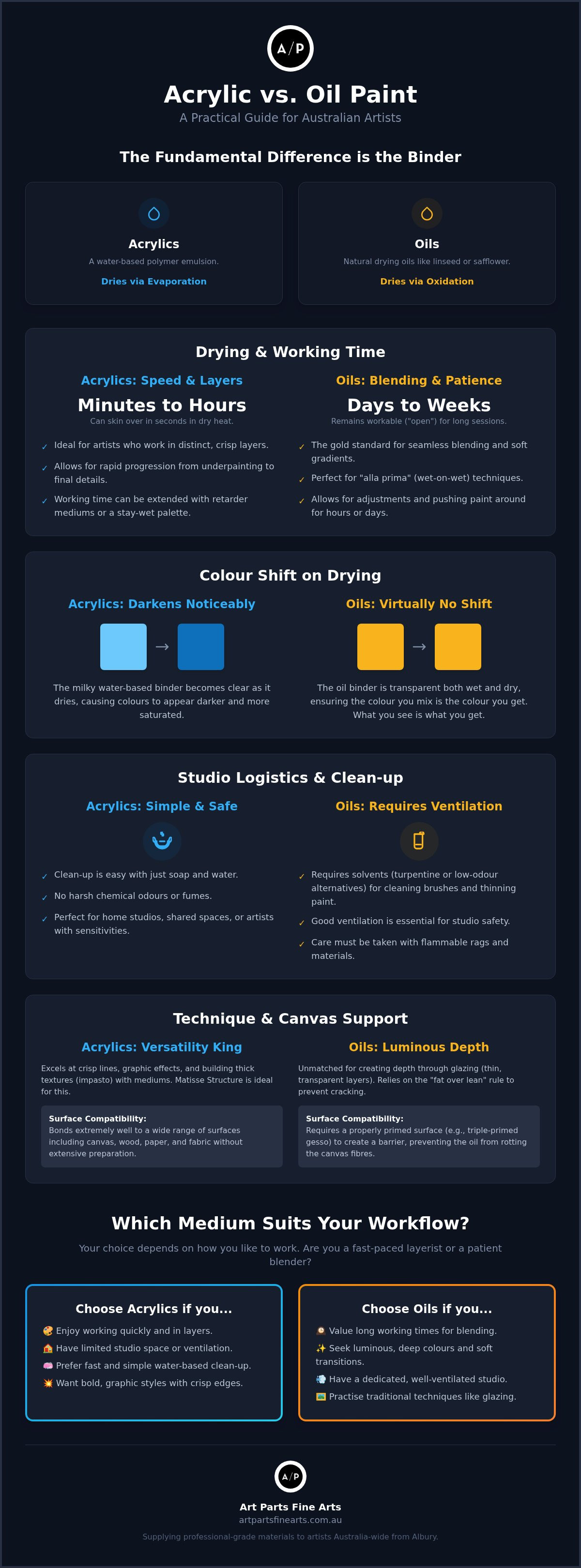
The core difference between these two mediums lies in the binder that holds the pigment together. Acrylics are suspended in a water-based polymer emulsion, while oils rely on drying oils such as linseed or safflower. This fundamental chemistry dictates everything from how you clean your brushes to how the paint behaves on the canvas. When choosing between acrylic and oil paint, the "open time," or the period the paint remains workable, is often the deciding factor for most artists.
Our local climate plays a significant role in this process. In the dry heat of an Australian summer, acrylics can skin over in seconds. You can manage this by using mediums such as retarders or by using a stay-wet palette to keep your colours fresh. Oils are far more relaxed; they dry through oxidation rather than evaporation. This means they stay wet for days, allowing for effortless blending that is difficult to replicate with water-based media.
You should also prepare for "colour shift." Acrylic binders appear slightly milky when wet and become transparent as they dry, which usually causes the colour to darken. Oils don't have this issue. The oil binder looks the same whether wet or dry, ensuring the stroke you lay down remains the same shade as it cures. Understanding this shift is vital for artists who need to match colours precisely across multiple sessions. This level of precision is also essential in other professional art forms; for those exploring the tattoo industry, you can find out more about Tatt Lab to source high-quality equipment and medical supplies.
The Drying Time Dilemma: Finding Your Rhythm
Fast-drying acrylics are a massive advantage for artists who work in layers. You can apply an underpainting and move to the next stage within minutes, making them ideal for graphic styles with crisp edges. Conversely, the slow oxidation of oil paint is perfect for "alla prima" (all at once) painting. It gives you the freedom to push paint around for hours to achieve soft transitions and subtle gradients in portraiture or landscape work.
Pigment Loading and Archival Quality
Professional brands like Matisse Acrylic Paint Structure and Langridge Oil Paints offer high pigment loads that ensure your work remains vibrant for decades. When selecting paint, always check the lightfastness rating on the tube. This is especially important in Australia, where bright interiors can subject your work to high UV exposure. High-quality pigments combined with a stable binder ensure your art resists fading and remains an archival piece for the long term.
Technique and Aesthetics: Blending vs. Layering
The tactile experience of applying paint is often what defines your artistic style. When choosing between acrylic and oil paint, you need to consider whether your work relies on the seamless transition of colours or the rapid build-up of physical texture. Oils remain the undisputed gold standard for portraiture and skies because they allow you to move pigment across the surface for hours; this creates gradients that feel soft and lifelike.
Acrylics offer a different kind of freedom. By using specific mediums, you can transform the paint from a thin, watercolour-like wash into a thick, sculptural paste. Acrylics also win on versatility. They bond to wood, paper, and fabric with ease. Oils are more demanding; they require a properly primed surface to prevent the oil from rotting the natural fibres of your support. If you are working on large-scale projects, you might consider our bulk stretched canvas options to ensure you have a consistent, professional surface ready for either medium.
Building Texture with Matisse Structure
Matisse Acrylic Paint Structure is specifically designed for artists who love the look of impasto. This heavy-body paint is thick enough to hold sharp brush marks and high palette knife peaks without sagging or flattening as it dries. You can push this even further by adding impasto mediums. These allow you to create dramatic 3D effects while extending your paint further, which is a great way to manage costs on larger works.
Glazing and Transparency in Oil Painting
Oil painting relies on the "fat over lean" rule to ensure the longevity of the work. This simply means each successive layer should have more oil (fat) than the one below it. Following this prevents the top layers from drying faster than the bottom ones, which is what causes cracking. Using Langridge mediums, you can create luminous, glass-like glazes that give oil paintings their characteristic depth and inner glow.
Studio Logistics: Safety, Solvents, and Clean-up
Your studio setup is just as important as your technique. Acrylics are the obvious winner for artists working in small apartments or shared family spaces. Since they are water-based, you don't need to worry about chemical odours or flammable rags. When choosing between acrylic and oil paint, consider how much dedicated space you have for drying and storage. Acrylic work can be stacked relatively quickly, whereas oils need a safe spot to sit undisturbed for weeks. To keep your clothing protected during these long sessions, investing in high-quality workwear from White Wear is a practical choice for any serious artist.
Oil painting has a reputation for being toxic, but modern alternatives have changed the game. You no longer need to use harsh turpentine; low-odour mineral spirits provide a much safer experience. You can even practise a completely solvent-free method by using walnut or linseed oil to clean your brushes during a session. This approach keeps your studio air clean and is much gentler on your brush fibres.
Proper waste management is vital regardless of your medium. Avoid rinsing heavy metal pigments like Cadmium or Cobalt directly down the sink. Instead, let your rinse water or solvent sit until the paint solids settle at the bottom. You can then wipe out the "sludge" with a paper towel and dispose of it in the bin. This simple habit keeps our waterways clean and protects your plumbing from acrylic build-up.
Ventilation and Air Quality
Good air quality is essential for a productive practice. Even though acrylics are low-fume, the varnishes and some spray mediums can still be quite strong. If you're working with oils, set up your easel near a window to ensure constant cross-ventilation. This is especially important in the Australian summer when closed-up rooms can trap heat and vapours.
The Cost of Entry: Brushes and Accessories
Your choice of accessories should match your paint's chemistry. Synthetic brushes are best for acrylics because water can damage natural hair fibres over time. For oils, you might prefer the "spring" of natural hog bristle or high-quality stiff synthetics. Starting with a limited palette of professional tubes is always a better investment than a cheap set of twenty student-grade colours, though exploring guided events like those by Paint Chill Co can be an excellent way to see which tools feel most comfortable in your hand before purchasing your own.
Browse our range of bulk canvas for your next project
Selecting the Right Support: Why Your Canvas Choice Matters
Your paint choice is only half the battle. The surface you work on dictates how well that paint adheres and how long the piece survives. When choosing between acrylic and oil paint, you must look at the "tooth" of the canvas. This refers to the texture of the weave; a coarser tooth is excellent for holding heavy impasto layers, while a finer grain suits detailed work and smooth glazing.
Priming is another critical technical step. Oils are naturally acidic and will eventually rot natural fibres like cotton or linen if they aren't properly sealed. This is why we recommend a triple-primed acrylic gesso barrier. This gesso acts as a protective shield, ensuring the oil stays on the surface rather than soaking into the fabric. For acrylic artists, this priming ensures the paint doesn't "sink" and lose its vibrancy over time.
The weight of your canvas is measured in gsm (grams per square metre). For professional results, especially on larger works, look for a weight between 380 and 500gsm. This thickness provides the necessary tension and prevents the canvas from sagging under the weight of the paint. Most of our professional ranges, like CreateART and Wright & Co, feature kiln-dried pine or hardwood bars to keep the frame square and stable in our changing Australian humidity.
Maintaining a consistent studio practice often comes down to logistics. Investing in full carton canvas is the most cost-effective way to ensure you always have a surface ready when inspiration strikes.
Cotton vs. Linen vs. Poly-Cotton
Cotton duck is the most versatile and affordable choice. It's a reliable workhorse for both acrylic studies and finished oil paintings. If you're an oil painter looking for the ultimate archival support, professional linen is the gold standard. It has a unique, irregular grain and superior strength that has been favoured by artists for centuries for its longevity and elegant finish. To see how such timeless quality can be complemented in a refined interior, you might explore Chest of Drawers & Commodes that offer a similarly classic aesthetic for your home.
Bulk Savings for Studios and Schools
High-volume artists, schools, and art centres benefit significantly from our full carton options. Brands like CreateART and Wright & Co offer consistent quality across every frame, which is essential for professional series. We ship these bulk orders Australia-wide from our Albury centre, making it easy to keep your studio stocked without the stress of local supply shortages.
For those managing high-volume studios or looking to expand into larger industrial facilities, you can read more about how A1 Precision Solutions assists with professional space optimisation and warehouse fitouts.
For artists who also need to manage the administrative side of their practice, you can check out Mega Office Supplies for everything from archival pens to filing systems, ensuring your studio remains as organised as it is inspired.
Start Your Next Masterpiece with Confidence
Deciding on a medium is about matching your painting pace to the paint's chemistry. Whether you prefer the fast layering of Matisse acrylics or the patient, seamless blending of Langridge oils, understanding your studio environment and technique is the first step toward better results. Choosing between acrylic and oil paint becomes much simpler once you align your tools with your specific artistic goals and workspace logistics.
A professional result always starts with a high-quality support. A triple-primed canvas with the right tooth ensures your work remains archival and vibrant for years to come. We are an artist-owned business based in Albury, and we have carefully selected our range to help you achieve the best possible outcome for your creative practice.
For those whose professional work extends into the construction and infrastructure sectors, Equipcon provides the specialised machinery and technical expertise required for high-performance concrete pumping.
To see how your finished creative pieces can be complemented by modern design and functional art, read more about Artistry Deco Shop and their collection of contemporary home accessories.
Beyond the studio, exploring other heritage-based crafts can be deeply rewarding; you might discover The Historic Arnott Bakehouse to take part in a sourdough class or enjoy a stay in their boutique heritage accommodation while seeking fresh inspiration for your art.
Stock your studio and save with our professional full carton canvas range
We are here to help you find the right supplies for your journey, offering competitively priced professional brands and reliable Australia-wide shipping. As you continue to develop your portfolio, you might find inspiration in how American Luxury Gifts uses themed prints to transform environments and boost creative energy. Don't hesitate to reach out if you need more advice on which materials will best support your next project; we look forward to seeing what you create.
Frequently Asked Questions
Can I use acrylic paint on top of oil paint?
You cannot apply acrylic paint on top of oil paint because the water-based acrylic won't bond to the oily surface. It will eventually peel or flake off. However, you can certainly paint oils over acrylics. This is a common technique where artists use acrylics for a fast underpainting and then finish with professional oils once the base is dry. This follows the basic archival rule of 'fat over lean' which ensures your work lasts.
Do I need special brushes for oil painting vs acrylics?
You should use different brushes for each medium to get the best results and protect your tools. Synthetic brushes are ideal for acrylics because they handle the water and alkaline nature of the paint well. For oils, natural hog bristles or stiffer synthetics are preferred to move the heavier paint and withstand the solvents used during clean-up. Keeping your sets separate also prevents cross-contamination of oils into your water-based supplies.
Is oil painting more expensive to start than acrylic painting?
The initial investment for oils is usually higher than for acrylics because you need extra supplies like solvents and specific mediums. When choosing between acrylic and oil paint, beginners often find acrylics more accessible because they only require water for clean-up. However, investing in a high-quality limited palette of professional tubes in either medium is better value for money than buying large sets of student-grade paint that lack pigment density.
How do I know if my canvas is suitable for oil paint?
Look for a canvas that is explicitly labelled as "triple-primed" with acrylic gesso. This gesso, which is a primer that seals the fabric, creates a non-porous barrier that prevents the oils from soaking into and rotting the natural cotton or linen fibres. Our CreateART and Wright & Co canvases are all professional-grade and safe for both mediums. If the canvas isn't primed, the oil will eventually make the fabric brittle and prone to tearing.
Can I make acrylics dry slower to act more like oils?
You can extend the "open time" of acrylics by adding a retarder medium or using a stay-wet palette. These tools slow down the evaporation of water, giving you more time to blend colours on the canvas. While it won't stay wet for days like oil paint, it makes choosing between acrylic and oil paint easier for artists who want a bit more flexibility without the long drying times or solvent requirements of traditional oils.
Article by
Art Parts Fine Arts
Art Parts Fine Arts is an Australian art-supplies store based in Albury, shipping Australia-wide. Hand-picked by artists, our range covers paints, canvas, brushes, paper, printmaking and more, for everyone from students to professionals. We share practical guides and tips to help you get the most out of your materials.
Disclaimer
This article is general information to help you choose and use art materials. It is not professional, health or safety advice. Always follow the manufacturer's instructions and safety guidance for any product, and take care when using solvents, varnishes and other materials. Product availability, specifications and pricing may change, so please check the current product page for details.