

Arches vs Hahnemühle Watercolour Paper: A Professional Comparison for 2026
Choosing the most expensive paper on the shelf doesn't always guarantee the best results for your specific technique. When deciding between arches vs hahnemuhle watercolour paper, the right choice depends more on your ha…Choosing the most expensive paper on the shelf doesn't always guarantee the best results for your specific technique. When deciding between arches vs hahnemuhle watercolour paper, the right choice depends more on your handling of water and pigment than the price tag alone. Most artists have felt the frustration of watching professional pigments settle poorly or seeing a surface pill under a heavy wash. It's a common struggle to find a reliable foundation that supports your creative vision rather than hindering it.
This comparison breaks down the practical differences between these two legendary mills to help you find your perfect match. You'll learn how Arches' traditional gelatin sizing, the substance that controls absorbency, compares to the vegan-friendly surface of Hahnemühle's The Collection. We'll explore how each brand handles lifting, glazing, and granulation to ensure your finished pieces maintain their colour vibrance and archival stability. By looking at everything from 300 gsm basics to heavy 640 gsm sheets, you can stop wasting paint on the wrong surface and start painting with confidence.
Key Takeaways
- Evaluate the structural differences in the arches vs hahnemuhle watercolour paper comparison to understand how their manufacturing processes impact your paint's archival stability.
- Master technical specifications like gsm (grams per square metre) and tooth to help you maintain colour vibrance and predictable granulation in your work.
- Learn which surfaces are best suited for wet-on-wet techniques or fine detail to avoid common frustrations like paper buckling and unwanted cauliflowers.
- Compare practical formats including individual sheets and gummed blocks to find the most efficient setup for both studio work and plein air painting.
Understanding the Composition of Arches and Hahnemühle Papers
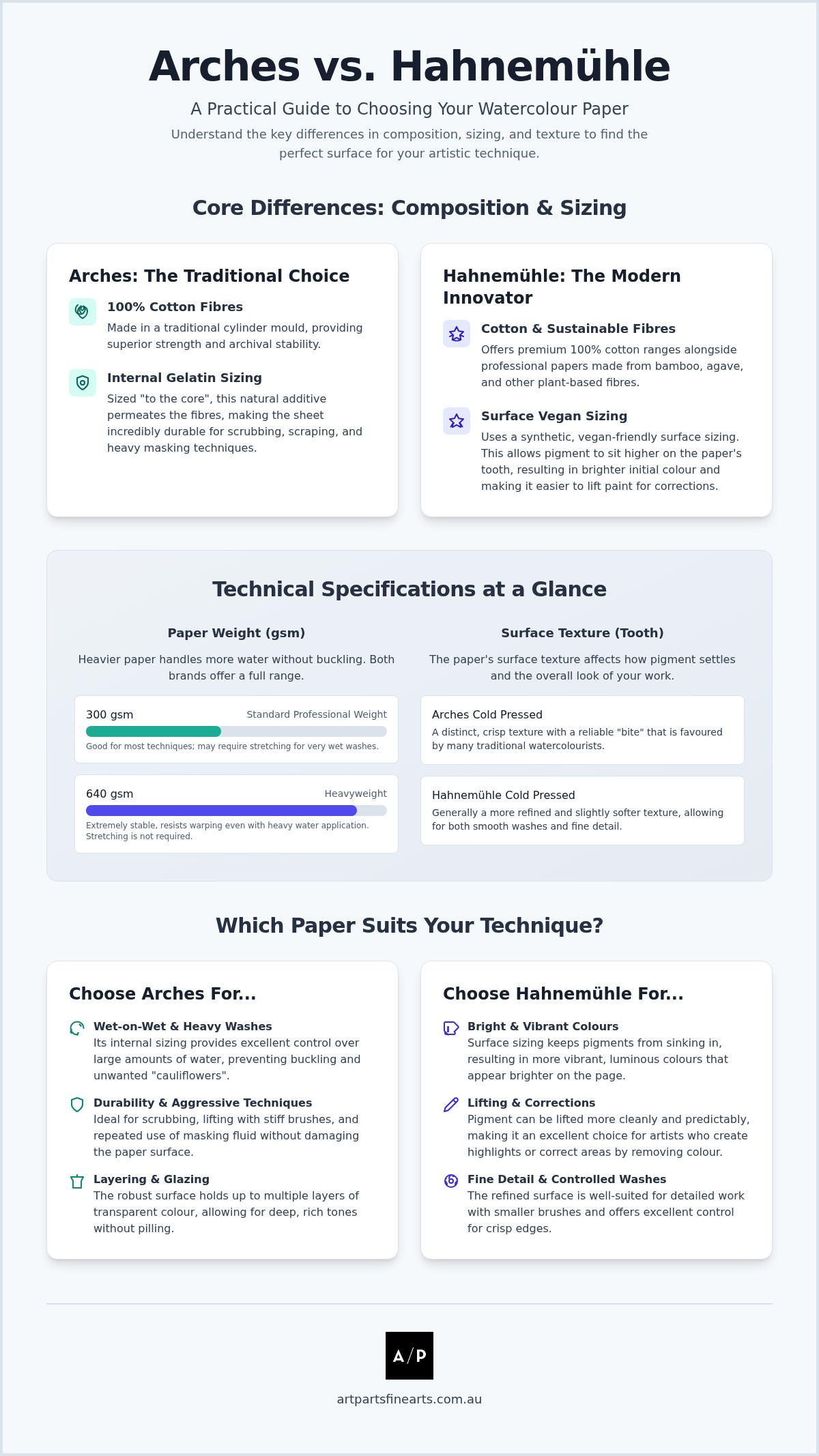
Heritage and chemistry define the performance of professional surfaces. When comparing arches vs hahnemuhle watercolour paper, the first thing to consider is the base material and how it's treated. The composition of watercolor paper typically involves 100% cotton fibres, which are prized for their archival stability and strength. A crucial component in this process is sizing. Sizing is an additive that acts as a barrier, preventing the paper from absorbing water too quickly. It ensures your pigment stays on the surface rather than sinking into the fibres and looking dull.
Arches: The 100% Cotton Tradition
Arches has operated its French mill since 1492, relying on a traditional cylinder mould-made process that mimics the quality of handmade sheets. They use 100% cotton and size the paper to the core with natural gelatin. This internal sizing means the paper remains consistent even if you scrub the surface or use heavy masking techniques. It's built for durability. You'll find it has a warm, natural white tone and a subtle, characteristic scent when damp. This gelatin sizing makes the sheet feel slightly stiffer, providing a reliable foundation for multiple glazes and intense water work.
Hahnemühle: Cotton and Sustainable Alternatives
Hahnemühle represents a blend of German engineering and modern innovation. While they produce high-end cotton ranges like The Collection, they've also introduced professional surfaces made from bamboo, agave, and sugar cane. These plant-based fibres offer unique textures and excellent archival properties. Most Hahnemühle professional paper ranges use synthetic, vegan-friendly sizing. This often creates a different surface tension than gelatin-sized sheets. When evaluating arches vs hahnemuhle watercolour paper, many artists find that colour sits with more immediate vibrance on these surfaces. Lifting pigments for corrections is also often more predictable than on traditional cotton sheets.
Comparing Technical Specs: Sizing, Tooth, and Weight
Technical specifications are the easiest way to objectively measure the differences in the arches vs hahnemuhle watercolour paper debate. Most professional artists start with a weight of 300gsm. This thickness provides enough stability for moderate washes, though heavier options like 640gsm or even 850gsm are available for those who prefer to avoid stretching their paper. These heavier sheets handle significant amounts of water without the risk of buckling or warping during the painting process.
The traditional papermaking process used by these mills ensures that even at standard weights, the paper remains archival and acid-free. However, how the surface handles water depends heavily on the specific sizing methods used by the manufacturer. Sizing acts as a barrier that controls how much water is absorbed into the cotton fibres.
The Impact of Internal and External Sizing
Arches is known for sizing its paper to the core with natural gelatin. Consequently, the water-resistant additive permeates every fibre, allowing you to scrub, erase, or use masking fluid without losing the paper's integrity. Hahnemühle often focuses on surface sizing in professional ranges like The Collection. This technique creates a different surface tension where pigments sit higher on the tooth, often resulting in brighter colour reproduction. If you frequently lift paint to create highlights or corrections, you'll find Hahnemühle's surface sizing makes this process more predictable.
Texture Profiles: Cold Pressed vs Hot Pressed
Tooth refers to the physical texture of the sheet. Arches Cold Pressed (Grain Fin) has a distinct, crisp texture that many traditionalists prefer for its consistent performance and "bite." Hahnemühle textures are generally more refined and feel slightly softer to the touch. For those using granulating Daniel Smith watercolours, Rough textures from both mills allow pigments to settle beautifully into the valleys of the paper. If you're diversifying your practice beyond paper, you might also consider our bulk stretched canvas for your larger acrylic or oil studies.
Performance in the Studio: Choosing for Your Technique
Studying how your pigments interact with the surface is the best way to resolve the arches vs hahnemuhle watercolour paper choice. For wet-on-wet techniques, you need a sheet that manages heavy pools without creating "cauliflowers" or backruns. Both mills offer acid-free, lightfast surfaces, ensuring your work remains professional for decades. The base colour of the paper also affects your colour mixing. Arches typically has a warm, natural white tone, while Hahnemühle offers ranges with a crisp bright white that makes cool blues and greens appear more vivid.
Best for Expressive Landscapes and Heavy Washes
Arches is a reliable partner for rugged techniques that involve heavy scrubbing and multiple layers of glazing. Because the gelatin sizing permeates the entire sheet, it offers a longer "open time." This means you can manipulate your paint on the surface for longer before it sets. We often see this durability in action during our Watercolour techniques masterclass, where students practise aggressive lifting and layering. It is difficult to damage the surface of a 300gsm Arches sheet with standard brushwork.
Best for Botanical Detail and Illustration
If your practice involves botanical illustration or fine linework, Hahnemühle Hot Pressed papers are exceptional. The surface is incredibly smooth, allowing for precise pen work or tiny brush strokes without the physical "skip" found on textured papers. The synthetic sizing in ranges like The Collection allows for very crisp edges and high colour vibrance. It's also the preferred choice for artists looking for a high-quality, vegan-friendly professional alternative to traditional gelatin-sized papers. Choosing between arches vs hahnemuhle watercolour paper often comes down to this specific balance of texture and surface tension.
Practical Considerations: Formats and Storage in Australia
Logistics play a major role when choosing between arches vs hahnemuhle watercolour paper for your daily practice. While the performance of the cotton is vital, the format you choose affects your preparation time and budget. Professional-grade paper is generally sold in three main forms: individual sheets, gummed blocks, and pads. Each serves a different purpose depending on whether you're working in a controlled studio or out in the field.
Sheets, Blocks, or Pads?
Individual 56x76cm sheets offer the most cost-effective path for high-volume artists. By tearing these down into halves or quarters, you can customise your surface size to fit specific frames or projects. Gummed blocks are a favourite for plein air painting because the sheets are glued on all four sides. This keeps the top sheet flat and taut while you paint, so you don't have to carry heavy boards or rolls of tape. Pads are a convenient, portable option for quick studies or when attending creative workshops.
Archival Storage and Care
Storing your paper correctly is essential in the varied Australian climate. High humidity can trigger a process called "foxing," which results in permanent reddish-brown mould spots on the surface. To avoid this, keep your paper flat in a cool, dry place and never store it directly on a concrete floor. Using acid-free portfolios or storage drawers helps maintain the archival quality of your materials. For more advice on setting up a professional workspace, our guide on Art Supply Gift Ideas for Adults includes several helpful suggestions for studio organisation.
Selecting Your Professional Surface for 2026
Choosing between arches vs hahnemuhle watercolour paper ultimately comes down to how you handle your brush and water. If your style involves heavy scrubbing and multiple layers of glazing, the traditional gelatin sizing of Arches provides the durable foundation you need. For those seeking crisp botanical detail or a vegan-friendly alternative, Hahnemühle’s innovative plant fibres and refined surface sizing offer exceptional colour vibrance.
Both mills provide professional-grade archival quality that ensures your work remains stable for years to come. Our staff are painters ourselves, and we're always happy to share expert advice on how these surfaces perform in different Australian climates. Whether you're stocking a school studio or your private practice, we offer nationwide shipping across Australia to get these premium materials into your hands.
Finding the right surface is a shared journey, and we're here to help you make an informed choice for your next project.
Frequently Asked Questions
Why does Arches watercolour paper smell when it is wet?
The distinct scent of Arches paper when damp is caused by its traditional gelatin sizing. This natural animal by-product is used to size the sheet to the core, ensuring the fibres are protected throughout the paper's thickness. While the smell is noticeable, it is a hallmark of the cylinder mould-made process that gives the paper its legendary durability. This sizing allows you to use heavy masking and scrubbing without damaging the surface.
Is Hahnemühle watercolour paper vegan-friendly?
Most professional Hahnemühle ranges, including The Collection and their sustainable plant-fibre papers, are explicitly vegan-friendly. Synthetic, starch-based sizing controls the paper's absorbency instead of traditional animal-derived gelatin. Artists seeking high-performance, archival surfaces without animal by-products often prefer this range. When comparing arches vs hahnemuhle watercolour paper, this ethical distinction is a deciding factor for many modern creators and professional studios working in Australia today.
What is the difference between 300gsm and 640gsm paper?
The primary difference lies in the thickness and the paper's ability to handle heavy water applications without buckling. While 300gsm (grams per square metre) is the professional standard for most techniques, it may require stretching to stay flat during intense washes. In contrast, 640gsm is a much heavier, stiffer sheet that remains stable even when saturated. This extra weight allows you to paint without the time-consuming preparation of pre-stretching your paper.
Can I use both sides of Arches and Hahnemühle paper?
You can certainly use both sides, though the felt side is the intended painting surface. This side typically features the watermark and the most consistent texture from the manufacturing process. Because these papers are professional-grade and sized thoroughly, the reverse side remains archival and handles paint well. Many artists use the back for practice pieces or studies to achieve better value while maintaining excellent colour vibrance and stability.
Which paper is better for lifting watercolour paint?
Hahnemühle is generally considered superior for lifting techniques due to its specific surface sizing. This treatment allows the pigment to sit slightly higher on the paper's tooth, making it easier to re-wet and remove colour for highlights. When evaluating arches vs hahnemuhle watercolour paper for botanical work or high-detail illustration, this ease of lifting is a significant advantage. Arches' gelatin sizing bonds firmly with pigments, making permanent staining more likely.

Article by
Art Parts Fine Arts
Art Parts Fine Arts is an Australian art-supplies store based in Albury, shipping Australia-wide. Hand-picked by artists, our range covers paints, canvas, brushes, paper, printmaking and more, for everyone from students to professionals. We share practical guides and tips to help you get the most out of your materials.
Disclaimer
This article is general information to help you choose and use art materials. It is not professional, health or safety advice. Always follow the manufacturer's instructions and safety guidance for any product, and take care when using solvents, varnishes and other materials. Product availability, specifications and pricing may change, so please check the current product page for details.