

Best Canvas for Acrylic Painting: Professional Guide
Have you ever spent hours perfecting a heavy impasto technique only to have the canvas bounce and vibrate under your brush? It's a common frustration for many Australian artists, especially when cheaper frames can't hand…Have you ever spent hours perfecting a heavy impasto technique only to have the canvas bounce and vibrate under your brush? It's a common frustration for many Australian artists, especially when cheaper frames can't handle the physical demands of professional work. Choosing the best canvas for acrylic painting is about more than just finding a white rectangle. It's about ensuring your creative vision has a stable, archival foundation that won't warp when the humidity spikes or sag after you've finished your piece.
We know you want your artwork to last a lifetime, whether it's for a private collection or a gallery sale. You've likely felt the disappointment of paint sinking into poor quality gesso or seeing a stretcher bar twist over time. This guide will help you select professional surfaces so you can invest your time and talent with confidence. We'll explore the crucial differences between cotton duck and Belgian linen, the weight requirements for heavy paint structures, and why museum-grade quality makes all the difference for your final colour vibrancy!
Key Takeaways
- Learn why archival stability and surface texture are the foundation of the best canvas for acrylic painting to ensure your work stands the test of time.
- Compare the consistent grid of cotton duck with the durable, irregular weave of Belgian linen to find the perfect surface for your specific style.
- Understand how surface "tooth" and quality priming support heavy-body applications like Matisse Acrylic Paint Structure without the paint sinking or peeling.
- Protect your artwork from the Australian climate by choosing kiln-dried stretcher bars designed to prevent warping and twisting in varying humidity.
- Discover why investing in professional-grade artist surfaces is a vital step in elevating your creative practice and ensuring gallery-ready results.
Understanding Why Your Canvas Choice Matters for Acrylics
Finding the best canvas for acrylic painting isn't just about grabbing the cheapest white rectangle from a discount shop. It's about finding a reliable partner for your creative process. The "best" surface is actually a delicate balance of structural support, surface texture, and archival stability. When you're working with a fast-drying medium like acrylic, the surface needs to do more than just hold the pigment; it has to manage moisture and provide a mechanical bond that lasts for decades.
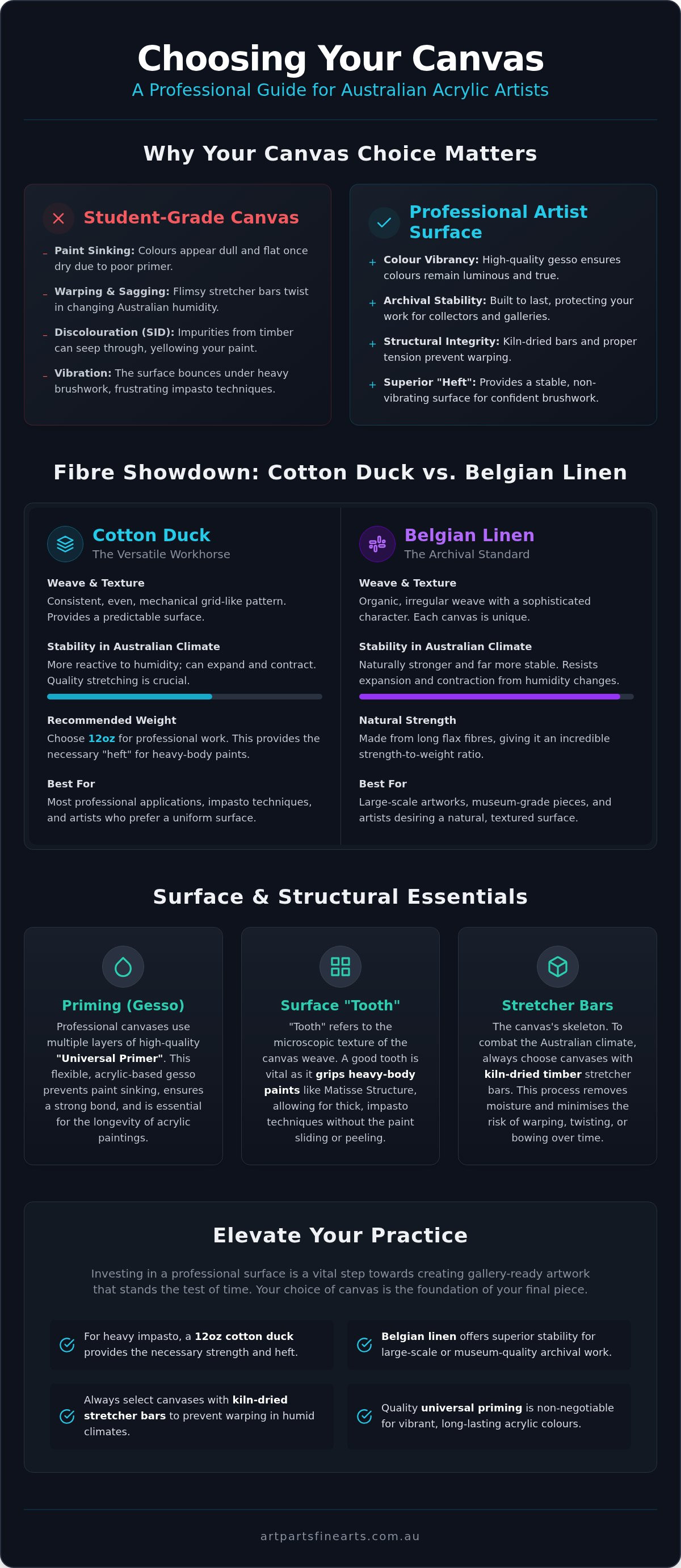
There's a massive gulf between student-grade "bargain" canvases and professional artist surfaces. Cheaper options often use thin, loosely woven fabric and a single layer of low-grade primer. This can lead to your paint "sinking," where the vibrant colours you mixed on the palette look dull and flat once they dry. Professional canvases offer a tighter weave and multiple layers of high-quality gesso, ensuring your colours remain as luminous as the moment they left the tube. Understanding the history of painting on canvas helps us appreciate how these materials have been refined to support different artistic movements and media over centuries.
One critical issue often overlooked by beginners is support-induced discolouration (SID). In poor quality canvases, impurities from the timber stretcher bars or the fabric itself can seep through the primer and into the paint film. Because acrylics dry so quickly through evaporation, they can pull these yellowing contaminants upward, muddying your highlights. A professional-grade surface acts as a barrier, protecting your hard work from these internal threats.
The Role of the Surface in Professional Art
Working on a premium surface changes the way you paint. There's a psychological boost when you aren't fighting your materials. High-quality canvases provide a specific "tooth", the microscopic texture of the surface, that allows heavy-body paints like Matisse Acrylic Paint Structure to grip and hold their shape. This reliable "heft" prevents the surface from bouncing or vibrating during vigorous impasto work. Ultimately, using professional materials increases the market value of your finished work, as collectors and galleries look for the archival security that only premium supports provide.
Acrylic vs. Oil Requirements
Acrylic paints are essentially liquid plastic. As they dry, they lose volume and become a flexible film. This means they require a primer that is equally flexible; if the primer is too brittle, the paint can eventually crack or peel. While oil painters might use specific oil-primed linen, acrylic artists usually look for "universal priming." Universal primer is a flexible, acrylic-based gesso designed to accept both oil and acrylic media while maintaining a strong bond with the fabric underneath. It's the industry standard for modern acrylic painting because it provides the perfect level of absorbency for fast-drying pigments.
Cotton Duck vs. Linen: Selecting the Right Fibre for Your Style
Choosing the best canvas for acrylic painting usually starts with a fundamental decision: cotton or linen? While they might look similar once they're primed and sitting on an easel, these two fibres behave very differently under the brush. Cotton offers a mechanical, grid-like consistency that many artists find comforting. Linen, conversely, provides an organic, irregular weave that adds a sophisticated character to your work. In our varied Australian climate, where humidity can swing from bone-dry to tropical within a single day, understanding how these materials react is vital for the long-term health of your art.
Cotton is often more reactive to moisture, expanding and contracting as the air changes. Linen is much more stable. It's made from flax fibres, which are naturally longer and tougher than cotton. This gives Belgian linen an incredible strength-to-weight ratio. For massive, large-scale works that need to stay taut over several metres, linen is often the superior choice. However, for most professional applications, a high-quality cotton remains the reliable workhorse of the studio.
Cotton Duck: The Versatile Professional Choice
We weigh canvas using the "oz" (ounce) system, which refers to the weight of the fabric per square yard. While you might find 8oz or 10oz options in big-box retailers, professional artists generally step up to 12oz Dixie cotton. This heavier weight provides the necessary "heft" to support thick, impasto techniques. If you enjoy the heavy-body feel of Matisse Acrylic Paint Structure, a 12oz cotton provides a predictable, even tooth that can handle the weight without sagging. It's a fantastic all-rounder that offers a consistent surface for everything from thin washes to bold palette knife work.
Linen: The Archival Luxury Surface
Linen is the gold standard for archival longevity. Because the fibres are so strong, it's far less prone to the "breathing" effect that causes cotton to go slack in humid weather. Many professional painters choose linen for high-end commissions because of its beautiful, fine texture. When you apply thin glazes, the subtle, irregular weave of the flax can peek through, adding a layer of depth that cotton simply can't replicate. It's a premium investment, but one that pays off in structural integrity and aesthetic appeal. To get the most out of these fibres, ensure they are mounted on a properly prepared stretcher frame that allows for re-tensioning over time. If you're ready to upgrade your studio staples, you can explore our curated range of professional canvases to find the perfect match for your next project.
Priming, Tooth, and Surface Texture for Acrylic Applications
The physical relationship between your brush and the surface is defined by one word: tooth. This refers to the microscopic "peaks and valleys" of the canvas grain. Without adequate tooth, your paint has nothing to grab onto. The best canvas for acrylic painting provides a surface that balances this mechanical grip with a flexible primer. When you apply a heavy-body paint like Matisse Acrylic Paint Structure, those tiny anchors in the canvas grain hold the weight of the impasto in place while it cures. If the surface is too smooth, your thickest strokes might simply slide or flatten out before they've had a chance to set.
A common trap for many artists is the "over-primed" canvas often found in discount stores. These surfaces are frequently coated in a low-grade, plastic-heavy gesso that feels slick to the touch. While it might look smooth, it's actually too non-absorbent for acrylics. Because acrylic paint is essentially a polymer emulsion, it needs to form a physical bond with the primer. On a slick, over-primed surface, the paint merely sits on top. Over time, this can lead to delamination, where the paint film literally peels away from the support. Professional gesso remains flexible, moving with the fabric to prevent these structural failures.
The Science of Gesso and Adhesion
Professional primers differ from student versions primarily in their pigment-to-filler ratio. High-quality gesso uses more titanium white and calcium carbonate, creating a porous, receptive surface. You can test your canvas by seeing how a drop of water reacts. If the water beads and rolls off, the surface is likely too slick or oily for a strong acrylic bond. If it soaks in immediately, it's too thirsty and will suck the life out of your colours. A balanced professional surface should allow the water to sit for a moment before slowly absorbing. Keep in mind that a coarser tooth will cause more brush wear, but it's a necessary trade-off for the superior adhesion required for professional work.
Matching Texture to Technique
Your choice of grain should always follow your intended technique. Fine-grain canvases are perfect for detailed portraiture where you want smooth transitions without the fabric weave interrupting your brushwork. Conversely, medium to rough grains are the natural home for expressive, textural styles. Using Matisse Acrylic Paint Structure on a stable 12oz surface with a medium tooth allows you to build genuine 3D effects. The paint can stand tall in peaks that won't sag, giving your work a sculptural quality that catches the light beautifully. Matching your paint's viscosity to the surface's texture is a hallmark of a professional practice.
Structural Integrity: Stretcher Bars and Australian Climate Considerations
Australia's climate is notoriously harsh on art materials. From the high humidity of Australia's northern and coastal regions to the parching dry heat of its vast interior, timber stretcher bars are constantly under pressure. If you've ever seen a canvas twist into a "propeller" shape on the wall, you've seen the result of using unseasoned timber. Investing in the best canvas for acrylic painting means looking behind the fabric at the timber frame itself. Professional-grade bars are always made from kiln-dried timber, which has been carefully seasoned to remove moisture and ensure the frame remains flat and true over time.
The way the timber is joined at the corners also dictates the lifespan of your work. High-quality professional canvases use mortise and tenon joinery. Unlike cheap frames that are simply glued or stapled together, these "active" joints allow the frame to expand and contract slightly without snapping. This flexibility is essential for maintaining even tension. To support this, professional frames include "keys," which are small wooden wedges. When your canvas naturally goes a bit slack due to seasonal changes, you can tap these keys into the corner slots to gently push the bars outward and restore that drum-like tension.
Avoiding the "Ghost Ridge"
There's nothing more frustrating than seeing a permanent horizontal line appear across your painting because the canvas was resting against the timber bar. This is known as a "ghost ridge." It happens when the stretcher bars have a flat face. Professional canvases prevent this by using a "beaded" or "rounded" edge. This raised lip keeps the fabric suspended away from the timber, ensuring your brush only ever hits the resilient canvas. If you do find a minor sag in an older piece, a light mist of water on the back followed by the careful use of keys can often pull the surface back into shape. Once your masterpiece is complete, choosing the right frame is the final step in preservation; for those unsure where to start, First4Frames Gallery provides an expert guide on selecting the perfect picture frame shop to showcase your work.
Choosing the Right Depth
The depth of your stretcher bar is both an aesthetic and a structural choice. Slim profiles, usually around 18mm to 20mm, are ideal if you plan on traditional framing. However, deep "gallery" profiles of 38mm or more offer a bold, modern look for unframed displays. Beyond looks, thicker bars provide much-needed structural rigidity for very large works, preventing the frame from bowing inward under the tension of the fabric. Australian cedar or pine must be kiln-dried for stability to ensure these larger structures don't warp over time. If you're tired of fighting with warped frames, you can browse our range of professionally stretched canvases built specifically for the Australian climate.
Elevating Your Practice with Professional Grade Surfaces
Choosing the best canvas for acrylic painting is a significant milestone in any artist's journey. It marks the transition from simply practising to producing work intended for a lifetime of display. When you invest in a premium surface, you're essentially buying peace of mind. You won't have to worry about your paint film cracking or your frame twisting after a few years on a collector's wall. This commitment to quality-first materials is what separates hobbyist work from professional-standard gallery pieces. It's an investment in your career that pays dividends in both the quality of your output and your reputation as a reliable creator.
This dedication to professional standards extends beyond the studio; for instance, MACLAIR Painting applies this same focus on quality and surface integrity to residential and commercial properties, illustrating how expert care transforms any project.
The synergy between your paint and your support is where the magic happens. We've seen how the right surface can completely transform the way a medium behaves. For instance, the thick, buttery consistency of Matisse Acrylic Paint Structure requires a support with enough "give" to be responsive but enough "heft" to remain stable. A high-quality 12oz cotton duck provides exactly that. It allows you to push the limits of impasto and 3D textures without the surface sagging under the weight of the polymer. When your materials work with you rather than against you, your creative energy can stay focused exactly where it belongs: on the work itself.
Curated Supplies for Discerning Artists
At Art Parts Fine Arts, our philosophy is simple: we only provide the tools we use in our own studios. We are passionate curators who understand that a professional artist needs more than just a supplier; they need a partner. We carefully select our range of canvases to suit the specific needs of Australian painters, focusing on archival stability and structural integrity. Transitioning from student materials to professional-grade supplies is a shared journey, and we're here to help you navigate that shift. By choosing specific canvas and paint combinations that we've vetted for longevity, you can ensure your artistic development is built on a solid foundation.
Hands-on Learning through Workshops
Sometimes, the best way to understand how a surface performs is to see it in action. Our creative workshops offer a welcoming space to experiment with different textures and weights without the pressure of a finished commission. You'll learn surface preparation and advanced acrylic techniques from experts who are deeply embedded in the creative community. These sessions are designed to inspire confidence and help you find the best canvas for acrylic painting that matches your unique style. Whether you're mastering heavy-body applications or delicate glazes, having a knowledgeable guide makes all the difference. Ready to upgrade your practice? You can organise your studio with professional canvases from Art Parts Fine Arts today and feel the difference that quality makes.
Ready to Transform Your Creative Foundation?
Finding the best canvas for acrylic painting is a vital step in your artistic journey. It's the difference between fighting your materials and having a surface that works with you. We've seen how professional priming ensures your colours stay vibrant and how kiln-dried timber protects your work from the unique stresses of the Australian climate. By matching your technique to the right fibre and tooth, you're giving your creativity the archival stability it deserves.
We're passionate curators at Art Parts Fine Arts, and our range is expertly curated by local artists in Albury who use these tools every day. We specialise in professional supplies like Matisse Structure and Langridge Oil Paints, offering national shipping across Australia to support creators everywhere. We're here to help you move from student-grade basics to the professional materials your talent demands!
Explore our range of professional artist canvases and Matisse paints and start your next masterpiece with confidence. We're excited to be part of your creative journey!
Frequently Asked Questions
What is the difference between cotton duck and regular cotton canvas?
Cotton duck is a specific heavy-duty weave that is much tighter and more durable than standard cotton fabric. While regular cotton canvas might be loosely woven and prone to stretching, "duck" canvas uses a dual-thread weave that provides a stable, professional surface. This makes it the best canvas for acrylic painting when you're looking for a balance of affordability and structural strength for your studio work.
Do I need to prime a pre-stretched canvas before using Matisse Structure acrylics?
Yes, applying an extra layer of professional gesso to a pre-primed canvas is highly recommended when using heavy-body paints like Matisse Acrylic Paint Structure. While factory priming provides a base, an additional coat allows you to customise the tooth and ensures the paint doesn't "sink" into the fabric. This extra step creates a superior mechanical bond that prevents the paint film from peeling or delaminating over time.
Why does my canvas warp after I finish a painting?
Canvas warping is usually caused by the timber stretcher bars reacting to moisture or the tension of the paint film as it dries. If the timber isn't kiln-dried, it will twist as it loses or gains moisture in our Australian humidity. To prevent this, always check that your supports are made from seasoned timber and use corner keys to adjust the tension if the fabric begins to pull the frame out of alignment.
Is linen really worth the extra cost for acrylic painting?
Linen is certainly worth the investment for large-scale commissions or works where archival longevity is the top priority. Its longer flax fibres are naturally stronger and less reactive to humidity than cotton, meaning your canvas stays taut for decades. While it costs more upfront, the fine texture and structural reliability make it the gold standard for professional artists who sell their work to serious collectors.
What does "triple-primed" actually mean for an artist?
Triple-primed means the manufacturer has applied three distinct layers of gesso to the fabric before it reaches your easel. This creates a much more effective barrier between the paint and the raw fibres, preventing support-induced discolouration. For an artist, it means a more consistent surface that doesn't absorb excessive amounts of expensive pigment, allowing your colours to stay true and vibrant across the entire piece.
How do I choose between a smooth and a rough canvas texture?
Choose a smooth texture for detailed portraiture and a rough texture for expressive, heavy impasto work. Smooth surfaces allow for fine brushwork without the weave showing through, while rougher grains provide the "tooth" needed to hold thick layers of paint in place. If you're unsure, a medium-grain 12oz cotton is a versatile starting point that handles the best canvas for acrylic painting requirements for most techniques.
Can I use oil-primed linen for acrylic painting?
No, you should never use oil-primed linen for acrylic painting because the water-based acrylic won't bond to the oily surface. The paint might look fine initially, but it will eventually crack and peel away as the layers cure at different rates. If you love the look of linen, ensure you select a "universally primed" version that is specifically designed to accept both acrylic and oil media.
What is the best way to store large stretched canvases in Australia?
The best way to store large canvases in Australia is vertically and off the ground in a space with stable temperature and humidity. Storing them flat can cause the fabric to sag or the frames to bow over time. Use a raised rack to keep them away from concrete floors, which can hold moisture, and try to keep them in a darkened area to prevent the primer from yellowing due to UV exposure.

Article by
Art Parts Fine Arts
Art Parts Fine Arts is an Australian art-supplies store based in Albury, shipping Australia-wide. Hand-picked by artists, our range covers paints, canvas, brushes, paper, printmaking and more, for everyone from students to professionals. We share practical guides and tips to help you get the most out of your materials.
Disclaimer
This article is general information to help you choose and use art materials. It is not professional, health or safety advice. Always follow the manufacturer's instructions and safety guidance for any product, and take care when using solvents, varnishes and other materials. Product availability, specifications and pricing may change, so please check the current product page for details.