

Best Easel for Artists in Australia: A Practical 2026 Guide
An easel holds your artwork at a workable height and angle while you paint. This guide helps beginners and experienced artists compare the main easel styles and choose a setup that suits their medium, posture, space and …An easel holds your artwork at a workable height and angle while you paint. This guide helps beginners and experienced artists compare the main easel styles and choose a setup that suits their medium, posture, space and canvas formats. The best easel for artists Australia offers is the one that fits the way you work.
Key Takeaways
- Choose an easel to suit your medium, working posture and available space, rather than assuming one style works for every artist.
- Compare studio, tabletop, field and display easels by their intended use and practical trade-offs.
- To find the best easel for artists Australia-wide, consider your usual canvas dimensions, surface weight and how often you need to adjust the setup.
- Check how canvas depth and weight affect support, particularly for larger or heavier work.
- Planning around the canvas formats you use regularly can make studio routines and shared teaching setups easier to organise.
Best easel for artists: what should the right one help you do?
An easel holds your artwork at a useful height and angle, so you can work without constantly repositioning the canvas. A good fit also makes it easier to return to a familiar setup from one session to the next.
No single style suits every artist, task or format. Start with your medium, posture, available space and the canvas sizes you use most. The best easel for artists Australia offers is the one that meets those practical needs, not necessarily the one with the most features.
Which parts of your painting practice should guide the choice?
Begin with how you paint. If you usually sit, you may want the canvas lower than an artist who works standing. If you alternate between sitting and standing, consider how easily the easel adjusts. Think about whether you focus on fine detail, make broad-brush marks, paint from observation or demonstrate to a group. These tasks can affect how often you need to change the canvas angle or move around the work.
Write down the canvas dimensions you use regularly, and note whether you work in both portrait and landscape orientations. This gives you a more useful starting point than choosing by appearance alone. For a broader overview of easel forms and their development, see this introduction to the history and types of easels.
What makes an easel practical for regular use?
Look for steady support, adjustments you can make easily and a secure hold for your artwork. Check whether the easel can accommodate your usual canvas width and height, and whether the canvas rests properly on its supports. Surface weight and stretcher-bar depth also affect the setup, so give larger or deeper canvases particular attention rather than assuming a compact easel will suit every format.
You should be able to reach the edges of the painting without repeatedly shifting the canvas or leaning awkwardly across it. Extra fittings can be useful if they solve a real problem in your routine, but they are not essential just because they are included.
- Check that the canvas is held securely in your usual orientation.
- Try the height and angle adjustments you expect to use, and see how straightforward they are.
- Allow enough room to sit, stand or move around the work as your process requires.
In short, choose an easel that supports your usual task, posture and canvas in the space you have.
Easel types for artists: compare studio, tabletop, field and display styles
Easel styles suit different tasks. A full-height studio easel supports a standing or seated painting setup, while a tabletop easel sits on a bench or desk. Field easels are designed with portability in mind for working away from a fixed studio. Display easels are primarily for presenting finished work, rather than making frequent adjustments during painting.
| Style | Purpose and typical setup | Likely trade-off |
|---|---|---|
| Studio | Painting at full height in a dedicated or shared workspace | Offers a more substantial setup, but takes more room than a tabletop format |
| Tabletop | Working on a desk, bench or other raised surface | Compact, but the support surface and easel both need to suit the artwork |
| Field | Painting outdoors or away from a regular studio | Portability matters, though a lighter setup may feel less steady than a studio easel |
| Display | Presenting a finished artwork for viewing | Designed primarily for display, not ongoing painting adjustments |
When does a studio or tabletop easel make sense?
A full-height studio easel can suit you if you regularly paint standing, work on larger canvases or want the artwork held at a height that fits your routine. A tabletop easel is a practical option if you work seated at a bench or need to set up on an existing work surface. Compare the footprint of the easel and the height of your work surface with the space you have. The right format depends on your process and scale, not a universal ranking. For more on planning a compact studio arrangement, see studio easels for small spaces.
What should artists know about field and display easels?
Painting outdoors calls for a setup that is practical to carry and use away from a fixed workspace. A studio easel usually prioritises steady support and adjustment. A display easel has a different purpose: it presents finished work, rather than making it easy to change the canvas position while painting. For a broader understanding, Art Parts Fine Arts offers helpful guidance on choosing the right equipment for your creative practice.
Choose according to the task, not just the style name. If you use the same canvas formats regularly, browsing full-carton canvas options can help you plan a consistent studio or teaching setup. Matching your canvas and easel to the work matters more than choosing a style because it sounds like the best easel for artists Australia-wide.
How to choose an easel for your medium, posture and canvas
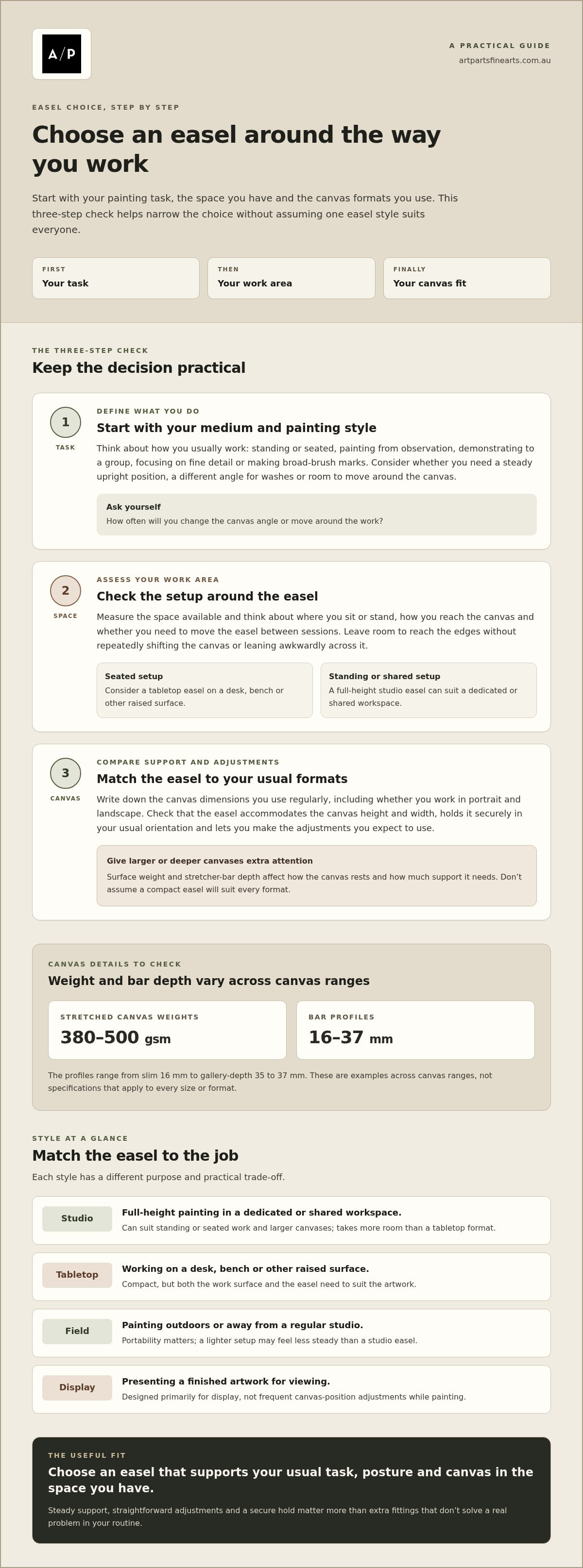
Use this three-step check before choosing an easel. It keeps the decision focused on the work you actually make, rather than features that may not earn their place in your studio.
- Define the task. Note your main medium and how you paint. Consider whether your work calls for a steady upright position, a different angle for washes or room to move around the canvas for broad brushwork.
- Assess your work area. Measure the available space and consider where you stand or sit, how you reach the canvas and whether you need to move the easel between sessions.
- Compare adjustments. Check how the easel accommodates your usual canvas height and orientation. Consider whether you often switch between portrait and landscape formats or change the canvas position during a session.
How do canvas size and construction affect easel choice?
Canvas height and width determine how the artwork sits between the easel’s supports. Surface weight and stretcher-bar depth also contribute to how the canvas rests and how much support it needs. Stretched canvas options range from 380 to 500 gsm, and bar profiles vary from slim 16 mm to gallery-depth 35 to 37 mm. These are examples across canvas ranges, not specifications that apply to every size or format.
If you regularly work with the same dimensions, full-carton stretched canvas can help keep a studio or teaching setup consistent. Consider canvas size and easel capacity together so the artwork is supported securely and sits at a useful working height.
How should posture and adjustment shape the decision?
Choose a working height that suits your usual posture, whether you paint seated, standing or switch between the two. A useful setup lets you reach the centre and edges without leaning awkwardly across the canvas. Beginners and experienced artists share these practical needs: comfort and access matter more than how advanced a setup looks.
Compare adjustments with real tasks in mind. If you often change the canvas orientation or height, look for a setup that makes those changes straightforward. If the canvas stays in one position, a simpler arrangement may be enough. When weighing up the best easel for artists Australia has available, matching these details to your own practice is more useful than relying on broad product claims.
Choosing an easel and canvas setup for ongoing studio work
A studio setup is easier to organise when you start with the work you make repeatedly. Before settling on an easel, note the canvas sizes you reach for most, whether you usually work in portrait or landscape and how often you switch formats. This gives you a practical reference for planning a consistent studio or teaching setup.
How can studios plan a dependable easel-and-canvas pairing?
Make a short list of your common canvas dimensions and orientations. If you teach or share a studio, include the formats used by the group as well as your own. Working with consistent sizes can make repeat projects easier to organise and help a shared teaching space prepare materials more predictably.
CreateART and Wright & Co offer stretched canvas options for artists planning around regular formats. Some surfaces in these ranges are triple-primed with acrylic gesso, a prepared ground that gives paint a ready-to-use surface. Full cartons can suit schools, art centres, TAFEs and high-volume artists who regularly use the same formats. Bulk savings and consistent quality are practical considerations when planning those purchases. Explore CreateART full-carton canvas if those formats fit your studio planning.
Use your list to plan the canvas and easel combination you need for regular work. If your practice includes a wide range of formats, consider how easily your setup can accommodate those changes.
What should artists do before choosing their setup?
Run through four checks before deciding:
- Medium: Consider the surface and working angle that suit your painting process.
- Posture: Think about whether you work seated, standing or alternate between them.
- Working area: Allow room for the easel and the movements your process requires.
- Canvas dimensions: Compare your regular formats with the support the easel provides.
These checks help beginners and experienced artists focus on what will make a setup useful day after day. The best easel for artists Australia-wide is a personal fit, chosen to support the work you make and the routine you want to build.
Set up a studio that supports your next body of work
Your easel can be part of a more considered studio routine. Before starting a project, note the canvas formats you expect to use and how you’ll move between planning, painting and reviewing the work. This simple check helps you choose a setup that supports the way you create, rather than making you adapt every session around the equipment.
When comparing the best easel for artists Australia offers, consider the surface you’ll paint on too. Cotton, linen, poly-cotton and black-primed canvas each give a project a different starting point. Matching your preferred surface and regular formats with a suitable easel can make it easier to begin with a clear plan.
Schools, art centres, TAFEs and artists working at higher volume can consider full cartons when repeat formats suit their practice. You don’t need to settle every studio decision at once. Start with the work you’re preparing now, then build a setup that can grow alongside your practice.
A thoughtful setup can reduce time spent rearranging your workspace and help you focus on the work itself. Explore Art Parts Fine Arts’ easels and canvas range to find supplies that suit your next project.
Frequently Asked Questions
What is the best easel for a beginner artist?
A good first easel is straightforward to set up and suits the kind of painting you want to practise. For short studies or exercises, a simple, compact arrangement may be enough. If you plan to work on larger finished pieces, consider a full-height support. Start with one clear use in mind, such as acrylic studies on a small canvas, rather than paying for fittings you are unlikely to use.
Can one easel be used for different canvas sizes?
Often, yes, if the supports can hold the range of formats you plan to use. Check the stated canvas capacity against your smallest and largest works, then consider how the supports accommodate each orientation. Try positioning your largest canvas and check that you can reach its top edge and that the easel still fits in the space you intend to use.
How high should an easel be for painting?
There is no single height that suits every painter. As a starting point, position the canvas so its centre is easy to view, then adjust for the detail or technique you are practising. Try the setup with your usual chair or standing position before a longer session. If you share a workstation, note the settings that work for you so you can reset them easily.
Is a field easel suitable for studio painting?
Yes, a field easel can be used indoors if it holds your work securely and suits your routine. It may be useful in a studio where equipment needs to be packed away or moved between locations. For frequent indoor use, consider where it will be stored, how quickly you can set it up and whether it feels steady during your usual brushwork.
Does canvas weight matter when choosing an easel?
Yes, especially for larger canvases, which can place more demand on the easel than a small study. The gsm figure describes the canvas fabric’s weight per square metre, not the complete stretched canvas. Consider the canvas size and stretcher bars too, and check for movement once the canvas is in place. A secure, steady hold is useful during firm brushwork or palette-knife painting.

Article by
Art Parts Fine Arts
Art Parts Fine Arts is an Australian art-supplies store based in Albury, shipping Australia-wide. Hand-picked by artists, our range covers paints, canvas, brushes, paper, printmaking and more, for everyone from students to professionals. We share practical guides and tips to help you get the most out of your materials.
Disclaimer
This article is general information to help you choose and use art materials. It is not professional, health or safety advice. Always follow the manufacturer's instructions and safety guidance for any product, and take care when using solvents, varnishes and other materials. Product availability, specifications and pricing may change, so please check the current product page for details.