

Charcoal Drawing for Beginners: Australian Artist Guide
Charcoal drawing is not about clinical precision; it is about the tactile freedom of mark-making with materials that respond to your every touch. Getting started with charcoal drawing for beginners Australia often feels …Charcoal drawing is not about clinical precision; it is about the tactile freedom of mark-making with materials that respond to your every touch. Getting started with charcoal drawing for beginners Australia often feels daunting because of the potential mess in a home studio or the confusion between different types of charcoal. It is completely normal to feel a bit overwhelmed when you first see the variety of sticks, pencils, and papers available.
We believe that with the right guidance, anyone can master this expressive medium. This guide covers the essential materials you need, the core techniques for creating light and shadow, and professional tips to ensure your work stays smudge-free. You will learn the practical differences between willow and compressed charcoal so you can choose the right tool for every mark.
By following these steps, you will gain the confidence to complete a first sketch you are proud to display. We will also show you how to protect your finished work so it remains archival and vibrant. Let's explore how these simple materials can help you find your creative feet and start your drawing journey on the right note.
Key Takeaways
- Differentiate between willow sticks for soft sketching and compressed charcoal for deep, permanent blacks.
- Master essential techniques like hatching and scumbling to start charcoal drawing for beginners Australia with confidence.
- Learn why choosing paper with the right tooth is critical for layering and building rich tonal values.
- Discover how to use fixative spray correctly to ensure your finished artwork is archival and smudge-resistant.
- Gain practical tips for managing your workspace and materials to keep your home studio clean while you create.
Getting Started with Charcoal Drawing in Australia
Charcoal is one of the oldest and most versatile drawing tools available to the modern artist. It has been used for millennia to capture everything from cave walls to contemporary portraits. For those exploring charcoal drawing for beginners Australia, it is important to realise that this medium is quite different from the graphite pencils you might have used in school. It is a tactile, raw material that invites you to be bold with your marks.
Why Choose Charcoal Over Graphite?
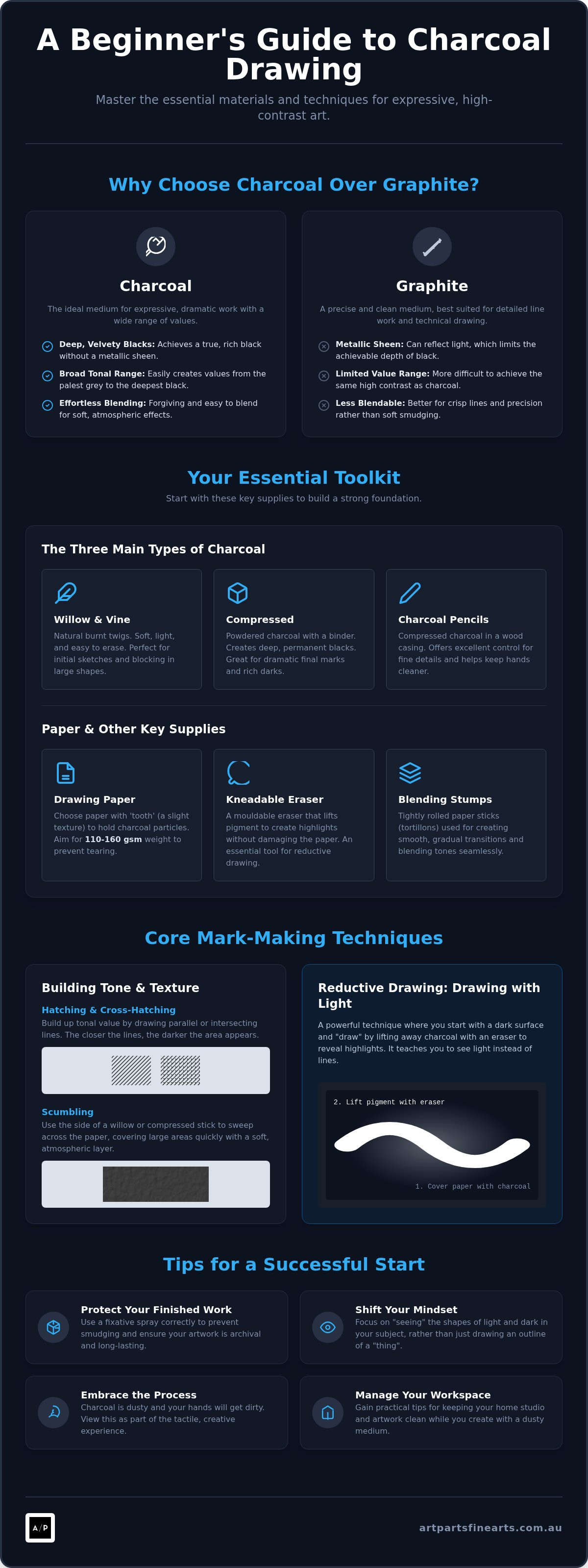
Unlike graphite, charcoal allows for deep, velvety blacks and expressive, sweeping lines. Graphite often has a metallic sheen and can feel restrictive when you want to cover large areas. Charcoal offers a much broader tonal range, which is simply the scale of values from the palest grey to the deepest, darkest black. This makes it much easier to create high-contrast drawings that have a sense of drama and depth.
The ease of blending makes charcoal ideal for large-scale works and atmospheric landscapes. It is a forgiving medium that encourages you to focus on light and shadow rather than getting bogged down in tiny details. If you make a mistake, you can often just wipe it away with a cloth or blend it into the background. You can find a curated selection of these materials in our drawing collection.
The Mentality of a Beginner Artist
Starting with the right mindset is the first step to success. You need to embrace the mess. Charcoal is dusty, and your hands will get dirty, but that is part of the creative process. Instead of trying to draw a specific "thing," like a tree or a face, try to focus on "seeing" the shapes of light and dark. This shift in perspective helps you understand the form of your subject more accurately.
We encourage you to view your early sketches as experiments rather than final masterpieces. This approach reduces the pressure and allows you to learn how the material moves on the paper. Practise making bold marks and seeing how they react to different pressures. Remember, every professional artist started with a messy first page, and the goal is simply to find your creative feet.
Essential Supplies: Choosing Your Charcoal and Paper
Selecting the right tools is the foundation of charcoal drawing for beginners Australia. Your choice of material dictates how easily you can blend, erase, and build depth. It is often best to start with a variety of types to see which feels most natural in your hand.
Willow and Vine charcoal are natural twigs burnt to a soft, brittle consistency. They are incredibly light and easy to wipe away, making them perfect for your initial layout or loose sketches. Compressed charcoal is different. These are harder sticks made of charcoal powder mixed with a binder like gum or wax. They produce the deep, permanent blacks that define the medium's drama. If you prefer a familiar grip, charcoal pencils are ideal for fine details and keeping your hands slightly cleaner during the process.
Understanding Paper Tooth and Weight
Paper selection is just as important as the charcoal itself. You need a surface with 'tooth', which is the microscopic texture that acts like tiny hooks to hold the charcoal particles in place. If your paper is too smooth, the dust will simply slide off. We recommend using Art Parts drawing paper with a weight between 110gsm and 160gsm. This thickness ensures the paper won't tear when you apply pressure or use an eraser repeatedly.
The Beginner's Tool Kit
Beyond the charcoal, a few simple accessories will make your practise much more enjoyable. A kneadable eraser is essential. You can mould it into a point to lift pigment and create highlights without damaging the paper surface. Blending stumps, also known as tortillons, are tightly rolled paper tools used to create smooth transitions in tone. You can find these in our range of drawing accessories. As you grow more confident, you might even consider trying your hand at mixed media on a bulk stretched canvas to see how different surfaces respond to your marks.
Core Techniques for Your First Charcoal Sketch
Once you have your materials ready, the next step in charcoal drawing for beginners Australia is to practise foundational mark-making. Hatching and cross-hatching involve drawing parallel or intersecting lines to build up tonal values. For broader areas, try scumbling; use the side of a willow stick to sweep across the paper, covering large sections quickly with a soft, atmospheric layer. These techniques allow you to create texture and depth without needing the precision of a fine-point pencil.
One of the most effective ways to learn is through reductive drawing. Instead of starting with a white page, cover the entire surface with a thin layer of willow charcoal and blend it smooth. Use your kneadable eraser to "draw" by lifting the charcoal away, revealing the bright highlights underneath. This technique is excellent for training your eye to see the world in terms of light and form rather than just outlines.
Be careful with blending. While it is tempting to use your fingers, the oils from your skin can create permanent marks that are difficult to erase. Use a paper stump or a soft cloth instead, and do so sparingly. Over-blending often leads to "muddy" textures where the distinct contrast between light and dark is lost, making the drawing look flat.
Explore bulk canvas options for your large-scale charcoal experiments
Creating Depth with Light and Shadow
Always identify your primary light source before making your first mark. This determines where your darkest shadows and brightest highlights will fall. By consistently applying this logic, your sketches will gain a three-dimensional quality. Use your kneadable eraser to "draw" the light back into your composition by lifting pigment from the areas where the light hits the subject most directly.
Avoiding the Common 'Smudge' Trap
Smudging is a frequent frustration for those new to charcoal drawing for beginners Australia. To prevent this, work from the top-left of your paper down to the bottom-right if you are right-handed. This keeps your palm away from the fresh charcoal. You can also place a simple piece of clean paper under your hand for protection or use a mahl stick to support your arm without touching the drawing surface.
Maintaining a clean and organised workspace is essential for any project, whether it's an art studio or a commercial facility. For those who need to ensure safety and precision in larger environments, check out StripeGuys Warehouse Line Striping for professional advice on industrial floor marking and safety efficiency.
Advancing Your Skills and Protecting Your Work
Your finished sketch is a record of your progress, but charcoal remains delicate even after you've put the sticks away. To ensure your work doesn't smudge or fade, using a fixative spray is an essential final step. This is particularly important for anyone exploring charcoal drawing for beginners Australia who wants to keep their home studio and their portfolio clean.
When applying fixative, always work in a well-ventilated area. Hold the can about 30 centimetres from the paper and apply light, even coats. Avoid saturating the paper; too much liquid can cause the charcoal particles to float and muddy your fine details. Two or three light mists are far better than one heavy layer. This process locks the pigment into the tooth of the paper without changing the appearance of your tones.
Building muscle memory and confidence only comes through regular practice. Practising your marks daily, even for just ten minutes, will help you master the pressure needed for different effects. If you find yourself hitting a plateau, consider joining one of our creative workshops. These in-person sessions at our Albury centre allow you to receive direct feedback from professional artists who can help you refine your technique.
Archival Storage and Framing
If you aren't ready to frame your work immediately, store it between sheets of glassine paper. This pH-neutral, air-resistant paper prevents the charcoal from transferring to other surfaces. When you decide to frame a piece, always use a mat. This is a cardboard border that creates a small gap between the artwork and the glass. If the glass touches the charcoal directly, static electricity or moisture can cause the pigment to lift off the paper over time.
Taking the Next Step
As you grow more comfortable with the medium, you might find that student-grade materials feel limiting. Transitioning to professional-grade charcoal offers a higher pigment density, resulting in richer blacks and smoother blending. You might even choose to move beyond paper and experiment with charcoal on our CreateART stretched canvases for large-scale mixed media pieces. Explore our full drawing collection to find high-performance tools that support your evolving style.
If you have any questions about selecting the right tools for your studio, we are always happy to help. Feel free to explore our range online or get in touch with us for a chat about your next project. We ship professional supplies Australia-wide from our Albury location to help you continue your journey in charcoal drawing for beginners Australia with confidence.
Master the Art of Charcoal
You now have the foundations to start your creative journey with confidence. Remember to choose paper with the right tooth for your willow and compressed sticks, and always protect your finished sketches with a light fixative spray. These simple habits ensure your experiments lead to lasting, archival results that you can be proud to display.
Exploring charcoal drawing for beginners Australia is an exciting process of discovery and mark-making. Our team of local Albury artists has expertly selected every item in our range to ensure you have access to high-quality materials that make the learning process easier. We ship these professional supplies Australia-wide so you can focus on your practice no matter where your studio is located.
Explore our curated range of professional drawing supplies and start your journey today.
Don't be afraid to make a mess and experiment with bold lines. Every smudge is a valuable lesson in light and shadow that brings you one step closer to finding your unique artistic voice.
Frequently Asked Questions
Is charcoal drawing suitable for someone who can't draw a straight line?
Yes, charcoal is actually one of the best mediums for those who struggle with precise lines. It encourages you to work with broad shapes and shadows rather than clinical outlines. Because it's so easy to blend and move, you can focus on the "feel" of a subject. It's a forgiving way to start charcoal drawing for beginners Australia because mistakes can often be wiped away or turned into atmospheric shadows.
How do I stop my charcoal drawings from smudging everywhere?
You can prevent smudging by using a professional fixative spray once your work is complete. During the drawing process, try placing a clean sheet of paper under your hand to act as a barrier. Working from the top down also helps. Many artists use a mahl stick to support their arm; this keeps their palm entirely off the paper surface while they work on fine details or deep shadows.
What is the difference between willow charcoal and compressed charcoal?
Willow charcoal consists of natural twigs burnt until they are soft and brittle; it's very easy to erase and blend. Compressed charcoal is made from charcoal powder mixed with a binder, resulting in a much harder stick. Use willow for your initial sketches and light tones. Switch to compressed charcoal when you need deep, velvety blacks that won't budge once they are applied to the page during your drawing sessions.
Do I need special paper for charcoal drawing in Australia?
You need paper with a noticeable "tooth," which is the texture that grips the charcoal dust. Smooth printer paper won't work because the particles have nothing to hold onto. We recommend choosing a dedicated drawing paper between 110gsm and 160gsm for your exercises. This weight provides enough durability to handle the pressure of blending and the repeated use of erasers without tearing the surface of your work.
Can I use hairspray as a fixative for my charcoal sketches?
We don't recommend using hairspray as it can yellow and become sticky over time. Hairspray isn't designed for art; it lacks the archival quality needed to preserve your work for years. A dedicated art fixative is a much safer investment for charcoal drawing for beginners Australia. It protects the charcoal without altering the colours or damaging the paper fibres, ensuring your sketches stay exactly as you intended.

Article by
Art Parts Fine Arts
Art Parts Fine Arts is an Australian art-supplies store based in Albury, shipping Australia-wide. Hand-picked by artists, our range covers paints, canvas, brushes, paper, printmaking and more, for everyone from students to professionals. We share practical guides and tips to help you get the most out of your materials.
Disclaimer
This article is general information to help you choose and use art materials. It is not professional, health or safety advice. Always follow the manufacturer's instructions and safety guidance for any product, and take care when using solvents, varnishes and other materials. Product availability, specifications and pricing may change, so please check the current product page for details.