

Drawing Materials for Beginners: A Practical Guide
What if the secret to improving your art isn't found in a massive collection of pencils, but in knowing exactly which three to pick? It's common to feel overwhelmed by the endless aisles of graphite grades and charcoal t…What if the secret to improving your art isn't found in a massive collection of pencils, but in knowing exactly which three to pick? It's common to feel overwhelmed by the endless aisles of graphite grades and charcoal types when searching for drawing materials for beginners. You've likely felt the frustration of staring at technical labels and wondering if you're about to buy supplies that might actually hinder your progress.
Our team at Art Parts Fine Arts believes that finding the right tools shouldn't be a confusing or expensive chore. We've curated this guide to help you build a versatile starter kit that avoids unnecessary complexity while prioritising professional quality. You'll discover exactly which tools provide the best value for money and how to tell them apart without the stress.
We'll explain the practical differences between various mediums and clarify confusing terms like "tooth," which refers to the surface texture of the paper, and "gsm," which indicates its weight. By the end of this guide, you'll have a clear list of essentials and the confidence to start your first self-taught session or join us for a creative workshop.
Key Takeaways
- Learn how to select the right graphite grades and willow charcoal to create depth and expressive lines in your sketches.
- Discover the benefits of adding soft pastels and lightfast drawing inks to your collection for vibrant, blendable colour.
- Master technical terms like gsm and tooth so you can choose the perfect paper surface for every project.
- Build a versatile kit of drawing materials for beginners that prioritises quality over quantity to support your creative growth.
- Learn how to organise your workspace effectively and use local workshops to build confidence with your new tools.
Essential Graphite and Charcoal: The Foundation of Every Drawing Kit
Every artist starts their journey with graphite and charcoal. These tools provide the most direct link between your hand and the paper. Choosing high-quality drawing materials for beginners helps you avoid the common frustration of scratchy, low-grade leads that refuse to blend. Investing in a few professional-grade items creates a smoother learning curve. It yields better results from your very first sketch, ensuring you don't feel held back by your supplies.
Understanding Pencil Grades and Graphite Powder
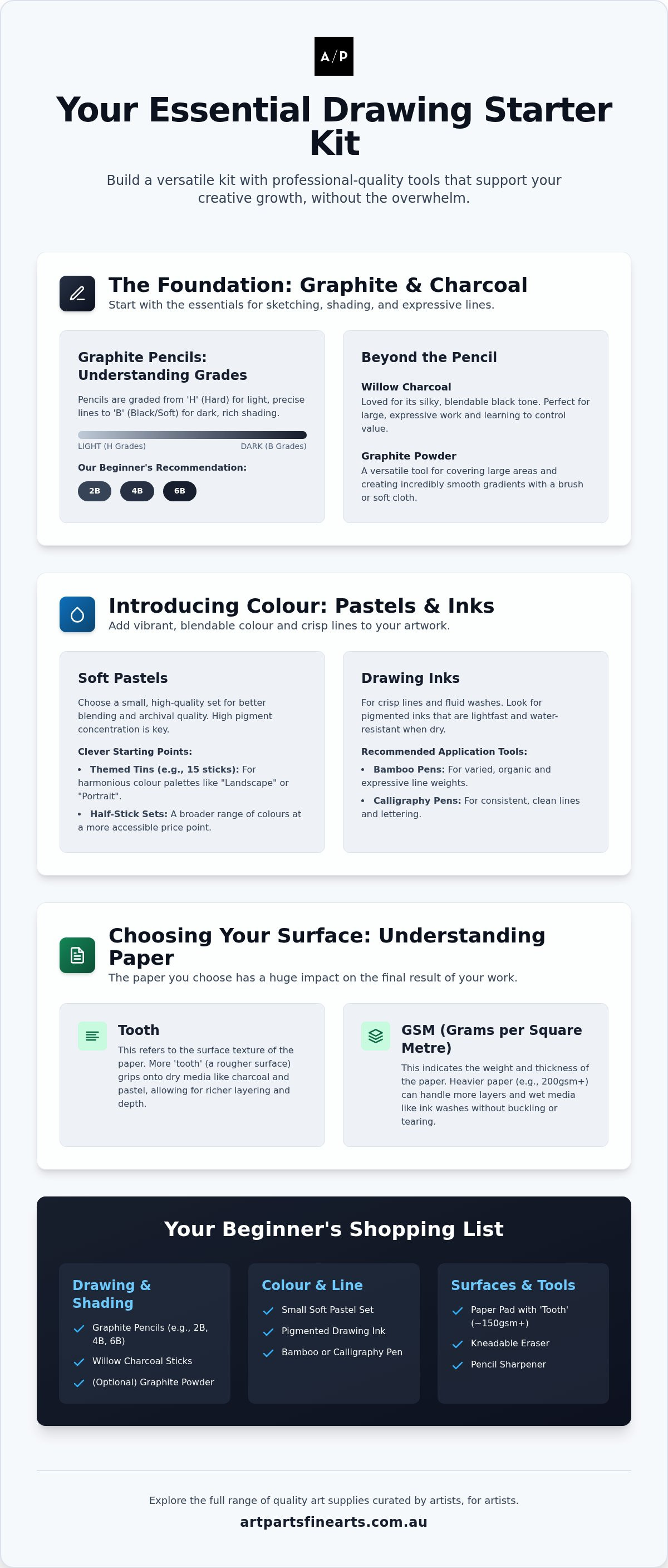
Graphite pencils are categorised on a scale from H to B. The "H" stands for hard; these leads produce light, precise lines perfect for technical layouts. The "B" stands for black, indicating a softer lead that creates darker, more artistic shading. We recommend starting with a versatile range like 2B, 4B, and 6B. These essentials are available in our drawing collection.
For those looking to cover large areas quickly, ArtGraf Graphite Powder is a fantastic addition. It allows you to create incredibly smooth gradients that are difficult to achieve with a pencil tip. You can apply it with a brush or a soft cloth to explore new textures and depths in your work. It's a versatile tool for anyone wanting to experiment with light and shadow without the limitations of a standard pencil.
The Tactile Appeal of Willow Charcoal
Willow charcoal is loved for its silky black tone and ease of use. Coates Artist Willow Charcoal is a particular favourite in our Albury shop because it glides across the paper without snagging. It's the perfect medium for large-scale, expressive work where you want to move quickly and blend with your fingers. This tactile feedback is essential for developing a feel for value and form.
If you're practising frequently or working in a classroom environment, the Coates 100 Short Thin Sticks pack offers excellent value. It ensures you always have a fresh stick ready when inspiration strikes. You might also consider charcoal powder for creating rich, velvety backgrounds. Selecting the right drawing materials for beginners, such as high-quality charcoal, makes your creative process much more enjoyable and lets you focus on your technique.
Introducing Colour and Texture: Pastels and Drawing Inks
Transitioning into colour adds a new dimension to your creative practice. Soft pastels and drawing inks are fantastic drawing materials for beginners because they provide rich, immediate results. We always recommend starting with a few high-quality sticks or bottles rather than a large, low-grade set. Professional tools offer better blending and archival quality, ensuring your first colour studies remain vibrant for years.
Selecting Your First Pastel Set
Art Spectrum Artists Soft Round Pastels are a staple for many Australian creators. We often suggest starting with a tin of 15 focused on a specific theme, such as Landscape or Portrait, to ensure your colours work harmoniously together. Because these are triple-milled, they contain a high pigment concentration that allows for effortless blending with your fingers or a cloth.
Half-stick sets are another clever way to start. They provide a broader range of colours at a more accessible price point, which is ideal if you aren't yet sure which palette you prefer. You can find these versatile sets within our drawing collection to help kickstart your colour journey with confidence.
Ink Drawing and Calligraphy Essentials
If you prefer crisp lines and fluid washes, Art Spectrum Pigmented Inks are an excellent choice. These inks are fast-drying and water-resistant once dry; this means you can layer transparent washes over your boldest lines without smudging. They offer a level of lightfastness that ensures your work doesn't fade when exposed to light.
To apply these inks, you might experiment with different tools to find your preferred style:
- Bamboo Pens: These offer a traditional dip-ink experience, allowing for varied line weights and a unique, hand-crafted feel.
- Artline Calligraphy Pens: A convenient, water-based pigment ink option for those who want crisp lettering or consistent line work without the need for a separate ink bottle.
Using a bamboo pen allows you to sketch finer lines or broader strokes simply by changing the angle of the nib. It's a tactile way to explore line weight and character in your drawings. Whether you're interested in traditional calligraphy or modern sketching, these tools provide the foundation for a professional finish.
Choosing the Right Surface: Paper, Pads, and Multimedia Primers
Selecting the right paper is a vital part of gathering drawing materials for beginners. If your paper is too thin, it buckles under pressure or wet media. If it's too smooth, your charcoal won't stick. We measure paper weight in gsm, which stands for grams per square metre. A higher number means the sheet is thicker, more durable, and better suited for heavy-handed techniques or wet washes.
Surface texture, or "tooth," is the other key factor for success. This is the microscopic roughness of the paper that grips your drawing medium. Without enough tooth, soft pastels or charcoal will simply slide off the page rather than layering beautifully. Matching your paper to your chosen medium is the most effective way to improve your drawing results immediately.
Pads and Papers for Illustration
For those interested in graphic arts or detailed linework, the Canson Illustration Manga Pad is an excellent choice. Its 250 gsm weight is robust enough to handle heavy markers and ink washes without bleeding through. Heavier paper is necessary for ink work because it prevents the fibres from warping when they get wet. You can explore a variety of weights and textures in our paper collection to find the best match for your specific style.
Pastel Primers and Multimedia Bases
You don't always have to use traditional paper for your sketches. Art Spectrum Colourfix Original Primer is a versatile tool that allows you to turn almost any surface into a pastel-ready base. It creates a fine, reliable tooth on wood, canvas, or heavy card. If you prefer a softer finish for detailed portraits, Colourfix Smooth Primer provides a less aggressive texture while still offering excellent grip.
These primers are also perfect for multimedia work. They allow you to combine wet media like gouache or inks with dry pencils or pastels on a single surface without the materials repelling each other. This flexibility is perfect for artists who enjoy experimenting with different textures and layers in one sitting.
Explore our range of drawing materials and surfaces
Completing Your Kit: Specialist Tools and Organisation
Accessories are often overlooked when selecting drawing materials for beginners, yet they play a vital role in protecting your work and extending the life of your supplies. Using professional tools like blending tips or blowers prevents the accidental smudging or contamination that can happen with household substitutes. A well-organised workspace also helps you maintain a consistent creative practice by removing the friction of searching for misplaced items.
Investing in a few high-quality accessories ensures that your primary materials, like those expensive soft pastels or delicate charcoals, aren't wasted. Transitioning from the buying phase to the actual practice of drawing is much easier when your tools are ready and easy to reach. This preparation builds the confidence you need to sit down and start your first session without hesitation.
Speciality Blenders and Effects
Managing delicate mediums requires precision. For those exploring fluid art or fine shading, Alcohol Ink Blending Tips (50pcs) allow for controlled colour transitions without muddying your palette. Pairing these with an Alcohol Ink Blower helps you create spectacular effects or simply clear dust from small surfaces without using your breath, which can introduce moisture to the paper.
To add a professional finish to your sketches, Artline 993 Calligraphy Markers are excellent for adding metallic gold or silver highlights. These markers provide a crisp, opaque finish that sits beautifully on top of graphite or charcoal. Selecting these specific accessories ensures you have the right tools to handle the finishing touches of any project.
From Materials to Mastery: Workshops and Community
Having the right tools is only the first step in your artistic journey. We encourage you to bring your new drawing materials for beginners to one of our creative workshops in Albury for hands-on instruction from experienced artists. These sessions are a wonderful way to learn practical techniques in a supportive, community-focused environment.
If you prefer a self-paced approach, our curated collection of drawing books offers detailed guidance on everything from anatomy to perspective. At Art Parts Fine Arts, we see ourselves as your expert peer, ready to offer advice whenever you feel stuck. Whether you visit us in-store or reach out online, our goal is to help you feel confident and supported as you build your skills.
Start Your Drawing Practice with Confidence
Building a versatile starter kit is about more than just filling a bag with pencils. It's about selecting a few high-quality tools that let you focus on your technique rather than struggling with your supplies. By understanding how different graphite grades work and how paper weight affects your results, you've already taken the most important step toward artistic growth.
Choosing the right drawing materials for beginners doesn't have to be overwhelming. Whether you're drawn to the silky texture of willow charcoal or the vibrant blending of soft pastels, we've curated a selection that prioritises archival quality and practical value. Our team in Albury is always ready to share advice from our own creative practices to help you find the perfect match for your style.
We proudly stock professional-grade Art Spectrum and ArtGraf supplies to ensure you get the best start possible. If you can't make it into our store to chat with us in person, we offer reliable nationwide shipping across Australia to bring the best materials directly to your studio.
Remember that every professional artist started with a single mark on a page. We're excited to be a part of your journey and can't wait to see the work you create.
Frequently Asked Questions
What is the best type of pencil for a complete beginner to start with?
A 2B graphite pencil is the most versatile starting point for any new artist. It strikes a reliable balance between being soft enough for dark shading and firm enough for crisp, clear outlines. While professionals use a broad range of grades, a single 2B pencil allows you to practise varied pressure and line weights effectively without the distraction of managing multiple tools at once.
Do I need to use a fixative on my charcoal and pastel drawings?
You should always use a professional fixative on drawings made with loose mediums like charcoal or soft pastels. These materials sit on the surface of the paper and smudge easily if the page is touched or moved. A light, even spray "locks" the pigment in place, ensuring your hard work remains crisp and archival while protecting it from accidental damage during storage.
What does gsm mean when I am looking at drawing paper?
GSM stands for "grams per square metre," which is the standard metric measurement for the weight and thickness of paper. For basic sketching with pencils, a weight of 110 to 150 gsm is usually sufficient. However, if you are selecting drawing materials for beginners for wet media like inks or heavy markers, you'll want a sturdier paper of at least 250 gsm to prevent buckling and bleed-through.
Can I use soft pastels on regular printer paper?
Regular printer paper is not suitable for soft pastels because it lacks "tooth," which is the microscopic surface texture needed to grip the pigment. Without this texture, the pastel will simply slide off the page or create a dusty mess rather than layering beautifully. For the best results, use a dedicated pastel paper or apply a specialised primer to create a receptive surface for your colours.
Is it better to buy individual pastels or a curated set?
Starting with a curated set is generally the most helpful approach when choosing drawing materials for beginners. These sets are designed by specialists to provide a balanced palette of colours that work harmoniously together, such as specific landscape or portrait selections. Once you have a foundation, you can then add individual sticks to replace your most-used colours or slowly expand your range as your skills grow.
Article by
Art Parts Fine Arts
Art Parts Fine Arts is an Australian art-supplies store based in Albury, shipping Australia-wide. Hand-picked by artists, our range covers paints, canvas, brushes, paper, printmaking and more, for everyone from students to professionals. We share practical guides and tips to help you get the most out of your materials.
Disclaimer
This article is general information to help you choose and use art materials. It is not professional, health or safety advice. Always follow the manufacturer's instructions and safety guidance for any product, and take care when using solvents, varnishes and other materials. Product availability, specifications and pricing may change, so please check the current product page for details.