

Expert Guide to Choosing Cotton Duck Canvas Rolls in AU
Purchasing pre-stretched frames often feels like the only way to start a new project, but relying on standard sizes can limit your creative vision and inflate your studio costs. It's frustrating to pay a premium for larg…Purchasing pre-stretched frames often feels like the only way to start a new project, but relying on standard sizes can limit your creative vision and inflate your studio costs. It's frustrating to pay a premium for large-scale supports only to find the surface texture inconsistent or the primer lacking the archival quality your work deserves.
We understand that choosing the right foundation is a deliberate artistic decision where weight and priming dictate the final character of your work. This guide helps you master the selection of cotton duck canvas rolls so you can create custom-sized supports that meet professional archival standards while managing your budget more effectively.
You'll learn how to navigate the confusion between imperial ounces and metric gsm, or grams per square metre, to ensure you're getting the right thickness for your medium. We also cover how to achieve a specific tooth, which is the surface texture that grips your paint, and how to utilise triple-primed options for immediate studio use.
Whether you're a professional artist preparing for an exhibition or a TAFE student sourcing materials for a large-scale project, these insights will help you achieve consistent, high-quality results. Let's look at how to choose the best materials to support your practice for years to come.
Key Takeaways
- Learn how cotton duck canvas rolls allow you to customise canvas sizes beyond standard frames while maintaining professional archival standards.
- Understand the relationship between weight and gsm to select a surface that handles heavy paint applications and high tension without sagging.
- Discover why triple-primed acrylic gesso is essential for protecting organic fibres and creating the ideal tooth, or surface texture, for your painting style.
- Master the practical techniques needed to stretch a drum-tight canvas that remains stable across changing Australian weather conditions.
- Learn why sourcing full rolls or cartons provides the material consistency and value required for professional series and art centres.
Choosing Cotton Duck Canvas Rolls for Professional Studio Work
Cotton duck canvas rolls are a reliable staple in professional art studios across Australia. This heavy, plain-woven fabric is selected for its structural integrity and predictable surface. Unlike budget alternatives that may stretch unevenly under tension, cotton duck provides a stable ground for both delicate glazes and heavy impasto techniques. Investing in rolls rather than individual frames gives you the flexibility to create custom supports that fit your specific creative vision.
The Material Advantage of Cotton Duck
To understand what cotton duck canvas is, we look back to the Dutch word "doek," which simply means cloth. The name refers to the tight, durable weave that resists tearing and sagging under the weight of wet paint. This mechanical strength is vital for large-scale pieces that require high tension. Professional-grade rolls also feature a specific tooth, which is the surface texture or "grip" of the canvas. This texture determines how paint interacts with the support. A medium tooth allows for versatile brushwork, while a smoother finish is better for fine detail.
Rolls vs Pre-Stretched: Making the Transition
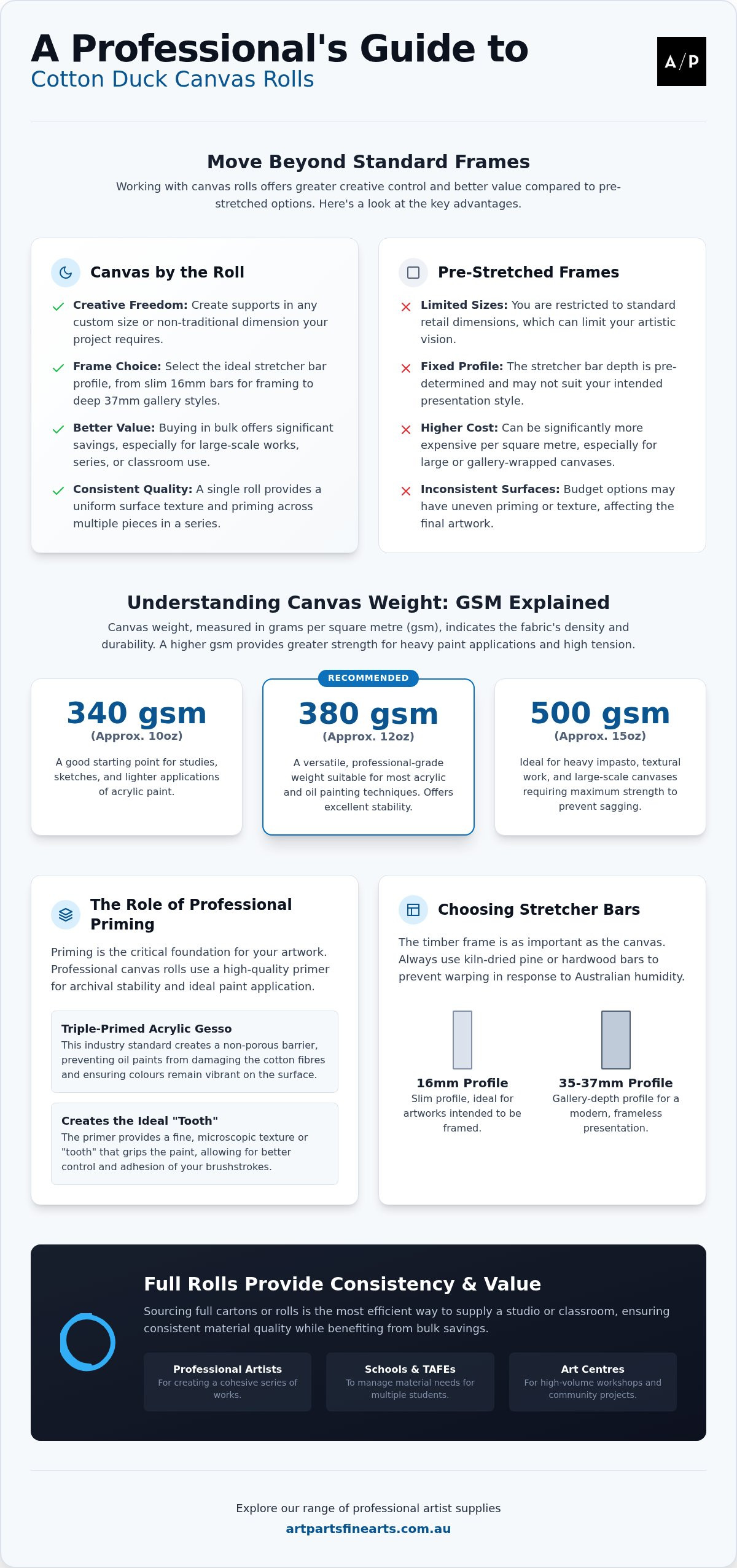
Transitioning from pre-stretched frames to rolls offers a new level of creative freedom. You aren't restricted by standard retail sizes, allowing you to build custom supports for site-specific commissions or non-traditional dimensions. This flexibility extends to your choice of stretcher bar profile. You might choose a slim 16mm bar for works intended for framing, or a 37mm gallery-depth bar for a modern, frameless look. For schools, art centres, and TAFEs, purchasing by the roll is often the most resource-efficient way to manage high-volume student needs.
Storing your material on a roll is also a space-saving solution for smaller studios. You can keep several metres of high-quality canvas tucked away and only cut what you need for each project. When you stretch your own, we recommend using kiln-dried timber bars to ensure the frame won't warp or twist as the wood adjusts to the humidity levels in your workspace. This keeps your bulk stretched canvas or custom-made supports perfectly flat.
Professional-grade choosing cotton duck canvas rolls ensures your work is built on an archival foundation. Most rolls in our range, including CreateART, are triple-primed with a professional acrylic gesso. This creates a non-porous barrier so your acrylic or oil paints sit on the surface to maintain their vibrancy and pigment load, rather than soaking into the raw cotton fibres.
Understanding Canvas Weight, GSM, and Priming Standards
Selecting the right cotton duck canvas rolls requires more than just picking a brand. You need to understand the technical specifications that determine how your paint will behave over decades. Weight is the primary indicator of a canvas's durability and its ability to withstand heavy tension without tearing. A higher gsm, or grams per square metre, indicates a denser weave that is less likely to sag under heavy paint applications.
Converting Ounces to GSM
The art industry often switches between imperial ounces (oz) and metric grams per square metre, which can lead to confusion when comparing products. To simplify your selection, consider these standard conversions:
- 10oz is approximately 340gsm.
- 12oz is roughly 400gsm.
- 15oz is approximately 500gsm.
We focus on the 380gsm to 500gsm range because these weights offer the structural integrity required for professional results. A 380gsm cotton canvas is a versatile choice for general acrylic painting. If you prefer heavy impasto techniques where thick layers of paint add significant weight to the support, a 500gsm option provides the necessary density to prevent the fabric from stretching or distorting over time.
The Role of Professional Priming
Priming is the critical barrier that sits between your paint and the organic cotton fibres. Most professional cotton duck canvas rolls are triple-primed with acrylic gesso. This primer provides the "tooth," which is the microscopic texture that helps paint adhere to the surface. Without a proper ground, the acidic nature of oil paints can eventually rot the cotton fibres, compromising the archival life of your work.
Triple-priming is especially important for oil painters to prevent support induced discolouration. This phenomenon occurs when impurities from the canvas support seep into the paint layers, causing unwanted yellowing or staining. When Preparing Your Own Canvas, the goal is to create a flexible surface that won't crack as the fabric expands and contracts with changes in humidity. If you are starting with raw duck, you can find professional-grade mediums and gesso to prepare your ground correctly.
Choosing the right weight and priming ensures your work remains taut and vibrant regardless of your chosen medium. If you find the process of stretching and priming from a roll too time-consuming for your current project, exploring our range of bulk stretched canvas can provide the same archival quality with immediate convenience.
Practical Steps for Stretching and Preparing Your Own Canvas
Stretching your own cotton duck canvas rolls is a rewarding skill that gives you complete control over your painting surface. While pre-stretched options are convenient, hand-stretching allows you to adjust the tension to suit your specific medium and the local environment. This is particularly important for artists across Australia, where shifting humidity levels can cause canvas fibres to expand or contract. By mastering this process, you ensure your work remains stable and professionally finished from the very first brushstroke.
Essential Tools for the Task
Achieving a drum-tight finish requires a few specific items. Canvas pliers are the most important tool, as they allow you to pull the fabric with much more force than your hands alone. You'll also need a heavy-duty stapler and a rubber mallet to securely assemble your kiln-dried timber bars. We recommend checking our range of accessories and tools to ensure you have everything needed for a professional setup. When you prepare to cut your canvas, always allow at least 5cm of extra fabric on each side. This ensures you have enough material to grip with the pliers and wrap neatly around the back of the frame.
The Stretching Sequence
A methodical approach prevents "ghosting," which occurs when the inner edges of the stretcher bars become visible through the canvas surface. This usually happens when the fabric isn't pulled with consistent tension across the frame. To avoid this, follow these steps:
- Step 1: Place a single staple in the centre of each of the four bars to anchor the canvas.
- Step 2: Work from the centres out towards the corners. Use your pliers to pull the fabric tight before placing each staple, alternating between opposite sides to maintain balance.
- Step 3: Fold the corners neatly to avoid bulk. This is vital for gallery-depth 35mm or 37mm bars, as it allows the finished work to sit flush against the wall.
Once finished, tap the centre of the canvas with your fingers; it should produce a clear, resonant sound like a drum. If the surface feels soft or shows ripples, you may need to remove a few staples and re-tension that area. Properly stretched cotton duck canvas rolls provide a reliable, archival ground that will support your creative work for years.
Investing in Full Carton Canvas and Bulk Rolls
Managing a high-output studio or educational facility requires a balance between archival quality and cost efficiency. Consistency is key. For artists working on a large series or oversized commissions, purchasing cotton duck canvas rolls provides the most reliable way to maintain a uniform surface across multiple works. When you buy by the roll, you ensure the weave density and the gesso application remain identical, which is vital for maintaining professional standards in a cohesive body of work.
Art Parts specialises in supplying full carton canvas Australia-wide from our Albury base. This bulk approach is a practical consideration for regional Australian studios, as it reduces the frequency of shipping and ensures you always have a ready supply of high-quality ground on hand. Sourcing in volume doesn't mean compromising on quality; it simply means organising your studio resources more effectively. Efficiency matters.
Sourcing for Schools and Art Centres
Educational institutions and community art centres often require materials that can withstand high-traffic environments and varied student techniques. The 380gsm cotton duck is a versatile choice for these settings, offering enough durability for student projects without the high cost of individual retail frames. We recommend the Wright & Co and CreateART ranges for their proven reliability in workshops and TAFE classrooms. All bulk orders are carefully packed to withstand long-distance transit across the country, ensuring your supplies arrive in perfect condition for the next term.
Studio Economics and Quality Control
Moving from individual canvas boards to a 25m roll of cotton duck canvas rolls results in substantial cost-per-metre savings. While the initial outlay is higher, the long-term benefit to your studio economics is clear. This approach allows you to view your materials as an investment in your professional legacy rather than a recurring transactional expense. Using a consistent ground across your practice helps you predict exactly how your paint will respond, allowing for more confident experimentation.
We invite you to explore the full CreateART range to find the weight and priming that best suits your artistic goals. Whether you need a roll for a specific project or a full carton of stretched frames for an upcoming exhibition, we are here to help you find the right tools for your craft. Our team is always available to discuss which bulk options will provide the best value for your specific practice.
Elevating Your Creative Foundation
Selecting the right foundation is a critical step toward a successful painting. By moving beyond standard sizes and understanding the technical differences between 380gsm and 500gsm weights, you gain total control over your artistic process. Archival durability is ensured through professional triple-priming; this protects your work from discolouration and fibre rot over time.
Whether you're stretching custom dimensions from cotton duck canvas rolls or sourcing full cartons for a series, focusing on material quality ensures your legacy is preserved. We ship our range of CreateART and Wright & Co products Australia-wide from Albury to support artists in every corner of the country. These professional-grade materials provide the reliability required for exhibition-standard work.
We look forward to seeing the projects you create with these archival tools. Your creative journey is a shared one, and we're here to support your practice with reliable supplies and practical advice.
Frequently Asked Questions
What is the difference between 8oz and 12oz cotton duck canvas?
The primary difference is the weight and density of the fabric weave. An 8oz canvas is lighter and better suited for smaller projects or sketching, whereas a 12oz canvas, which is approximately 400gsm, is thicker and handles higher tension and heavier paint layers. Most professional cotton duck canvas rolls fall in the 12oz to 15oz range to ensure the structural integrity required for exhibition-standard work.
Do I need to prime a cotton duck canvas roll before painting?
You only need to prime the material if you have purchased raw, unprimed cotton duck. Most professional rolls we supply are already triple-primed with acrylic gesso, meaning they are ready for immediate studio use. If you are working with raw fabric, you must apply a sizing and then several coats of gesso to prevent the paint from soaking into the fibres and to protect the cotton from the acidic nature of oil paints.
How many metres are usually in a professional canvas roll?
Professional canvas rolls are typically available in lengths of 10 metres or 20 metres. The width often ranges around 2.1 metres, providing ample material for several large-scale projects or a cohesive series of smaller works. Buying in these lengths is a practical choice for high-volume artists and schools looking for material consistency and better value for money compared to buying individual pre-stretched frames at retail prices.
Can I use oil paints on an acrylic-primed cotton duck roll?
You can certainly use oil paints on a canvas that has been primed with acrylic gesso. This type of primer is a universal ground that provides a flexible, non-porous surface suitable for both acrylic and oil mediums. It is a popular choice because it prevents the oil from penetrating the cotton fibres, which would eventually cause the fabric to rot. Just ensure the primer is a professional-grade gesso to maintain archival quality.
What is the best way to store a canvas roll in a small studio?
The best way to store cotton duck canvas rolls is to keep them on their original heavy-duty cardboard core. Stand the roll vertically in a cool, dry place away from direct sunlight to prevent the fabric from sagging or developing permanent creases. If you must store it horizontally, ensure it is supported along its entire length to avoid flat spots. Keeping the roll wrapped in its original plastic sleeve will also protect the surface from dust.
Is cotton duck or linen better for large-scale professional paintings?
Both materials are suitable, but the choice often depends on your budget and desired texture. Cotton duck is a more affordable and versatile option that offers a very consistent weave, making it excellent for most professional applications. Linen is traditionally favoured for very large works because it has longer fibres and is naturally more resistant to expansion. However, a high-weight 500gsm cotton duck provides excellent stability for large-scale paintings at a more accessible price point.

Article by
Art Parts Fine Arts
Art Parts Fine Arts is an Australian art-supplies store based in Albury, shipping Australia-wide. Hand-picked by artists, our range covers paints, canvas, brushes, paper, printmaking and more, for everyone from students to professionals. We share practical guides and tips to help you get the most out of your materials.
Disclaimer
This article is general information to help you choose and use art materials. It is not professional, health or safety advice. Always follow the manufacturer's instructions and safety guidance for any product, and take care when using solvents, varnishes and other materials. Product availability, specifications and pricing may change, so please check the current product page for details.