

Faber-Castell art supplies: how to choose the right pencils and tools
The largest Faber-Castell set isn’t automatically the right choice. Start with the medium and finish you want, then choose pencils and tools to suit the way you work. This guide compares pencil types and formats for begi…The largest Faber-Castell set isn’t automatically the right choice. Start with the medium and finish you want, then choose pencils and tools to suit the way you work. This guide compares pencil types and formats for beginners and experienced artists.
Key Takeaways
- Compare pencil ranges by how they work on the page and the finish you want to achieve.
- Narrow down Faber-Castell options for dry colour, water-based techniques, pastel and graphite drawing.
- Choose a tin for a broader palette or individual pencils to build a focused selection.
- Consider which supporting tools will make drawing easier, and which extras you can leave out.
- Match product options to your needs, from fine detail to softer, smudged marks.
Faber-Castell pencils: start with the medium you want to use
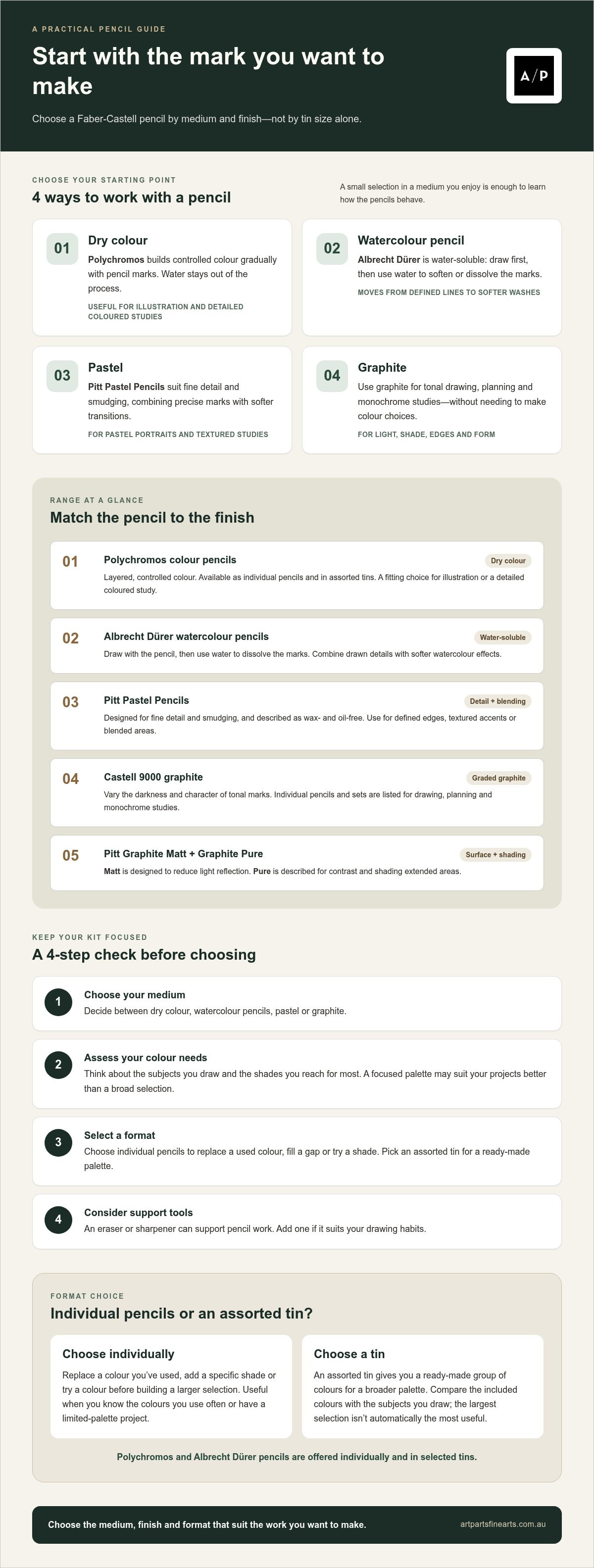
First, decide what you want the pencil to do: lay down dry colour, mix with water, create soft pastel marks or build a drawing in graphite. That decision narrows the options more usefully than starting with the largest tin. Faber-Castell ranges suit different ways of working, so pencils that look similar can make quite different marks.
You don’t need a full palette to get started. A small selection in a medium you enjoy lets you learn how the pencils behave before adding colours or tools. Browse the drawing supplies collection for materials suited to pencil-based work. For broader background on the company and its product lines, see the Faber-Castell Wikipedia article.
Which Faber-Castell pencil type suits your technique?
Coloured pencils suit controlled dry-colour drawing and illustration, especially when you want to build marks gradually. Watercolour pencils can be used for drawing, then worked with water for a watercolour approach. Albrecht Dürer pencils are water-soluble, so they suit artists who want to move between defined pencil lines and softer washes. Test them on a small study before starting a larger piece.
Pastel pencils are useful when pastel is your chosen medium but you want more control over small marks. Pitt Pastel Pencils are described as suited to fine detail and smudging, making them useful for defined edges, textured accents or softer transitions. They let you combine precise marks with the looser, blended character of pastel work.
When graphite is a better fit than colour
Choose graphite for tonal drawing, early planning and monochrome studies. It lets you focus on light, shade, edges and form without making colour choices part of the exercise. Standard graphite is a straightforward starting point for sketches and studies. Choose a pencil based on the marks you want, rather than expecting one range to suit every task.
If you want to reduce reflections from graphite, Pitt Graphite Matt is designed for reduced light reflection. That feature may suit drawings where you prefer a more subdued surface appearance. For everyday sketching or planning, standard graphite may be all you need. Start with the finish and process you prefer, then choose accordingly.
Compare Faber-Castell colour, watercolour, pastel and graphite ranges
Compare how each range works, then use the project examples as starting points rather than rules. The product details describe the pencils, while the suggested projects show practical ways to use them.
| Medium | Working method | Finish | Suitable project suggestion |
|---|---|---|---|
| Polychromos colour pencils | Dry colour; available as individual pencils and in assorted tins. | Layered, controlled colour. | Illustration or a detailed coloured study. |
| Albrecht Dürer watercolour pencils | Draw with the pencil, then use water to dissolve the marks. | Can shift from defined lines to softer washes. | A study combining drawn details and watercolour effects. |
| Pitt Pastel Pencils | Designed for fine detail and smudging; described as wax- and oil-free. | Precise marks with soft transitions. | A pastel portrait or textured study with blended areas. |
| Castell 9000 graphite | A graded graphite range, with individual pencils and sets listed. | Tonal marks from lighter drawing to darker shading. | Figure drawing, planning or monochrome studies. |
| Pitt Graphite Matt and Pitt Graphite Pure | Matt is intended to reduce light reflection; Pure is described for contrast and shading extended areas. | Matt supports a more subdued appearance; Pure can cover broader shaded sections. | A tonal drawing where surface appearance or larger dark areas matter. |
Polychromos, Albrecht Dürer and Pitt Pastel compared
Polychromos is the dry-colour choice if you want to build an image with pencil marks and keep water out of the process. Albrecht Dürer pencils are water-soluble, so you can add a wet stage to the drawing. Pitt Pastel suits a different feel: use its fine point for smaller marks, then smudge selected areas for a softer edge. These differences matter more than choosing a tin by colour count alone.
Castell 9000, Pitt Graphite Matt and graphite tools
Castell 9000 offers graded graphite for artists who want to vary the darkness and character of their marks. Consider Pitt Graphite Matt if reduced reflection is a priority, or Pitt Graphite Pure for contrast and shading larger areas. An eraser or sharpener can support pencil work, but the useful choice depends on how you draw. Faber-Castell’s pencil manufacturing process explains how the company makes its pencils.
Explore the Faber-Castell pencil and tool collection to compare ranges and formats.
Choose individual pencils, tins and accessories without overbuying
A practical pencil kit starts with what you’ll use, not how many pieces fit in a tin. Use this four-step check to choose a format and keep your selection focused on the work you want to make.
- Choose your medium. Decide whether you’re working with dry colour, watercolour pencils, pastel or graphite.
- Assess your colour needs. Think about the subjects you draw and the shades you reach for most. A focused palette may suit your projects better than a broad selection.
- Select a format. Choose individual pencils to fill gaps or try a colour, or an assorted tin for a ready-made selection.
- Consider support tools. Decide whether a sharpener or eraser would be useful for your drawing habits before adding accessories.
When to buy pencils individually or in a tin
Individual Faber-Castell pencils are practical when replacing a used colour or adding a specific shade to your palette. They also let you try a colour before building a larger selection. This approach suits artists who know which colours they use often, or who are working on a project with a limited palette.
Assorted tins offer a ready-made group of colours for artists who want to build a broader palette. Polychromos and Albrecht Dürer pencils are offered individually and in selected tins. Compare the colours included with the subjects you draw. The largest selection isn’t automatically the most useful. Browse the collection to compare product details and formats.
Sharpeners and erasers that support pencil work
The Grip Three-Hole Sharpener is described as suitable for popular pencil shapes and has a large waste box. The Twin Metal Sharpener offers sharp and blunt point settings for artists’ colour pencils. These features give you options for sharpening. Choose a point that suits the marks you want to make.
Kneadable and PVC-free erasers are distinct options. Choose between them based on the product features and the way you draw. A useful accessory fits your technique; it doesn’t need to be another item in your pencil case.
Compare individual pencils, assorted tins and accessories in the Faber-Castell collection.
Faber-Castell product picks for different kinds of artists
These examples match a working need with a pencil range, rather than treating one format as right for everyone. Use them as a starting point, then choose colours and supporting tools that suit the work you make.
A focused colour or watercolour selection
- For adding specific colours: Polychromos pencils are sold individually, which suits artists topping up a shade they use often or choosing a few colours for a particular subject.
- For a broader dry-colour palette: Polychromos assorted tins group colours together, making them a useful starting point for illustration or coloured studies. A larger assortment isn’t essential if you mainly work with a small, familiar palette.
- For drawing with a watercolour stage: Albrecht Dürer pencils are water-soluble. They suit artists who want to begin with drawn marks, then use water to soften or spread some of the colour.
If you’re unsure which colours you’ll use, start with a few individual pencils and notice what your subjects call for. A tin makes more sense when you want to explore a wider selection from the outset.
Options for pastel detail and graphite drawing
- For small marks within pastel work: Pitt Pastel Pencils are described as suited to fine detail and smudging. They can help you place sharper accents alongside softer colour transitions.
- For graded graphite drawing: Castell 9000 offers a graphite range, making it a practical choice if you want to vary your marks across sketches and tonal studies.
- For a more subdued graphite appearance: Pitt Graphite Matt is designed to reduce light reflection. Consider it if that finish suits the way you view or present your drawing. Standard graphite remains a straightforward choice for everyday sketching.
Keep support tools simple. A sharpener is useful if your work relies on a clean pencil point, while an eraser can help with corrections or adjustments. Choose tools that suit your pencils and habits, rather than adding accessories you’re unlikely to use.
There’s no need to settle on a complete setup at once. Browse the Faber-Castell collection and take your time choosing pencils that fit your practice.
Make your next pencil choice with confidence
Let your next project guide your materials. Before adding to your kit, think about the marks you want to make, the colours you reach for and whether you’d rather build a selection gradually or begin with a ready-made assortment. A small, well-used set can be a better fit than a collection chosen simply for its size.
The Faber-Castell range brings together individual pencils and selected assorted tins, with options across colour, watercolour, pastel, graphite and drawing accessories. Shape your kit around your process, then add to it as new ideas or techniques take you in a different direction.
Choose materials that feel useful for the work in front of you, and let your practice show you what to explore next.
Frequently Asked Questions
Are Faber-Castell Polychromos pencils watercolour pencils?
No. Polychromos are dry colour pencils, so water won’t turn their marks into a wash. If you’re planning a drawing with areas of painted colour, choose watercolour pencils such as Albrecht Dürer. For a mixed technique, you can keep both types in your kit and use each for the marks it handles well. Check the pencil name before buying if water activation is essential to your project.
Can you use Albrecht Dürer watercolour pencils without water?
Yes. You can draw with Albrecht Dürer pencils without adding water, just as you would with a dry pencil. This is handy for planning a composition, adding fine lines or keeping parts of a piece crisp while softening other areas with water. Test the dry marks on your intended paper first, particularly if you’re combining them with washes or other drawing materials.
Are Pitt Pastel Pencils suitable for detailed pastel drawings?
Yes. Pitt Pastel Pencils are described as suitable for fine detail, so they can help place small accents that are awkward to make with broader pastel marks. Their marks can also be smudged for softer edges. For a portrait, for example, use a pencil to define features, then blend selected areas. Test the pressure and blending on a spare piece of your drawing paper first.
What is the difference between Castell 9000 and Pitt Graphite Matt pencils?
Castell 9000 is a graded graphite range for varying your marks across a drawing. Pitt Graphite Matt is designed to reduce light reflection, which may suit work where a less reflective graphite surface is your priority. Neither is automatically the right choice for every sketch. If you’re deciding between them, make a small tonal study and compare how the marks look under the lighting where you usually draw or display your work.
Which Faber-Castell eraser is suitable for charcoal or pastel?
A kneadable eraser can be used to gently lift or lighten marks in charcoal or pastel. Results depend on the paper, medium and pressure, so test it on a spare area first. Choose an eraser by its stated features and how it performs with your drawing materials.
Do I need a special sharpener for Faber-Castell colour pencils?
No special sharpener is essential, but choose one that suits the pencil’s shape and the point you prefer. A sharp point helps with small details, while a blunter point can feel more comfortable for covering larger areas. Faber-Castell options include sharpeners with different openings and point settings. Keep the blade clear of pencil residue and sharpen gently, especially if you’re aiming for a fine point for close work.
Article by
Art Parts Fine Arts
Art Parts Fine Arts is an Australian art-supplies store based in Albury, shipping Australia-wide. Hand-picked by artists, our range covers paints, canvas, brushes, paper, printmaking and more, for everyone from students to professionals. We share practical guides and tips to help you get the most out of your materials.
Disclaimer
This article is general information to help you choose and use art materials. It is not professional, health or safety advice. Always follow the manufacturer's instructions and safety guidance for any product, and take care when using solvents, varnishes and other materials. Product availability, specifications and pricing may change, so please check the current product page for details.