

PanPastel Colours Australia: The Professional Artist’s Guide to Soft Pastels
For professional and serious hobby artists, finding a medium that combines the rich pigment of soft pastels with the clean, painterly application of paint can be a challenge. PanPastel colours offer a unique solution, br…For professional and serious hobby artists, finding a medium that combines the rich pigment of soft pastels with the clean, painterly application of paint can be a challenge. PanPastel colours offer a unique solution, bridging the gap between drawing and painting with their innovative pan format. This guide explores what makes PanPastels a studio essential for artists across Australia, from their technical properties to their versatile application in mixed media work.
What are PanPastel Colours and Why are They a Studio Essential?
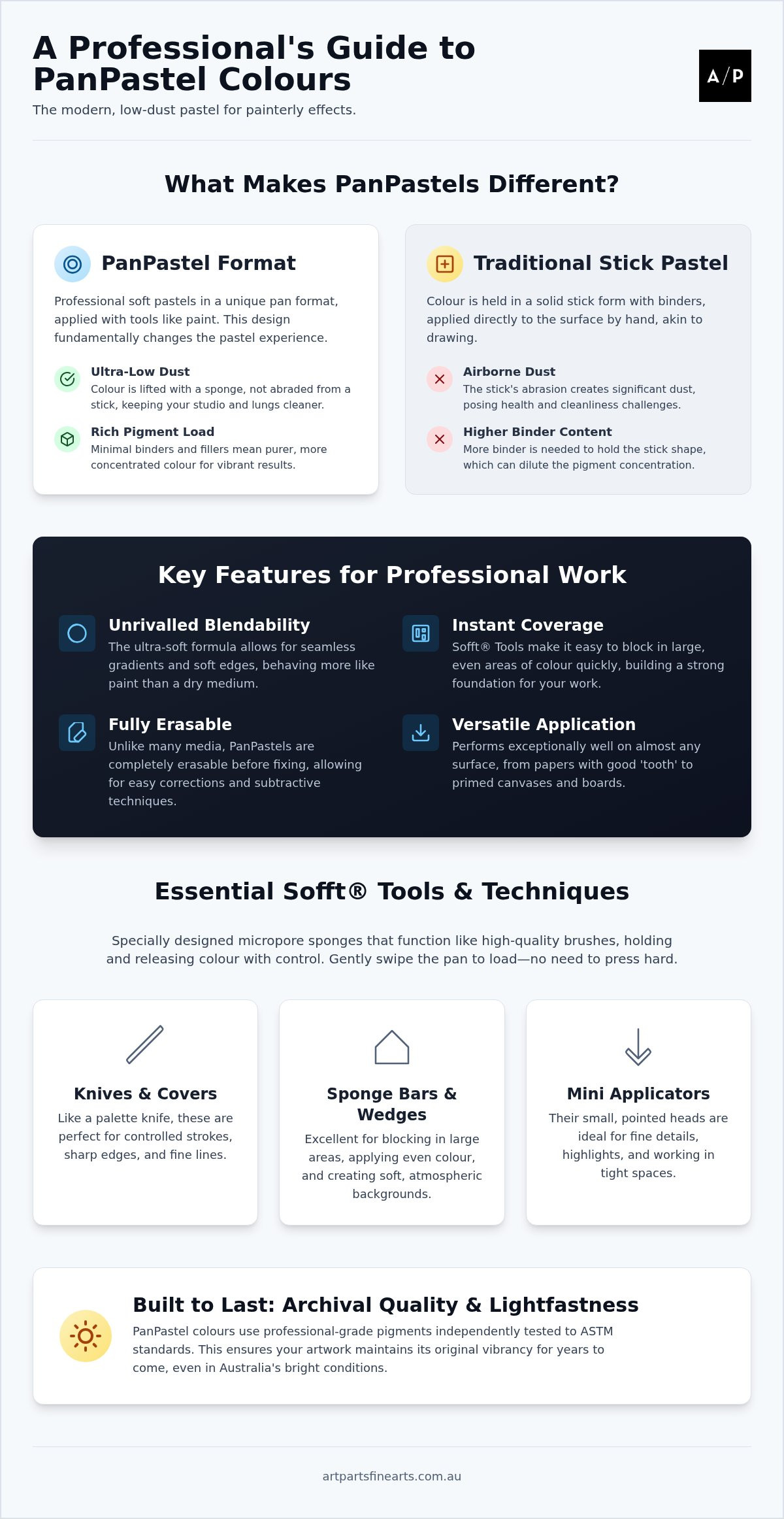
PanPastel colours are professional artists' quality soft pastels packaged in a flat, circular pan, similar to a cosmetic compact. This format allows them to be applied with specialised sponge tools, offering a completely different experience from traditional pastel sticks. The formulation is key to their performance, containing a high concentration of pigment with minimal binders and fillers.
This results in an ultra-soft, low-dust texture that feels more like painting than drawing. The colours are highly pigmented and have been developed for excellent lightfastness, making them a reliable choice for archival-quality work intended for exhibition or sale. For artists seeking painterly effects without the use of liquid solvents, PanPastels provide a direct and expressive alternative.
The Science of Minimal Binders
Traditional pastel sticks require a certain amount of binder to hold them in their stick form. The PanPastel formula reduces this binder content significantly, which allows for a much higher pigment load. This means the colour is purer and more concentrated, delivering vibrant results with less product.
The cake-like format also reduces the waste associated with the breakage of fragile pastel sticks. Because the colour is so rich, a little goes a long way, providing significantly more coverage than a typical stick. This formulation is also designed for lightfastness, an important consideration for work that may be displayed in the bright conditions common in Australia.
A Low-Dust Solution for the Modern Studio
One of the most common challenges with traditional soft pastels is the amount of airborne dust they create. This can be a concern for health and studio cleanliness. PanPastels are formulated to be a low-dust medium, as the colour is lifted from the pan with a tool rather than being abraded from a stick.
This process keeps pigments on the paper and out of the air, creating a cleaner working environment for your studio and your lungs. In essence, PanPastel is a dry-painting medium, applied with specialised sponges for maximum control and minimal mess.
Key Features That Distinguish PanPastel for Professional Work
PanPastels offer several performance benefits that make them ideal for professional studio use. Their unique properties allow for techniques that are difficult or impossible to achieve with traditional pastel sticks.
- Unrivalled Blendability: The soft formula allows for smooth, seamless gradients and soft edges, perfect for creating atmospheric effects and realistic skin tones.
- Instant Coverage: Applying colour with Sofft Tools makes it easy to block in large areas quickly and evenly, establishing a strong foundation for your work.
- Erasability: Unlike many other professional media, PanPastels are fully erasable before being sealed with a fixative, allowing for easy corrections and subtractive drawing techniques.
- Versatility: They perform well on almost any artist surface, from papers with a good 'tooth' (a slight texture that grips pigment) to primed canvases and boards.
Seamless Blending and Layering
Colours can be mixed directly in the pan before application or blended on the work surface, much like paint on a palette. This gives the artist complete control over their colour palette. The fine pigment particles allow for multiple layers to be applied without quickly filling the tooth of the paper.
This layering capability is comparable to applying glazes in oil or acrylic painting, enabling the artist to build up depth and luminosity. You can apply light, transparent veils of colour or build up to full, opaque saturation.
Archival Quality and Lightfastness
Using professional-grade pigments is essential for any artwork intended to last. PanPastel colours are made with high-quality pigments and are independently tested for lightfastness according to ASTM standards. Each colour is rated, giving artists confidence in the longevity of their work.
This is particularly important for artists in Australia, where high levels of UV light can cause less stable pigments to fade over time. Choosing lightfast materials ensures that the artwork maintains its original vibrancy for years to come.
Essential Sofft Tools and Application Techniques
To get the most out of PanPastels, it is important to use the specially designed Sofft Tools. These applicators are made from a unique micropore sponge material that is formulated to hold and release the colour in a controlled manner, functioning much like a paintbrush.
To use them, gently swipe the sponge across the surface of the pan two or three times to load it with colour. There is no need to press hard or scrape the pan. Using the correct applicator is key to achieving your desired effect, whether you need broad strokes for a background or fine lines for detail. Sofft sponges are also easy to clean by simply wiping them on a paper towel between colours.
Choosing the Right Sofft Applicator
- Knives and Covers: These are flat-edged tools with removable sponge covers. They behave like palette knives or brushes, allowing for controlled strokes, sharp edges, and calligraphic marks.
- Sponge Bars and Wedges: The large sponge bars are excellent for blocking in large areas of colour and creating soft, atmospheric backgrounds. The smaller wedges offer a balance between broad coverage and controlled application.
- Mini Applicators: With their small, pointed heads, these tools are perfect for fine details, highlights, and working in tight spaces.
Mastering the 'Paint-like' Application
The way you move the Sofft Tool across the surface affects the final mark. A gentle circular motion can create soft, blended areas, while a direct swipe will produce a more defined, brush-like stroke. The amount of pressure you apply controls the intensity of the colour, from a faint, transparent tint to a fully saturated, opaque layer.
Sofft Tools are non-abrasive and designed to hold just the right amount of colour for a smooth, even release onto the paper or canvas.
Integrating PanPastels into Your Mixed Media Practice
PanPastels are highly versatile and work exceptionally well with other art materials. Their unique properties make them a valuable addition to any mixed media artist's toolkit, allowing for new combinations of texture and finish.
They can be used as a base layer for drawings, an underpainting for paintings, or layered over other media to create subtle shifts in colour and tone. Understanding how to use fixatives is important when combining PanPastels with wet media to prevent unwanted smudging or mixing.
PanPastels and Acrylic Underpaintings
One popular technique is to use PanPastels to map out the composition and values of a painting before applying heavy body acrylics. The dry, blendable nature of the pastels allows you to establish your lights and darks quickly and efficiently. Because they are erasable, you can easily adjust the initial drawing before committing to paint.
Once you are satisfied with the underpainting, a light coat of fixative will lock the pastel in place, providing a stable ground for subsequent layers of professional-grade acrylics or other paints.
Fixing and Protecting Your Work
While not always necessary, a fixative can be used to protect the finished surface of a PanPastel artwork and prevent smudging. It is important to choose a high-quality, workable fixative that is non-yellowing. Always apply it in light, even coats in a well-ventilated area, holding the can at the distance recommended by the manufacturer.
Applying too much fixative can darken or dull the colours, so it is best to build up thin layers. For final protection, framing any pastel work under glass is the most effective way to ensure its long-term preservation.
Finding the Best PanPastel Assorted Colours in Australia
Buying from an artist-run business like Art Parts Fine Arts ensures you receive expert advice from people who use these materials themselves. We can provide guidance on which set best suits your artistic practice and ensure your order is packed securely for national shipping, so your pans arrive intact and ready to use.
Selecting Your First Assorted Colour Set
For a versatile starting point, a 10 or 20-colour set is an excellent choice. These sets typically include a range of primary and secondary colours, plus black and white, allowing for extensive colour mixing. Once you are familiar with the medium, you can expand your palette by adding individual 'tints' (colours mixed with white), 'shades' (colours mixed with black), and extra-pure colours.
For artists looking for hands-on guidance, our Creative Workshops offer opportunities to learn new techniques and explore different materials in a supportive environment.
Why Professional Artists Choose Art Parts Fine Arts
We are committed to sourcing only high-quality, professional-grade art supplies that we trust in our own studios. As practising artists, we understand the importance of reliable materials and can offer practical advice to help you select the right tools for your work.
By choosing Art Parts Fine Arts, you are supporting a local Australian business that is dedicated to the creative community and passionate about helping artists achieve their vision.
Frequently Asked Questions
Can PanPastel be used with traditional soft pastel sticks?
Yes, they are fully compatible. Many artists use PanPastels for blocking in large areas and traditional sticks for fine details and sharp lines.
Do I need to use a fixative with PanPastel colours?
It is not essential, but a light coat of workable fixative can help to reduce smudging and protect the finished work. For final protection, framing under glass is recommended.
Are PanPastels suitable for beginners or just professional artists?
They are suitable for all skill levels. Their erasability and clean application make them very forgiving for beginners, while their professional quality meets the standards of experienced artists.
How long does a single pan of PanPastel usually last?
A single pan contains a high volume of pigment and provides significantly more coverage than a traditional pastel stick, making them very economical for their quality.
Can I use PanPastel on canvas or just on paper?
PanPastels work well on a wide variety of surfaces, including pastel papers, watercolour paper, primed canvas, and pastel boards. A surface with some tooth will grip the pigment best.
What is the best way to clean Sofft Tools between colour changes?
Simply wipe the sponge applicator firmly on a dry paper towel until it no longer leaves a mark. No water or solvents are needed.
Are PanPastel colours lightfast for long-term display in Australia?
Yes, they are made with professional-quality pigments and are rated for lightfastness according to international ASTM standards, making them suitable for archival work.
Can PanPastels be used for underpainting with oil or acrylic paints?
Yes, they are excellent for creating an underpainting. Once the pastel layer is complete, apply a light coat of fixative to isolate it before applying wet media like oil or acrylic paints on top.
Explore the painterly possibilities of this unique medium and see how it can enhance your studio practice. Shop our range of PanPastel assorted colours and Sofft tools today.
- Expertly curated by local artists
- Professional-grade pigments
- National shipping across Australia

Article by
Art Parts Fine Arts
Art Parts Fine Arts is an Australian art-supplies store based in Albury, shipping Australia-wide. Hand-picked by artists, our range covers paints, canvas, brushes, paper, printmaking and more, for everyone from students to professionals. We share practical guides and tips to help you get the most out of your materials.
Disclaimer
This article is general information to help you choose and use art materials. It is not professional, health or safety advice. Always follow the manufacturer's instructions and safety guidance for any product, and take care when using solvents, varnishes and other materials. Product availability, specifications and pricing may change, so please check the current product page for details.