

Premium Canvas for Painting Studios: Bulk Options & Quality
The true cost of an artist's practice is often hidden in the invisible overhead of replacing a warped frame or wrestling with a surface that won't hold its tension. Finding a reliable canvas for painting studios involves…The true cost of an artist's practice is often hidden in the invisible overhead of replacing a warped frame or wrestling with a surface that won't hold its tension. Finding a reliable canvas for painting studios involves more than just picking a size off a shelf; it requires a balance between archival integrity and sustainable studio costs. We understand that for high-output artists and educators, the frustration of a poorly primed ground or a sagging weave can disrupt the entire creative flow.
You shouldn't have to choose between museum-standard materials and your bottom line. This article will show you how to select high-quality studio canvas that pairs archival durability with the significant savings found in bulk purchasing. We'll cover essential specifications for CreateART and Wright & Co ranges, including why 380gsm cotton or 500gsm linen weights matter for different techniques. You'll also learn how kiln-dried stretcher bars and triple-primed surfaces protect your work from the Australian climate while reducing your long-term overheads through smart, full-carton choices.
Key Takeaways
- Understand why professional-grade canvas requires a consistent tooth and triple-priming with acrylic gesso to ensure long-term paint adhesion.
- Learn why 380gsm cotton is the professional baseline for durability and how it compares to heavier 500gsm linen options for large-scale work.
- Discover how purchasing a full carton of canvas for painting studios reduces overheads while ensuring consistent surface quality across an entire exhibition series.
- Identify how kiln-dried pine and hardwood stretcher bars protect your work from warping in varying Australian humidity levels.
- Determine the best surface for your specific medium, whether you require smooth poly-cotton for fine detail or textured grounds for heavy impasto techniques.
Understanding Studio-Grade Canvas: Beyond the Hobbyist Standard
Studio-grade canvas is a high-performance surface designed to withstand heavy paint application and ensure the longevity of your work. Unlike lightweight hobbyist options, a professional canvas for painting studios provides a stable foundation that won't warp or degrade when subjected to thick impasto or multiple layers of glaze. Choosing the right support is the first step in ensuring your work meets the standards required for professional gallery sales and long-term collections.
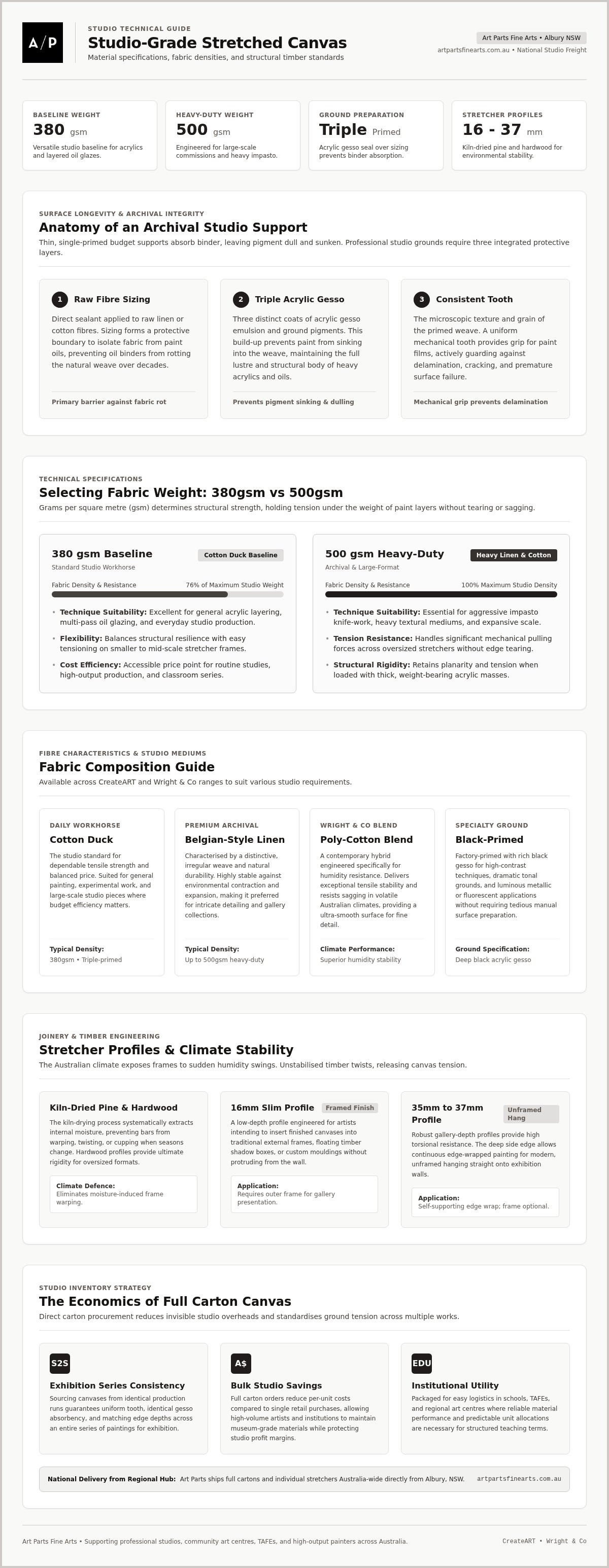
One of the most critical factors in a quality surface is consistent tooth, which refers to the microscopic texture or grain of the weave. This texture acts as a mechanical grip, allowing paint to grab onto the surface effectively. Without a reliable tooth, paint layers may fail to adhere properly, leading to delamination or cracking over time. Professional artists often look to canvas fabric weight and weave standards to ensure their chosen support can handle the physical stress of their specific technique.
Professional studios typically avoid thin, single-primed budget canvases because they lack the structural integrity needed for serious practice. These inferior supports often soak up too much binder, leaving the pigment dull and "sunken" into the fibres. Investing in archival-quality materials ensures that the vibrancy of your colours remains intact and the structural bond between the paint and the ground stays secure for decades.
The Role of Priming and Sizing
Before any paint touches the fabric, the canvas must be properly prepared with sizing and priming. Sizing is an initial sealant applied directly to raw fibres to block oil binders from rotting natural materials like cotton or linen. Once sized, the surface is treated with gesso, a protective primer made from acrylic emulsion and pigments. We recommend surfaces that are triple-primed with acrylic gesso to prevent paint from sinking into the weave. This preparation ensures that professional mediums, such as Matisse acrylics, maintain their body and lustre without being absorbed into the fabric.
Cotton vs Linen in the Studio Environment
Cotton duck is the versatile workhorse of the modern studio, favoured for its strength and accessible price point. It's an excellent choice for daily practice and large-scale works where cost-efficiency is a priority. Linen remains the premium choice for many professionals due to its unique, irregular texture and superior durability. It's less prone to expansion and contraction than cotton, making it a stable choice for intricate work. For artists working in humid Australian environments, poly-cotton blends from ranges like Wright & Co offer a modern alternative that provides exceptional tension stability and resists sagging.
Technical Specifications: GSM, Priming, and Timber Profiles
GSM stands for grams per square metre. It's a metric measurement that indicates the density and weight of the fabric. For a professional canvas for painting studios, 380gsm is the standard baseline. This weight provides enough structural strength for acrylics and oil glazes without the surface sagging under the weight of the paint. Choosing the right technical specifications ensures that your work remains stable from the first brushstroke to the final varnish.
Weight and Weave: Choosing Your GSM
The weight you choose depends on your technique and medium. A 380gsm cotton canvas is the versatile standard for most studio work and layering. It offers a reliable balance of flexibility and strength. If you're working with aggressive impasto or creating very large-scale pieces, a 500gsm heavy-duty cotton or linen is necessary. This heavier fabric density dictates the canvas strength, ensuring it can handle the tension required for larger frames without tearing or losing its shape over time.
Stretcher Bar Profiles and Warping Prevention
The timber behind the fabric is just as important as the weave itself. We use kiln-dried pine stretcher bars because the kiln-drying process removes moisture, which prevents the bars from twisting or warping in the variable Australian climate. High humidity can cause untreated timber to move, but kiln-dried bars remain stable. For oversized studio works, hardwood bars offer even greater rigidity, providing the ultimate level of support to keep the frame square and true.
Profiles usually fall into two categories based on how you intend to finish the work:
- Slim 16mm profiles: These are the traditional choice for artists who prefer to finish their work with an external frame.
- 35mm to 37mm gallery-depth profiles: These provide a robust look for edge-wrapped hanging without a frame.
When you select CreateART canvas full carton options, you ensure that every piece in your studio meets these professional specs. Consistency across your supports is a practical step in maintaining the archival value of your portfolio. You can explore our full carton range to see how these technical specifications can support your current creative projects.
Managing Studio Inventory: The Economics of Full Carton Canvas
High-volume painters and commercial studios often find that purchasing individual units is an inefficient way to manage a creative practice. The full carton model is the standard for a professional canvas for painting studios. It allows for significant cost-per-unit savings while ensuring you always have a fresh surface ready when inspiration strikes. Buying in bulk reduces the administrative burden of frequent small orders and helps you maintain a steady workflow.
Consistency is another major benefit of the carton model. When you buy a full carton, every canvas features the same weave tension, tooth, and gesso absorbency. This is vital for artists working on an exhibition series where a uniform finish across all pieces is required for a professional presentation. We ship these cartons Australia-wide, making it easy for regional and metropolitan studios to access professional-grade supports without the hassle of local retail markups.
Bulk Savings for Art Educators and Centres
Educational institutions like TAFEs and high schools often prioritise the 380gsm cotton canvas in bulk. It provides a reliable, professional surface for students while fitting within strict budget constraints. Streamlining studio inventory with uniform sizes simplifies storage and ensures all students are working on an equal playing field. For a deeper look at the numbers, you can read about the financial benefits of buying full carton canvas.
Storing and Handling Large Volumes
Managing bulk stretched canvas requires a bit of planning to ensure the materials stay in gallery-ready condition. We recommend vertical storage. Stacking canvases flat on top of each other can cause indentations in the fabric or "ghosting" from the stretcher bars over time. Keeping your inventory in a climate-controlled space helps preserve the tension of the kiln-dried timber and prevents the fabric from slackening during seasonal humidity shifts. You can find more detailed advice on storing and handling bulk canvas orders to keep your supplies in peak condition.
Selecting the Right Surface for Your Studio Practice
Selecting the right canvas for painting studios requires matching the mechanical properties of the support to your specific application. If you work in oils, you might prefer the slight absorbency of a natural cotton or the traditional feel of linen. Acrylic painters often benefit from the immediate, non-reactive surface of a triple-primed poly-cotton blend. The tooth, or the microscopic texture of the weave, dictates how much paint is pulled from your brush. A fine, ultra-smooth tooth is essential for detailed portraiture and glazing, while a coarser grain supports expressive, heavy impasto brushwork.
Black-primed canvas offers a distinct aesthetic starting point, providing a dark foundation that makes fluorescent and metallic colours pop. Starting on a dark ground changes how you perceive value and can significantly speed up the painting process by providing middle and dark tones from the first stroke. While buying canvas by the roll offers flexibility for custom sizes, pre-stretched options remain the best choice for studio efficiency. They allow you to move straight to the easel without the time-consuming labour of stretching and priming raw fabric.
Professional Ranges: CreateART and Wright & Co
CreateART serves as a reliable studio standard, offering professional cotton and poly-cotton options that maintain consistent tension across various sizes. For artists requiring premium linen or heavy-duty weights, the Wright & Co range provides the necessary structural integrity for high-end gallery commissions. Choosing a full carton canvas from these ranges ensures that your materials remain uniform throughout an entire exhibition series, avoiding the variations in weave that can occur with piecemeal purchases.
Preparing for Large Scale Works
Large-scale works present unique technical challenges, particularly regarding frame stability and fabric tension. Oversized supports require robust cross-bracing to prevent the timber from bowing inward under the tension of the stretched fabric. Beyond the frame construction, understanding canvas weight is critical for large formats. Heavier gsm fabrics, such as 450gsm or 500gsm, are less likely to stretch or sag over a wide span. Ensuring these technical details are correct is essential for a professional finish that will pass the scrutiny of gallery curators and collectors.
Building a Sustainable Studio Practice
Choosing the right foundation for your work is an investment in your artistic future. By prioritising technical standards like triple-priming and kiln-dried stretcher bars, you ensure your work remains stable for years to come. Selecting a reliable canvas for painting studios doesn't have to be a compromise between quality and cost. Using full cartons allows you to maintain consistency across a whole series while significantly reducing your studio overheads.
The team at Art Parts Fine Arts consists of practicing artists who understand the importance of consistent materials. We stock professional CreateART and Wright & Co ranges to help you achieve gallery-ready results. Whether you are stocking a school or preparing for your next solo exhibition, we ship full cartons Australia-wide to keep your practice moving forward.
We are here to help you find the right tools for your creative journey. Reach out to our team if you need advice on selecting the specific weights or profiles that best suit your next project.
Frequently Asked Questions
What is the difference between studio and gallery-wrapped canvas?
Studio-grade canvas refers to the material quality, while gallery-wrapped describes the profile depth of the stretcher bars. A slim 16mm profile is typically used for works intended for external framing. Gallery-depth bars, usually 35mm to 37mm, allow you to wrap the canvas around the edges for a clean finish that doesn't require a frame. Both options are suitable as a canvas for painting studios depending on your final presentation needs.
Why is kiln-dried timber important for stretcher bars in Australia?
Kiln-drying is a controlled process that removes moisture from timber to ensure long-term structural stability. In the Australian climate, fluctuating humidity can cause untreated wood to twist, bow, or warp. Using kiln-dried pine or hardwood stretcher bars prevents the frame from moving once the fabric is stretched. This is a critical technical specification for maintaining a square, flat surface that won't distort your painting over time or during seasonal weather shifts.
Can I use Matisse Structure acrylics on all professional canvases?
Matisse Structure acrylics perform exceptionally well on all our professional-grade canvases. These heavy-bodied paints require a stable surface with enough tooth to hold thick impasto applications. Our professional ranges are triple-primed with acrylic gesso to support both oil and acrylic mediums. This preparation ensures the paint sits on the surface rather than soaking into the fabric fibres, which preserves the vibrancy, body, and texture of your brushwork as it dries.
Is it more cost-effective for a school to buy full carton canvas?
Purchasing bulk stretched canvas is the most cost-effective strategy for any high-volume educational environment. Schools and TAFEs benefit from significant cost-per-unit savings when they choose a full carton of canvas for painting studios. Beyond the financial advantages, bulk orders ensure identical weave tension and gesso absorbency across every unit. This consistency is essential for classroom settings, providing every student with a reliable and uniform surface for their creative development and assessments.
What does triple-priming mean and why does it matter for my art?
Triple-priming is the application of three layers of acrylic gesso over an initial sealant known as sizing. This process creates a stable, non-porous barrier that prevents paint binders from being absorbed into the natural cotton or linen fibres. It also provides the tooth required for paint to mechanically grip the surface. Without these layers, your colours would appear dull and the fabric could eventually rot from exposure to oil-based paints and mediums.
Does Art Parts Fine Arts ship bulk canvas cartons to regional Western Australia?
Art Parts Fine Arts provides national shipping for all bulk canvas orders, including regional locations across Western Australia and the rest of the country. We dispatch our full cartons using established freight partners to ensure your supplies arrive safely. Whether you are in a metropolitan city or a remote regional area, you can access the same professional CreateART and Wright & Co ranges used by leading studios, art centres, and educators nationwide.

Article by
Art Parts Fine Arts
Art Parts Fine Arts is an Australian art-supplies store based in Albury, shipping Australia-wide. Hand-picked by artists, our range covers paints, canvas, brushes, paper, printmaking and more, for everyone from students to professionals. We share practical guides and tips to help you get the most out of your materials.
Disclaimer
This article is general information to help you choose and use art materials. It is not professional, health or safety advice. Always follow the manufacturer's instructions and safety guidance for any product, and take care when using solvents, varnishes and other materials. Product availability, specifications and pricing may change, so please check the current product page for details.