

Pricing Your Art in Australia: A Professional Guide to Value and Materials
If you double the investment in your materials by switching to artist-grade paints, can you justify doubling the price of your finished painting? Many Australian artists struggle with the tension between wanting their wo…If you double the investment in your materials by switching to artist-grade paints, can you justify doubling the price of your finished painting? Many Australian artists struggle with the tension between wanting their work to be accessible and needing to cover the rising costs of professional tools and studio time. It's a common worry that a higher price point might alienate local collectors or leave stock sitting on the studio floor.
You'll find that the answer often lies in the archival quality and lightfastness of your work; specifically, do professional art supplies increase artwork value in the eyes of serious buyers? This guide provides a repeatable pricing formula tailored to the Australian market, ensuring your income remains sustainable while you account for gallery commissions and the 2026 NAVA payment standards. We will break down how to calculate a fair hourly rate, factor in the longevity of high-quality pigments like those found in Langridge oils or Matisse acrylics, and help you explain your prices to collectors with absolute confidence. By understanding how to value your expertise and your materials, you can build a practice that is both creatively fulfilling and financially viable.
Key Takeaways
- Treat your art pricing as a professional business decision to ensure consistency and build long-term trust with Australian collectors.
- Apply practical formulas like the Square Centimetre or Hourly Rate methods to remove the guesswork and emotion from your price list.
- Understand how archival longevity and lightfastness directly impact market demand and see how do professional art supplies increase artwork value for serious buyers.
- Factor in standard Australian gallery commissions of 30% to 50% to ensure your take-home pay covers your time and overheads.
- Protect your profit margins by scaling your studio practice with bulk materials like full carton canvas and artist-grade paint ranges.
The Foundation of Professional Art Pricing in Australia
Pricing your work is one of the most significant business decisions you'll make as an artist. It's helpful to view your price list not as a reflection of your personal worth, but as a calculation based on production costs and market positioning. When you move away from emotional attachment and focus on a transparent structure, you build professional integrity and ensure sales consistency across different galleries and platforms.
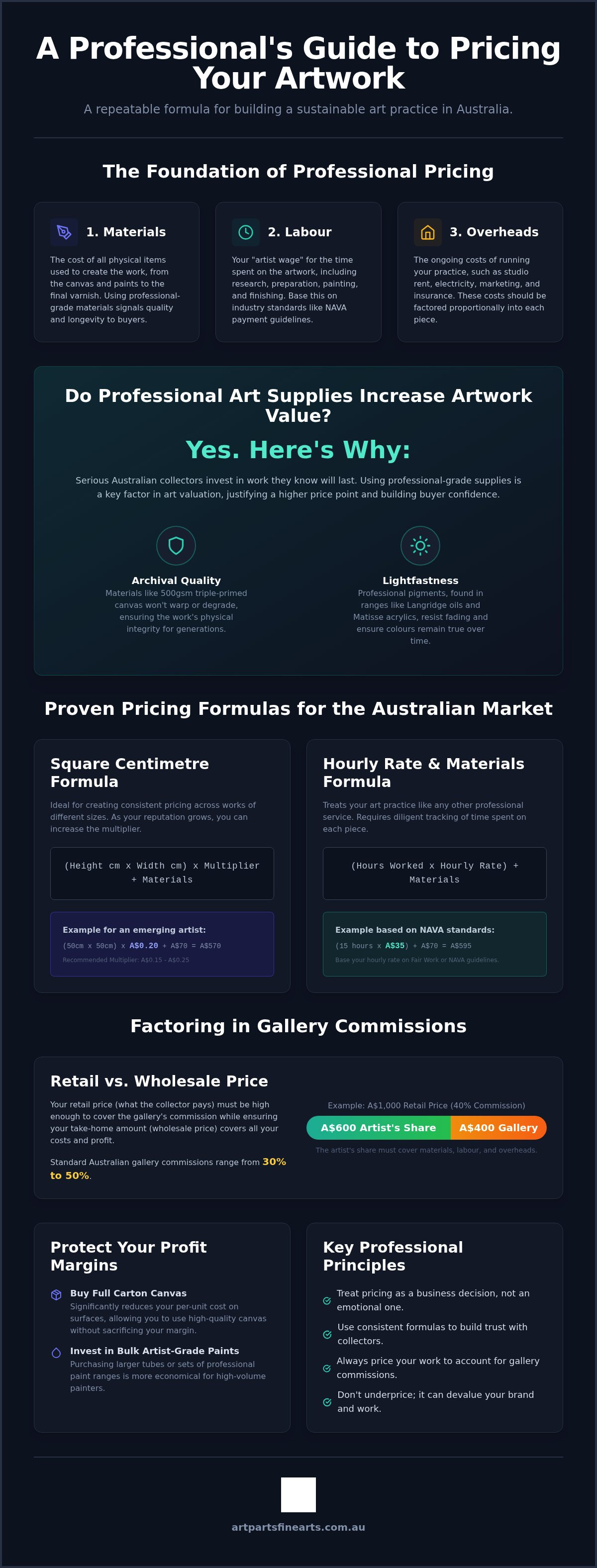
Every professional artist works with three core variables: materials, labour, and overheads. Your material costs include everything from the paint on your palette to the surface you work on. Many emerging artists ask, do professional art supplies increase artwork value? In the eyes of serious Australian collectors, the answer is yes. Using professional materials ensures the work won't fade or crack over time, which is a key factor in Art valuation principles. Labour should be calculated using a consistent "artist wage," often informed by the National Association for the Visual Arts (NAVA) payment standards. Overheads cover your studio rent, electricity, and marketing expenses.
You must also distinguish between your retail and wholesale prices. The retail price is the final amount a collector pays, while the wholesale price is what you keep after deductions. If you sell through a commercial gallery, they will typically take a commission of 30% to 50%. Your retail price must be high enough to cover this commission while still ensuring your "wholesale" portion covers your materials, labour, and profit.
Separating Emotional Value from Market Price
It's natural to feel a deep connection to a piece that took weeks to finish. However, if you find yourself "not ready to let a piece go," it's better to keep it in your private collection rather than inflating the price. Overpricing based on sentiment can confuse buyers and make your brand appear inconsistent compared to other Australian artists at a similar career stage.
Conversely, pricing your work significantly lower than your peers can devalue your brand. Buyers may wonder why your work is "cheap" and question the quality of the materials used. To maintain a healthy profit margin without overpricing, consider managing your production costs. Purchasing full carton canvas or bulk artist-grade paints allows you to use high-quality materials like triple-primed 500gsm canvas while keeping your per-piece costs manageable.
Proven Pricing Formulas for the Australian Market
Setting a price shouldn't feel like a guessing game. By using established art pricing formulas, you can explain your rates to any gallery or collector with clarity. Two primary methods work well in the Australian market: the Square Centimetre Method and the Hourly Rate Method. Both ensure that your costs are covered while providing a logical pathway for your prices to grow as your career progresses.
A common question among makers is: do professional art supplies increase artwork value? From a technical standpoint, they absolutely do. When you use a 500gsm triple-primed stretched canvas, you're guaranteeing a stable, archival surface that won't warp or degrade. This professional foundation allows you to justify a higher multiplier because the collector is investing in a piece with long-term durability. Using high-quality pigments, such as those found in Matisse Acrylic Paint Structure, ensures lightfastness that student-grade alternatives simply cannot match.
The Square Centimetre Formula
This method is excellent for maintaining consistency across a body of work. To calculate your price, multiply the height of the work by the width, then multiply that total by a set dollar amount. For example: (Height x Width) x Multiplier + Materials = Price. Emerging artists in Australia often start with a multiplier between A$0.15 and A$0.25. As you gain exhibition history and your reputation grows, you can gradually increase this multiplier without disrupting your overall price structure.
The Hourly Rate and Materials Method
This approach treats your art practice like a professional service. Start by tracking your time accurately; this includes research, surface preparation, and the final varnishing stage. Use the Australian Fair Work standards or the 2026 NAVA payment standards as a baseline for your hourly artist wage. Add the cost of your materials to this labour total. For expensive pigments like Langridge oils, track your consumption carefully to ensure your margins remain healthy. If you're a high-volume painter, you can further protect your profits by investing in full carton canvas to reduce your per-unit costs.
Researching the Australian Art Market and Gallery Commissions
Researching the Australian art market requires a discerning eye and a focus on local peers. Look for artists whose career stage matches your own, specifically those with similar exhibition histories and mediums. Avoid comparing your work to international outliers or blue-chip artists; instead, look at what is selling in local commercial galleries or reputable art prizes. While skill is paramount, many emerging artists ask, do professional art supplies increase artwork value when compared to works made with student-grade materials? In professional Australian galleries, the answer is a definitive yes because of the archival security and lightfastness they offer.
One non-negotiable rule in professional practice is price consistency. Your studio price must always match your gallery price. If a collector finds your work cheaper in your studio, it undermines the gallery's effort and damages your professional reputation. When selling domestically, you should also factor in the cost of framing and shipping. Tasmanian Oak is a popular choice for 2026, but its cost must be built into your retail price or clearly stated as an additional fee to avoid eating into your profit margins.
Finding Your Market Tier
Differentiate between local craft markets, community art shows, and commercial galleries. A hobbyist selling at a community show might use a lower multiplier because their overheads are minimal and the audience is price-sensitive. As you move into commercial spaces, your multiplier increases to reflect your growing reputation. When researching your peers, you'll notice that those in higher market tiers prioritise high-quality surfaces like CreateART or Wright & Co canvases. This leads many to ask, do professional art supplies increase artwork value in a competitive gallery setting? Most directors will tell you that archival quality is a prerequisite for representation.
Accounting for Gallery Commissions
Commercial galleries in Australia typically charge between 30% and 50% commission. You must work backwards from your desired artist's take to set a retail price. For example, if you need A$600 to cover your labour and materials, and the gallery takes 40%, your retail price needs to be A$1,000. If your business is registered for GST, remember that the final retail price includes a 10% tax component. This tax is paid to the ATO, not kept by you or the gallery, so calculate your margins carefully to ensure your studio remains sustainable.
Browse full carton canvas for your next exhibition
Consistency and Scaling Your Art Business
Maintaining a steady price list is vital for building long-term trust with your collectors. You should never lower your prices for a "sale" or a "studio clearance," as this can alienate previous buyers who invested in your work at full value. If a collector sees your work discounted shortly after their purchase, it damages their confidence in your brand as a stable investment. Instead of lowering prices to move older stock, consider offering a gift certificate for a future purchase or including a small, unframed study as a thank-you.
Scaling your business effectively involves knowing exactly when to raise your rates. A reliable industry standard is the 75% sell-through rule; if you sell three-quarters of the work in an exhibition or within a six-month period, it's time to increase your prices by 10% to 15%. This steady growth reflects your increasing market demand without priced-out your existing audience. To further improve your profit margins as you grow, focus on reducing your production costs by purchasing full carton canvas and artist-grade paints in larger tubes or tins.
Your technical skill is the other half of the value equation. Attending professional creative workshops allows you to refine your techniques and experiment with new mediums under expert guidance. These skills often translate directly into more complex, refined works that can command higher prices in the Australian commercial market.
The Role of High-Quality Materials in Pricing
When collectors ask, do professional art supplies increase artwork value, you can confidently explain the concept of archival quality. A painting created with Langridge oils on heavy linen is priced higher because it's built to last for generations without yellowing or becoming brittle. Using professional mediums and varnishes protects the paint film from environmental pollutants and UV damage, ensuring the artwork remains a tangible asset. This commitment to quality justifies your pricing and gives the collector peace of mind.
Maintaining a Professional Price List
Organising your inventory is the final step in running a professional studio. Keep a clear spreadsheet that lists every work by size, medium, and price, ensuring your Square Centimetre multiplier is applied consistently. Communicating your pricing transparently on your website or social media removes the "fear of asking" for potential buyers. When your pricing is logical and based on the high standards of your materials and labour, you'll find that collectors are much more comfortable making an investment in your creative journey.
Building a Sustainable Art Practice in Australia
Success in the Australian art market relies on balancing your creative vision with a clear, formula-based pricing structure. By using the Square Centimetre or Hourly Rate methods, you remove the stress of negotiation and ensure your labour and overheads are always covered. It's also vital to remember the technical side of the equation; serious collectors often ask, do professional art supplies increase artwork value, and your use of lightfast pigments and archival surfaces provides a definitive, value-backed answer.
As an independent Australian artist-owned business, we understand the importance of quality. We specialise in CreateART and Wright & Co canvases and supply professional-grade Matisse and Langridge pigments to help you create work that stands the test of time. Scaling your practice becomes much easier when you manage your production costs without compromising on the standard of your materials.
Ensure your work meets archival standards by investing in full carton canvas for your studio.
Your journey from hobbyist to professional is built on these small, consistent business decisions. Keep refining your technique, trust your pricing formulas, and stay focused on the quality of your craft. We are always here to help you find the right tools for your next big project.
Frequently Asked Questions
How much should I charge per hour as an artist in Australia?
An hourly rate for an Australian artist should align with current industry standards, such as those recommended by the National Association for the Visual Arts (NAVA). For the 2026-27 financial year, NAVA has updated its payment standards in line with the Fair Work Commission's Annual Wage Review. Many emerging artists start with a baseline rate between A$35 and A$50 per hour, ensuring their time is valued appropriately while they build their exhibition history.
Should I include the cost of framing in my artwork price?
You should include the cost of framing in your retail price if the work is sold ready to hang. If you don't build this into the price, the gallery commission will be calculated on the total sale, which can result in you losing money on the frame itself. If you prefer to sell works unframed, clearly state that professional framing in popular finishes like Tasmanian Oak can be organised for an additional, specified fee.
What is the average gallery commission in Australia?
Commercial gallery commissions in Australia typically range between 30% and 50% of the final retail price. This percentage covers the gallery's marketing efforts, exhibition costs, and the professional staff who sell your work to their collector base. When you're calculating your prices, it's essential to work backwards from your desired take-home pay to ensure your materials and labour are fully covered after the gallery takes its cut.
Is it better to price art by size or by the time it took to create?
Pricing by size is generally better for maintaining a consistent and transparent price list that collectors can easily understand. While tracking your time is vital for internal labour calculations, a square centimetre formula ensures that two paintings of the same size have the same price, regardless of which one took longer to finish. This consistency builds professional trust and makes it easier for galleries to represent your work across different series.
How do I explain my prices to a potential buyer who thinks they are too high?
Focus your explanation on the archival longevity and the high standard of materials used in the work. You can explain that you use artist-grade pigments and heavy-duty 500gsm triple-primed canvases specifically to ensure the painting won't fade or warp over time. When asked, do professional art supplies increase artwork value, you can confidently tell buyers that these materials protect their investment, ensuring the work remains in pristine condition for decades rather than degrading like student-grade alternatives.

Article by
Art Parts Fine Arts
Art Parts Fine Arts is an Australian art-supplies store based in Albury, shipping Australia-wide. Hand-picked by artists, our range covers paints, canvas, brushes, paper, printmaking and more, for everyone from students to professionals. We share practical guides and tips to help you get the most out of your materials.
Disclaimer
This article is general information to help you choose and use art materials. It is not professional, health or safety advice. Always follow the manufacturer's instructions and safety guidance for any product, and take care when using solvents, varnishes and other materials. Product availability, specifications and pricing may change, so please check the current product page for details.