

Pro vs Student Acrylic Paint: Guide for Australian Artists
Have you ever wondered if your budget-friendly paint is actually costing you more in the long run? It is a common frustration to find your colours looking dull or requiring three layers just to hide the texture of your c…Have you ever wondered if your budget-friendly paint is actually costing you more in the long run? It is a common frustration to find your colours looking dull or requiring three layers just to hide the texture of your canvas. Choosing between professional vs student grade acrylic paint is not a reward for reaching a certain skill level; it is a technical decision that affects how you work in the studio every day.
We understand that every artist needs to balance their budget with the desire for vibrant, archival results. While student paints are useful for initial sketches and large-scale block-ins, they often contain fillers that make colour mixing difficult and results unpredictable. Investing in professional-grade tools like Matisse Structure can actually save you money because you use less paint to achieve full opacity and lasting lightfastness.
This guide explains the technical differences in pigment load and binders so you can make an informed choice for your next project. You will learn the specific indicators that tell you it is time to switch grades and how to understand the cost-per-pigment value of your materials.
Key Takeaways
- Understand why professional paints offer better coverage and more vibrant mixes due to their high pigment concentration and lack of fillers.
- Learn how to manage performance issues like colour shift and low tinting strength when comparing professional vs student grade acrylic paint.
- Discover how to balance your budget by using student grade for underpainting while reserving professional tubes for the final, visible layers of your work.
- Recognise the benefits of choosing Australian-made professional brands like Matisse to ensure archival longevity and superior texture in your studio practice.
What Is Actually in the Tube? Pigment Loads and Binders Explained
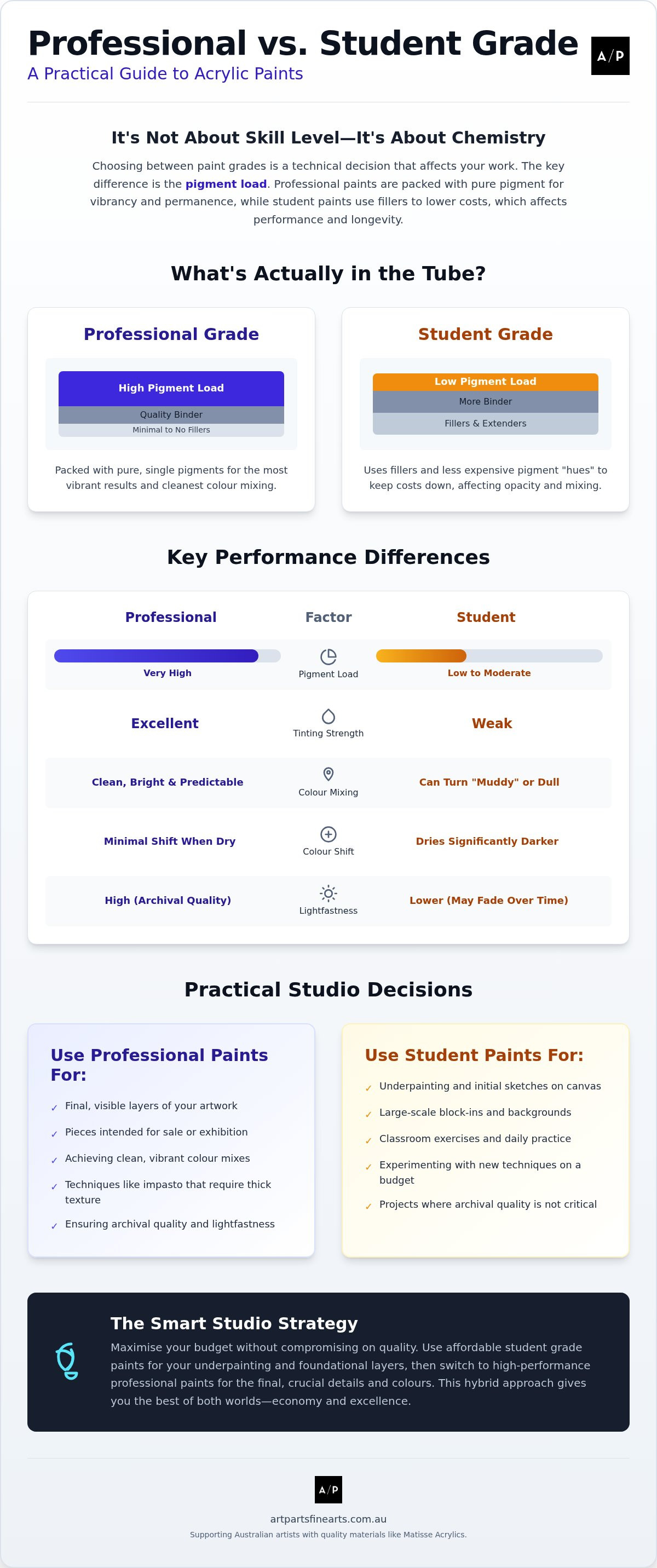
To understand the real value of your materials, you have to look at the chemistry inside the tube. At its most basic level, what is acrylic paint? It is a combination of dry pigment particles suspended in an acrylic polymer emulsion. The primary difference when comparing professional vs student grade acrylic paint is the ratio of these ingredients. Professional paints are packed with the highest possible concentration of pure pigment; student paints rely on more binder and inexpensive additives to fill the tube.
Quality also determines how your work stands the test of time. Lightfastness is the ability of a pigment to resist fading when exposed to light. Professional ranges use pigments with high lightfastness ratings to ensure your painting looks the same in twenty years as it does today. Because these high-quality pigments vary in cost to source, professional brands use a "Series" system. A Series 1 colour, like Yellow Ochre, is made from abundant earth minerals and is quite affordable. A Series 4 or 5 colour, such as Cobalt Blue or Cadmium Red, costs more because the raw minerals are rare and difficult to process.
The Role of Pigment Concentration
Higher pigment loads mean you don't need to use as much paint to achieve a vibrant result. When you use professional grades, you will notice a much higher tinting strength. This means a tiny dab of professional Phthalo Green will transform a large pile of white, whereas a student grade version might just turn it a pale, watery mint. Professional ranges also prioritise single pigments. This allows for much cleaner colour mixing. Student paints often use "hues," which are mixtures of cheaper pigments designed to mimic expensive ones, but these often turn "muddy" when you try to mix them with other colours.
Understanding Fillers and Extenders
Student grade paints often feel thick in the tube, but this isn't always due to pigment. Manufacturers often add opacifiers and extenders like calcium carbonate to keep costs down. These fillers take up space and make the paint feel substantial, but they affect the final finish. You might find that student paints dry with a slightly chalky or matte appearance. Because there is less pigment and more filler, these paints often dry significantly more transparently than you expect, forcing you to apply multiple layers just to get decent coverage on your stretched canvas.
Key Performance Differences: How Professional Paints Change Your Workflow
The way paint behaves on your brush directly impacts your enjoyment and the final result of your work. Professional heavy body acrylics have a thick, buttery consistency that holds peaks and brushmarks with precision. Student grades are often more fluid or "stringy" because they contain more binder and less pigment. Using professional painting materials allows for more sophisticated techniques like impasto, where the paint stands off the surface without levelling out as it dries.
Colour Shift and Drying Times
Acrylic binders are naturally milky-white when wet and become clear once the water evaporates. In lower-quality paints, this transition causes a frustrating "colour shift" where the paint dries significantly darker than it appeared on the palette. Professional binders are formulated to be much clearer from the start. This minimises the shift so you can mix colours with confidence, knowing the vibrant sky you just painted won't turn into a dark navy by tomorrow morning.
Tinting Strength and Mixing
When comparing professional vs student grade acrylic paint, tinting strength is the most immediate difference you will notice. Professional paint is so concentrated that a tiny dab of Phthalo Blue can transform a large pile of white. Student paints lack this punch because they are diluted with fillers. Because professional ranges prioritise single pigments, you can mix complex secondary colours that remain bright and clear. Student "hues" are often pre-mixed from three or four cheap pigments; adding another colour into that mix usually results in a dull, "muddy" mess.
You will also find that professional paints offer much better coverage and opacity. Instead of applying three layers of yellow to hide your pencil marks, you can often achieve a solid, flat colour in a single pass. This efficiency saves you time and material in the long run. If you are preparing for a large series of works, you might consider saving on your supports with bulk stretched canvas so you can invest more of your budget into these high-performance pigments.
Practical Studio Decisions: When to Use Student vs Professional Grade
Making the right choice between professional vs student grade acrylic paint often comes down to the specific stage of your painting. Student grade paints are excellent for the early stages of a piece, such as toning a canvas or blocking in large areas of background colour. They allow you to work loosely and experiment with new techniques without worrying about the cost per millilitre. However, for the final layers of a commission or exhibition piece, professional grade is essential. These paints offer the archival stability needed to ensure your work won't yellow or flake as the decades pass.
The surface you choose also dictates the quality of paint you should use. If you have invested in a heavy 500gsm CreateART canvas, using low-pigment student paint can feel counterproductive. The term gsm stands for grams per square metre, which tells you the weight and thickness of the canvas fabric. High-quality supports like these feature triple-primed acrylic gesso, which is the white foundation layer that seals the fabric and prevents paint from soaking into the fibres. This primer provides the perfect amount of tooth, the microscopic texture that allows paint to grab hold of the surface.
Mixing Grades in a Single Painting
You don't need to stick to just one range for your entire studio. Because both grades are acrylic-based, they are perfectly compatible and can be mixed on the same palette. A smart way to transition is to buy your workhorse colours, like Titanium White, in larger student tubs while splurging on professional Series 4 and 5 colours. Investing in a professional Cadmium Red or Cobalt Blue early on will give you a much wider mixing range than any student-grade hue ever could.
Surface Preparation and Gesso
Professional results depend on how the paint interacts with your support. A properly primed surface provides the ideal foundation for high-pigment loads. When you use professional-grade acrylics on a high-quality surface, the paint maintains its structure and vibrancy rather than sinking into the weave. This synergy between paint and surface is why many artists spend time choosing the right canvas to complement their specific painting style.
Shop our professional CreateART and Wright & Co canvas range
Elevating Your Practice with Australian-Made Matisse Acrylics
For many Australian artists, the search for the perfect professional vs student grade acrylic paint leads to a local solution. Matisse is manufactured in Australia, offering a world-class professional range that understands our unique light and landscape. Their Matisse Acrylic Paint Structure is a premier heavy body option that provides the thick, sculptural quality demanded by serious studio practices.
Choosing an Australian-made professional brand isn't just about supporting local industry. It means you're using pigments designed for high performance and archival longevity. Matisse ensures that their professional range maintains a high standard of lightfastness, so your work remains vibrant for decades.
The Matisse Structure Advantage
The primary benefit of this range is its high pigment concentration. You'll find that a little goes a long way, especially when compared to the diluted feel of student alternatives. The consistency is famously buttery, which is perfect for palette knife work and impasto. If you need to change the flow, these paints integrate perfectly with various painting mediums. This allows you to shift from thick textures to transparent glazes without the paint becoming unstable or losing its rich colour.
Stocking Your Studio
Transitioning to professional gear is a gradual process. You don't need every colour in the catalogue to see an improvement in your work. We often suggest starting with a limited palette of professional primaries; the mixing potential is far superior to a large set of student paints. For artists working on a larger scale, there are ways to manage the budget. Buying in bulk or investing in full cartons of canvas can free up funds for those high-series professional pigments.
Art Parts Fine Arts is proud to be an official stockist of these professional tools. We offer competitive pricing and ship Australia-wide from our Albury location. Whether you're a student ready to upgrade or a professional artist maintaining a busy studio, we're here to help you find the right materials for your craft.
Choosing the Best Tools for Your Creative Journey
Deciding between professional vs student grade acrylic paint is a technical choice that directly affects your daily studio practice. You now understand that professional pigments offer superior coverage and lightfastness, while student grades serve as a cost-effective tool for underpainting and experimentation. Mixing these grades strategically allows you to manage your budget without compromising the archival quality of your final exhibition pieces.
Our team at Art Parts Fine Arts is composed of practising artists who understand the importance of reliable materials. We offer competitively priced professional supplies and expert advice to help you navigate your next project. Everything in our shop is carefully selected for quality and ships Australia-wide from our Albury location.
Outside of the studio, if you're looking for creative ways to show your team spirit at a game or party, check out Fanbrush Australia for their range of multi-line face paint pens.
Explore our range of professional Matisse Acrylics and premium canvases
Whether you are just starting out or preparing for a solo show, the right materials will always make the process more rewarding. We look forward to seeing what you create.
Frequently Asked Questions
Can I mix professional and student grade acrylic paints together?
Yes, you can safely mix different grades because they both share a compatible acrylic polymer binder. However, adding student paint will reduce the high pigment concentration of your professional tubes. This dilution affects the tinting strength and usually leads to a more noticeable colour shift as the work dries.
Does student grade acrylic paint fade over time?
Student grade paints are more likely to fade because they often contain less stable pigments and more extenders or fillers. Professional paints are formulated for archival longevity, meaning they have high lightfastness ratings. If you want your painting to look the same in several decades, using professional grade for your final layers is the best way to prevent yellowing or fading.
Is professional acrylic paint harder for beginners to use?
Professional paint is actually often easier for beginners because it behaves more predictably on the palette. When choosing between professional vs student grade acrylic paint, beginners often find that professional pigments require fewer layers for coverage and produce cleaner mixes. This prevents the frustration of "muddy" colours that often occurs with lower-quality paints containing multiple pigments.
Why are some professional paint colours much more expensive than others?
Professional ranges use a Series system based on the rarity and cost of raw pigments. Series 1 colours like earth tones are inexpensive to source and process. Series 4 or 5 colours, such as genuine Cadmiums or Cobalts, are rare minerals that cost significantly more to manufacture, which is reflected in the price per tube regardless of the brand.
What does "Hue" mean on a paint tube label?
A "Hue" is a mixture of inexpensive pigments designed to mimic the appearance of a costly single pigment. For example, a Cadmium Red Hue looks similar to the real thing but doesn't contain the actual mineral. While these are great for the budget, they often lack the mixing clarity and heavy body texture of a true professional single-pigment paint.

Article by
Art Parts Fine Arts
Art Parts Fine Arts is an Australian art-supplies store based in Albury, shipping Australia-wide. Hand-picked by artists, our range covers paints, canvas, brushes, paper, printmaking and more, for everyone from students to professionals. We share practical guides and tips to help you get the most out of your materials.
Disclaimer
This article is general information to help you choose and use art materials. It is not professional, health or safety advice. Always follow the manufacturer's instructions and safety guidance for any product, and take care when using solvents, varnishes and other materials. Product availability, specifications and pricing may change, so please check the current product page for details.