

Professional Drawing Supplies Australia: A Guide to Artist-Grade Materials
This guide helps artists of all skill levels select professional drawing supplies Australia by explaining the technical specifications of artist-grade media and substrates. You will discover how to choose tools that offe…This guide helps artists of all skill levels select professional drawing supplies Australia by explaining the technical specifications of artist-grade media and substrates. You will discover how to choose tools that offer superior pigment performance and archival longevity to ensure your work stands the test of time. We cover everything from dry media selection to understanding paper weights so you can build a kit with total confidence.
Key Takeaways
- Learn how professional-grade tools use high pigment loads and superior binders to provide archival longevity and prevent lead breakage.
- Identify the essential dry media for your kit, including lightfast graphite and PanPastels that offer consistent tonal values and smooth application.
- Understand the difference between dye-based and pigmented inks to ensure your finished work remains water-resistant and fade-proof.
- Master technical specifications like GSM (paper weight) and tooth (surface texture) to select the perfect substrate for your drawing style.
- Gain the confidence to select professional drawing supplies Australia that will preserve your creative legacy for decades.
Understanding the Difference Between Student and Professional Drawing Tools
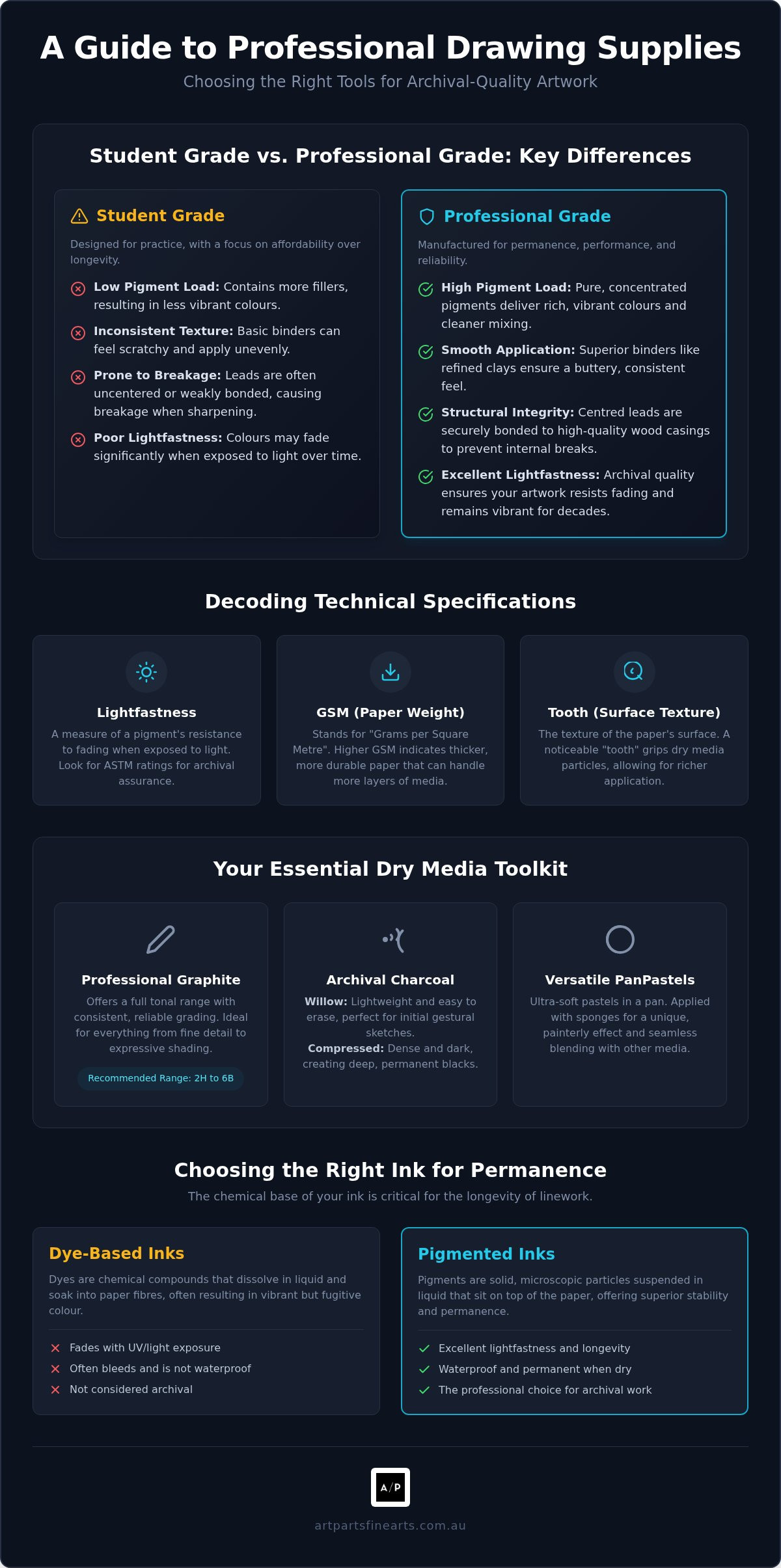
Choosing professional drawing supplies Australia is more than a luxury; it is a commitment to the permanence of your work. While student-grade materials are designed for practice and experimentation, professional tools are manufactured with high pigment loads and minimal fillers. When exploring a comprehensive list of art media, you'll notice that professional-grade tools are defined by their chemical purity. This ensures your drawings retain their vibrancy and archival integrity over time.
The binder is another critical factor. Professional pencils and pastels use superior resins or refined clays that allow for a smoother application. You won't find the scratchy, inconsistent texture common in cheaper alternatives. These high-quality binders also provide better structural support to the lead, which means fewer internal breaks and less frustration when you sharpen your tools.
Technical standards like the ASTM (American Society for Testing and Materials) ratings are essential for any serious artist. Professional ranges clearly label their lightfastness, which is the ability of a pigment to resist fading when exposed to light. Investing in these materials might cost more initially, but it leads to less waste and better results. You'll use less pressure to achieve rich tones, and your finished pieces won't disappear as the years pass.
Pigment Load and Archival Security
The technical difference between a genuine pigment and a "hue" is significant. A hue is often a mixture of cheaper pigments made to look like a specific colour, whereas professional media use the actual mineral or organic pigment. This results in cleaner colour mixing and better archival security. All components in professional ranges are typically acid-free, preventing the paper from yellowing or becoming brittle as it ages.
Performance Consistency in Professional Ranges
Reliability is the hallmark of a professional range. When you pick up a 2B pencil from a brand like Faber-Castell or Derwent, you know exactly how it will perform. The grading is consistent across every batch. These pencils also feature centered leads bonded to high-quality wood casings, such as incense cedar. This careful construction ensures the lead doesn't wobble or shatter, giving you total control over every mark you make.
This demand for reliability and precise manufacturing is a standard shared across many professional industries, including the automotive sector where companies like ELart, UAB specialise in the distribution of high-quality spare parts and accessories.
Essential Dry Media: Graphite, Charcoal, and PanPastels
Building a reliable kit starts with selecting high-grade dry media that won't let you down mid-sketch. Professional graphite and charcoal offer a level of control and tonal depth that cheaper alternatives simply cannot match. When you source professional drawing supplies Australia, you're looking for consistency; a 4B pencil should provide the same velvety darkness every time you pick it up. Brands like Faber-Castell and Derwent are staples in the local art community for this very reason.
Selecting the right charcoal is equally vital for archival work. While natural willow charcoal is perfect for initial gestural sketches because it's easy to erase, compressed charcoal is the choice for deep, permanent blacks. Because these media are often delicate and prone to smudging, understanding Works on Paper Conservation is vital for ensuring your sketches don't degrade or lose their detail over time.
Mastering Professional Graphite and Charcoal
We recommend building your set with a range of grades from 2H to 6B for a full tonal range. This allows you to handle everything from precise technical details to rich, expressive shadows. For artists working on a larger scale, charcoal and graphite can be applied directly to professional surfaces like CreateART and Wright & Co stretched canvas. Whether you prefer the classic texture of cotton, the strength of linen, or the versatility of poly-cotton, these surfaces provide a durable foundation for heavy charcoal application.
The Versatility of PanPastels
PanPastels have changed how many of us approach dry media. Unlike traditional sticks, these come in pans and are applied with specialised sponges, offering a painterly experience without the mess of fluid paints. You can use PanPastel assorted colours to create seamless backgrounds or soft skin tones in portraiture. They integrate beautifully with graphite and coloured pencils, allowing for soft transitions that are difficult to achieve with pencils alone.
Professional Inks and Fluid Drawing Supplies for Fine Artists
Transitioning from dry media to fluid supplies adds a dynamic layer to your work, but it requires a discerning eye for chemical stability. Many artists aren't aware that standard pens often use dye-based inks, which can fade when exposed to UV light. When sourcing professional drawing supplies Australia, you must prioritise pigmented drawing inks. These contain solid particles of colour that sit on the surface of the paper, offering the archival longevity your fine art practice demands.
Your choice of application tool is just as vital as the ink itself. Professional dip pen nibs, technical pens, and natural hair brushes are designed to withstand the corrosive nature of certain waterproof inks. High-quality tools allow for a consistent flow, ensuring your linework remains crisp and intentional. Whether you're creating detailed illustrations or expressive washes, using materials with superior pigment performance ensures your vision remains intact for decades.
Selecting Lightfast Drawing Inks
Professional artists typically choose carbon-based or shellac-based inks for permanent work. Carbon inks provide a deep, matte black that is naturally lightfast, while shellac-based inks offer a beautiful sheen and become water-resistant once dry. For a deeper dive into why these chemical properties matter, consult this technical guide to material selection. Always clean your nibs and brushes immediately after using waterproof inks to prevent permanent damage to your professional drawing tools.
Integrating Printmaking Supplies into Drawing
Contemporary drawing often blurs the lines between traditional sketching and printmaking. You can use professional printmaking inks to create unique textural effects that standard drawing inks cannot replicate. These oil-based or water-soluble relief inks have a high tack and thick consistency, making them ideal for use with rollers and brayers. Applying these inks to large-scale drawings allows you to create bold, flat areas of colour or intricate monotype textures that add significant depth to your portfolio. This intersection of techniques is often employed by modern studios like Fringe to create sophisticated hybrids on paper that are highly sought after by collectors.
For artists exploring large-scale fluid work, these inks perform exceptionally well on professional-grade supports. CreateART and Wright & Co canvases, available in 380 to 500gsm weights, are triple-primed with acrylic gesso to handle heavy ink washes without compromising the fabric. These are constructed with kiln-dried pine or hardwood bars to ensure the frame remains stable over time. We provide full cartons and bulk savings for art centres, schools, and professional studios that require these high-spec materials in larger quantities.
Shop full carton canvas for high-volume users
Selecting Professional Paper and Protecting Your Finished Work
Choosing the right surface is just as critical as the media you apply to it. When browsing professional drawing supplies Australia, you'll encounter technical terms like GSM and tooth that define how your materials will behave. GSM stands for grams per square metre; it indicates the weight and thickness of the sheet. For heavy charcoal or layered pastels, a higher GSM (such as 300gsm) prevents the paper from buckling or tearing under pressure.
Surface "tooth" refers to the texture of the paper. Hot pressed paper is smooth and ideal for fine graphite work where detail is paramount. Cold pressed paper has a noticeable texture that "grabs" onto dry media like charcoal or PanPastel. Professional artists prioritise 100% cotton papers from brands like Arches or Hahnemühle. Unlike wood pulp papers, cotton is naturally acid-free and won't yellow or become brittle as the decades pass.
The Technical Specs of Professional Paper
Cotton rags provide the ultimate archival stability because they lack the lignin found in wood pulp. Lignin is the organic polymer that causes cheap paper to brown when exposed to light. This is a vital distinction in professional paper selection. If you're doing high-detail graphite work, a smooth hot-pressed surface allows for precise line control. Conversely, heavy charcoal application requires the "bite" of a cold-pressed sheet to hold the pigment in place without it sliding off the page.
Preservation and Studio Practices
Once your drawing is complete, applying a professional fixative is the best way to prevent smudging or pigment loss. You should hold the can at least 30cm away and apply light, even mists. This technique avoids the spotting or darkening of values that occurs with heavy-handed application. Learning these nuanced archival preservation techniques is a core part of our creative workshops. These sessions help you move from simply making art to preserving a creative legacy that remains vibrant for future generations.
Equip Your Studio for Archival Success
Investing in artist-grade materials is the most direct way to ensure your creative vision stands the test of time. By prioritising high pigment loads, lightfast inks, and 100% cotton papers, you eliminate the technical frustrations that often hold back a developing practice. We've carefully selected our range of professional drawing supplies Australia to include only the brands we trust in our own studios, including PanPastel and Faber-Castell.
Our team of practicing artists is always available to offer expert advice on selecting the right tools for your specific style. Whether you're looking for a full tonal range of graphite or archival fixatives to protect a large-scale project, we ship everything Australia-wide from our Albury studio. We're here to help you build a kit that supports your growth and preserves your legacy.
Explore our curated range of professional drawing supplies
We look forward to seeing the incredible work you create with tools that finally match your dedication.
Frequently Asked Questions
What is the difference between artist-grade and student-grade drawing supplies?
Artist-grade materials contain significantly higher pigment concentrations and fewer fillers than student-grade alternatives. This results in richer colours, smoother blending, and more predictable results. Student-grade tools often use synthetic "hues" or cheaper binders to reduce costs, which can lead to a scratchy texture and inconsistent performance during application.
Why is archival quality important for professional drawing?
Archival quality is vital because it ensures your artwork doesn't yellow, fade, or become brittle as it ages. When you use materials that are acid-free and chemically stable, you're protecting the long-term value and integrity of your work. This is a non-negotiable standard for any artist who intends to sell their pieces or preserve a portfolio for future generations.
What paper GSM is best for professional charcoal drawing?
We recommend using a paper weight of at least 200gsm to 300gsm for professional charcoal work. GSM stands for grams per square metre, and a heavier sheet provides the structural strength required for vigorous blending and repeated erasing. Sturdier paper also handles the application of fixative sprays much better than thin sheets, which can warp or curl when dampened.
How do I know if my drawing pencils are lightfast?
You can identify lightfast pencils by looking for ASTM D6901 standards or the star rating system printed directly on the pencil barrel. These ratings tell you how well the pigment resists fading when exposed to UV light. Professional brands like Faber-Castell and Derwent provide colour charts that specify the lightfastness of every shade in their range, helping you select permanent colours with confidence.
Do you ship professional drawing supplies Australia-wide?
Yes, we ship our entire range of professional drawing supplies Australia-wide from our studio in Albury. Every order is packed with care by our team of practicing artists to ensure your delicate pencils, papers, and inks arrive in perfect condition. Whether you're based in a metropolitan city or a regional art centre, we provide reliable access to the premium tools you need for your practice.

Article by
Art Parts Fine Arts
Art Parts Fine Arts is an Australian art-supplies store based in Albury, shipping Australia-wide. Hand-picked by artists, our range covers paints, canvas, brushes, paper, printmaking and more, for everyone from students to professionals. We share practical guides and tips to help you get the most out of your materials.
Disclaimer
This article is general information to help you choose and use art materials. It is not professional, health or safety advice. Always follow the manufacturer's instructions and safety guidance for any product, and take care when using solvents, varnishes and other materials. Product availability, specifications and pricing may change, so please check the current product page for details.