

Professional vs Student Grade Oil Paint: A Guide to Choosing Your Medium
The most affordable paint on the shelf often ends up being the most expensive for your creative practice. While it is tempting to reach for cheaper tubes to avoid the fear of wasting precious materials, the struggle with…The most affordable paint on the shelf often ends up being the most expensive for your creative practice. While it is tempting to reach for cheaper tubes to avoid the fear of wasting precious materials, the struggle with muddy colour mixes and inconsistent textures can quickly stall your progress. Deciding between professional vs student grade oil paint is a significant milestone for any artist, and it is natural to wonder if the extra investment truly changes the result on the canvas.
We understand that every tube in your kit needs to earn its place, especially when you are balancing a budget with the desire for professional results. This guide breaks down the technical differences in pigment concentration and binder quality so you can invest in your materials with confidence. You will learn how to identify where you can save and where you should spend, ensuring your finished pieces remain vibrant and lightfast for decades to come.
Key Takeaways
- Understand the chemistry behind professional vs student grade oil paint, specifically how pigment load and the use of 'hues' affect your colour mixing.
- Learn how to save money without sacrificing quality by using a hybrid kit where you prioritise artist-grade primary colours.
- Discover why high-quality binders like linseed and safflower oil matter for the longevity and texture of your work.
- Gain confidence in selecting paints that won't fade over time by understanding lightfastness ratings and archival standards.
- See why Australian-made Langridge oil paints are a preferred choice for artists seeking single-pigment clarity and professional performance.
Defining the Grades: What Makes a Paint 'Professional'?
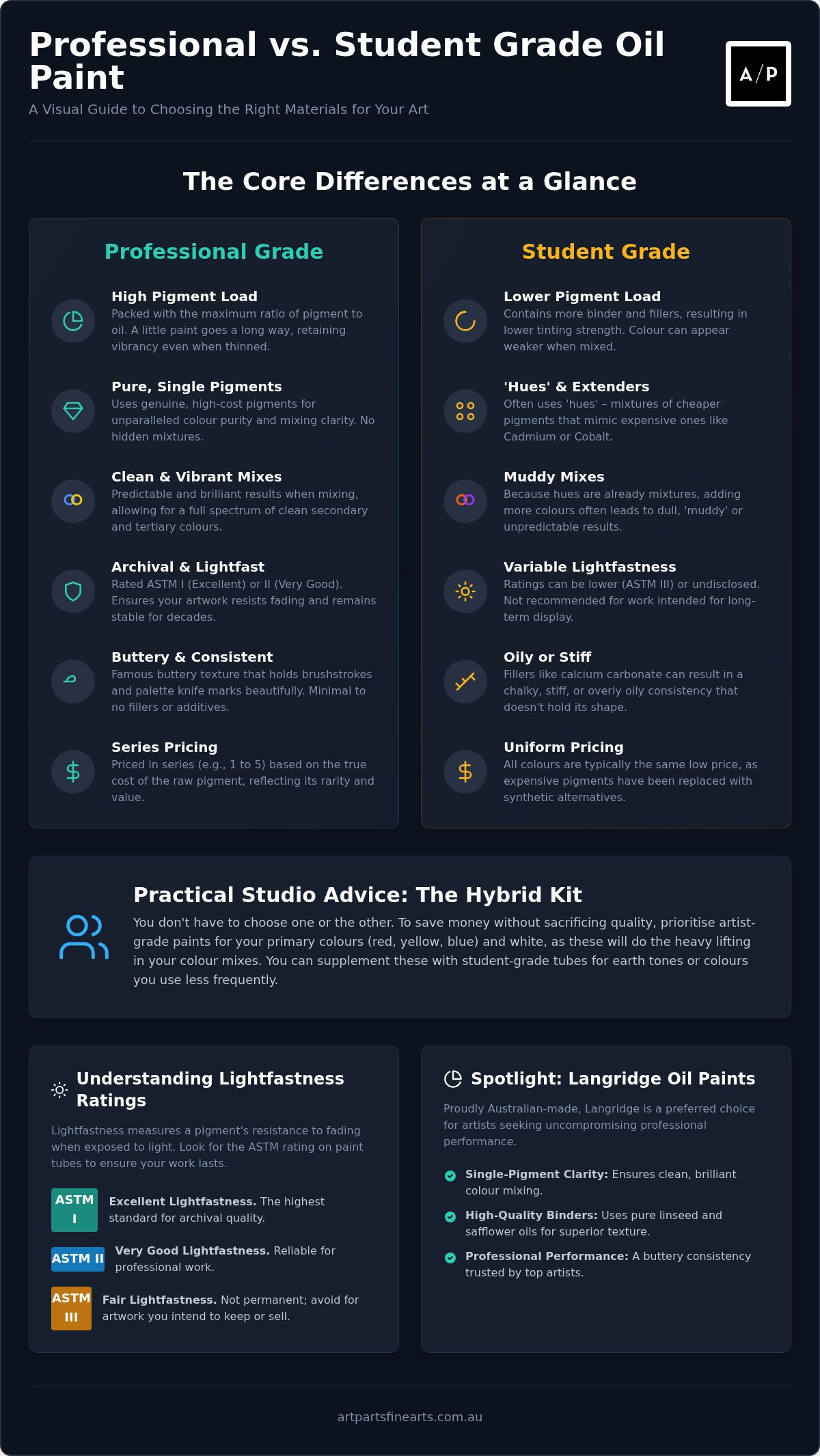
The price gap between two tubes of what looks like the same red can be startling. The fundamental difference between professional vs student grade oil paint lies in what's actually inside the tube. Professional or 'artist' grade paints are formulated with the highest possible pigment concentration and superior lightfastness, ensuring your work looks as good in fifty years as it does today.
Student grade paints are designed to be an accessible entry point. To keep costs down, manufacturers often replace expensive pigments with 'hues' or extenders. These are mixtures of cheaper pigments that mimic the appearance of a single, more costly pigment. While they look similar on the palette, they often lack the mixing clarity and intensity of their professional counterparts. Professional ranges avoid 'fillers' like barium sulphate or aluminium stearate, which can make colours appear milky or dull when mixed.
You'll notice series numbers, usually ranging from 1 to 5, on professional tubes. This system reflects the raw cost of the pigment itself. A Series 1 earth colour like Yellow Ochre is more affordable to produce than a Series 5 Cobalt Blue. In student ranges, prices are usually uniform because the expensive pigments have been replaced by synthetic alternatives. You can explore our full range of oil paints to see these series differences in action.
The Role of Pigment Concentration
Pigment load refers to the ratio of dry pigment to the oil binder. Professional paints are packed with as much pigment as the oil can physically hold. This high concentration means a tiny bit of paint goes a long way. Even when you dilute professional paint with mediums or white, it retains its vibrancy. Understanding the history and properties of oil paint helps clarify why this concentration is the hallmark of quality; it's about the purity of the material rather than just the volume of the tube.
Lightfastness and Archival Quality
Lightfastness is the ability of a pigment to resist fading when exposed to light. Most reputable brands use the ASTM rating system to help artists choose durable materials:
- ASTM I: Excellent lightfastness.
- ASTM II: Very good lightfastness.
- ASTM III: Fair lightfastness (rarely used in professional lines).
The Technical Differences: Pigments, Binders, and Fillers
Inside every tube, the ratio of ingredients determines how the paint behaves under your brush. The primary distinction in professional vs student grade oil paint is the quality and quantity of the pigment compared to the binder and additives. Professional paints rely on pure pigments, whereas student lines frequently use 'hues' made from mixtures of cheaper chemicals to mimic expensive colours. When choosing the right oil colors, it's vital to check the tube label for these substitutes, as they directly impact your ability to mix clean, vibrant tones.
The binder is just as important as the pigment. Professional paints, such as the Australian-made Langridge range, use high-quality linseed, walnut, or safflower oils. These binders are selected for their clarity and natural drying characteristics, avoiding the excessive chemical driers often found in budget sets. To keep costs low, student grades are padded with fillers like calcium carbonate or barium sulphate. These add bulk and volume but can lead to a chalky or dull finish once the oil has cured. Tinting strength is the ability of a small amount of paint to alter the colour of a large amount of white.
Understanding 'Hues' in Student Paint
You can spot a 'hue' by looking for the word after the pigment name, such as 'Cadmium Red Hue'. This indicates that a synthetic replacement has been used instead of the genuine mineral. Mixing these can be a source of constant frustration for artists. Because hues are already mixtures of multiple cheaper pigments, adding another colour to the mix often results in 'mud' rather than the clean secondary or tertiary colour you were aiming for.
Consistency and Handling
Professional oils have a famously buttery feel that holds the shape of a brushstroke or palette knife mark. Cheaper paints can feel either overly oily or strangely stiff because of those extra fillers. These additives also change the 'tooth'—the physical texture of the paint film—and can cause uneven drying across your work. If you're planning a large-scale project where consistency is key, starting with a high-quality bulk stretched canvas ensures your professional materials have the best possible foundation to bond with.
Practical Studio Advice: When to Upgrade Your Kit
Transitioning your entire studio doesn't have to happen overnight. A hybrid approach is often the smartest way to manage your budget while improving your results. Focus on upgrading your primary colours first, as these are the workhorses of your palette. When comparing paint grades, you'll find that earth colours like Burnt Sienna or Yellow Ochre are quite reliable in student ranges because the natural pigments are relatively inexpensive. However, for high-chroma pigments like Cadmiums and Cobalts, the professional versions offer a level of brilliance that student 'hues' cannot match.
Professional paint actually covers more surface area. Because the pigment density is so high, you use significantly less paint to achieve the same saturation. Over time, this makes the cost per painting more comparable than it first appears. You can explore our range of professional oil paints to find the best fit for your next project.
Mixing Different Grades
It is perfectly safe to mix professional and student paints on a single canvas; they use compatible oil binders. The risk is purely aesthetic. If you mix a high-intensity professional pigment with a student-grade Titanium White, the fillers in the white can 'kill' the vibrancy, leaving your mix looking flat. For the best results, try to use professional-grade whites even if your other colours are still being upgraded.
The Best Starting Palette for Upgrading
If you're ready to start the shift in your professional vs student grade oil paint journey, these six colours provide a versatile foundation:
- Titanium White (Essential for maintaining tinting strength)
- Cadmium Red (Genuine)
- Ultramarine Blue
- Cadmium Yellow (Genuine)
- Alizarin Crimson
- Phthalo Green
Shop our full carton canvas range for bulk savings on professional surfaces
Investing in Quality: Why Langridge Oil Paints Lead the Way
Choosing between professional vs student grade oil paint often leads artists to Langridge Artist Colours. As a premier Australian-made brand, Langridge represents the gold standard for pigment purity and archival performance. Their commitment to single-pigment colours is what truly sets them apart. When you work with a single pigment, your colour mixing remains predictable and luminous, avoiding the dullness that comes from the multi-pigment 'hues' found in budget ranges.
Supporting local manufacturers like Langridge ensures you're using materials specifically designed for high performance. They understand the needs of artists working in the unique Australian climate and prioritise raw material quality over mass-market fillers. If you're unsure how these paints behave on the palette, you can book a workshop at our studio to see the difference professional pigments make in person.
The Langridge Philosophy
The core of the Langridge approach is simplicity and purity. They avoid unnecessary stabilisers or bulking agents that can interfere with the natural handling of the paint. This results in a product with exceptional tinting strength and a true, buttery consistency that holds every mark of your brush. To get the most out of these paints, their range of mediums and varnishes is formulated to complement the specific oil binders used in their colours, ensuring a sound paint film from the first sketch to the final glaze.
Long-term Value for Australian Artists
For artists looking to exhibit or sell their work, professional paint is a non-negotiable investment. Collectors expect archival quality. Using professional-grade materials is the only way to guarantee your work won't fade or crack prematurely under the harsh Australian sun. While the initial cost is higher, the density of the pigment means you'll find yourself replacing tubes far less often than you would with student alternatives. We stock a full range of Langridge products alongside our other drawing and painting supplies, with national shipping available from our Albury base to artists right across Australia.
Elevate Your Artistic Practice
Choosing the right materials is a personal journey that evolves alongside your skills. While student grades offer a low-pressure way to start, the transition to professional vs student grade oil paint is what truly unlocks the potential for clean colour mixing and archival durability. By focusing your investment on high-pigment primary colours and Australian-made Langridge pigments, you ensure your work retains its brilliance for years to come. For inspiration on how these professional materials can be used to capture everything from urban landscapes to historical narratives, you might look to the portfolio of Duke Windsor Fine Art Studio.
Our team of practising artists is always available to provide tailored advice on building a kit that suits your specific style. Whether you are visiting us in Albury or ordering with our Australia-wide shipping, we are committed to helping you find the highest quality tools for your studio. We take pride in sourcing materials that we use and trust in our own creative practices.
Whether you are honing your skills in the visual arts or exploring a new discipline through Rising Tones Music, investing in professional guidance is the surest way to elevate your creative practice.
Upgrade your studio with professional Langridge oil paints and bulk canvas savings
We look forward to seeing what you create with the right materials by your side. Happy painting.
Frequently Asked Questions
Is professional oil paint really worth it for beginners?
Professional paint is often better for beginners because it removes the technical hurdles of poor colour mixing. Cheaper paints rely on fillers that make it difficult to achieve clean secondaries, which can be incredibly frustrating when you are trying to learn colour theory. By using a higher grade, you spend less time fighting your materials and more time mastering your technique with predictable results.
Can I use student grade oil paint for the first layers and professional for the top?
You can use student-grade paint for your initial layers to save on costs. This is a practical choice for large underpaintings where you need to cover a lot of surface area quickly. As long as you maintain the traditional 'fat over lean' principle, applying more flexible, oil-rich professional layers over the leaner student base, your work will remain structurally sound.
Why is some oil paint so much more expensive than others in the same brand?
Price variations within a professional brand are driven by the rarity and processing costs of the raw pigments. Common earths like Yellow Ochre are easy to source and refine, while semi-precious minerals like Cobalt or Cadmium require intensive mining. Professional brands use series numbers to help you identify these cost differences based on the actual ingredients inside the tube.
What does 'hue' mean on an oil paint tube?
A 'hue' is a synthetic alternative designed to look like a traditional, more expensive pigment. While they are useful for practice, they are usually made from a mixture of three or four different pigments. This makes them more likely to turn into muddy tones when you mix them with other colours, which is a key consideration when comparing professional vs student grade oil paint.
How do I know if my oil paint is lightfast?
Look for the ASTM rating on the back or side of the tube. This international standard tells you how resistant a pigment is to fading when exposed to light, with ASTM I being excellent and ASTM II being very good. When deciding between professional vs student grade oil paint, you'll find that professional lines consistently offer these higher ratings, ensuring your work remains vibrant for decades.

Article by
Art Parts Fine Arts
Art Parts Fine Arts is an Australian art-supplies store based in Albury, shipping Australia-wide. Hand-picked by artists, our range covers paints, canvas, brushes, paper, printmaking and more, for everyone from students to professionals. We share practical guides and tips to help you get the most out of your materials.
Disclaimer
This article is general information to help you choose and use art materials. It is not professional, health or safety advice. Always follow the manufacturer's instructions and safety guidance for any product, and take care when using solvents, varnishes and other materials. Product availability, specifications and pricing may change, so please check the current product page for details.