

Save on Quality: Bulk Artist Canvas Buying Guide
Buying the cheapest multi-packs often costs more in the long run when a commission is ruined by a warped frame or sagging fabric. Securing a genuine discount canvas bulk rate shouldn't mean you have to settle for light, …Buying the cheapest multi-packs often costs more in the long run when a commission is ruined by a warped frame or sagging fabric. Securing a genuine discount canvas bulk rate shouldn't mean you have to settle for light, unprimed cotton that tears easily. We understand that high-volume artists and art centres need to balance a strict budget with the archival integrity of their finished work, ensuring every surface stays taut and every frame remains square.
This guide explains how to access wholesale carton rates on professional CreateART and Wright & Co stretched canvases without compromising on durability. You will learn the critical differences between fabric weights like 380gsm and 500gsm, and why kiln-dried timber bars are essential for preventing long-term warping. We also break down technical terms like gesso and tooth to help you establish a dependable studio ordering routine with straightforward nationwide shipping across Australia.
Key Takeaways
- Learn how full carton purchases provide better value than retail units by reducing the cost per painting without sacrificing archival quality.
- Understand the structural benefits of kiln-dried pine and hardwood stretcher bars in preventing timber warping on completed commissions.
- Identify the right fabric weight for your technique, ranging from 380gsm cotton to heavy 500gsm linen, all triple-primed for immediate use.
- Secure a reliable discount canvas bulk supply by coordinating orders that meet the specific volume requirements of busy studios and educational institutions.
- Choose between slim 16mm profiles for educational projects or 37mm gallery-depth frames for professional displays and exhibitions.
Evaluating Bulk Canvas: Why Price Per Unit Beats Cheap Upfront Cost
Finding a genuine discount canvas bulk deal involves more than just looking for the lowest price on a sticker. Many artists fall into the trap of purchasing budget multipacks from large retailers, only to find the hidden costs of substrate failure far outweigh the initial savings. When a canvas sags after the first layer of paint or the timber frame twists under studio lights, the time and materials required to re-stretch or repair the work quickly erase any perceived bargain.
Professional artists, schools, and TAFEs require a surface that remains stable from the first sketch to the final varnish. Choosing a full carton of professional-grade surfaces ensures you receive a consistent product where every frame is square and every surface tension is uniform. This reliability is vital when preparing a cohesive body of work for a solo exhibition or managing a classroom syllabus where every student needs the same quality of starting point.
The Hidden Costs of Low-Grade Multipacks
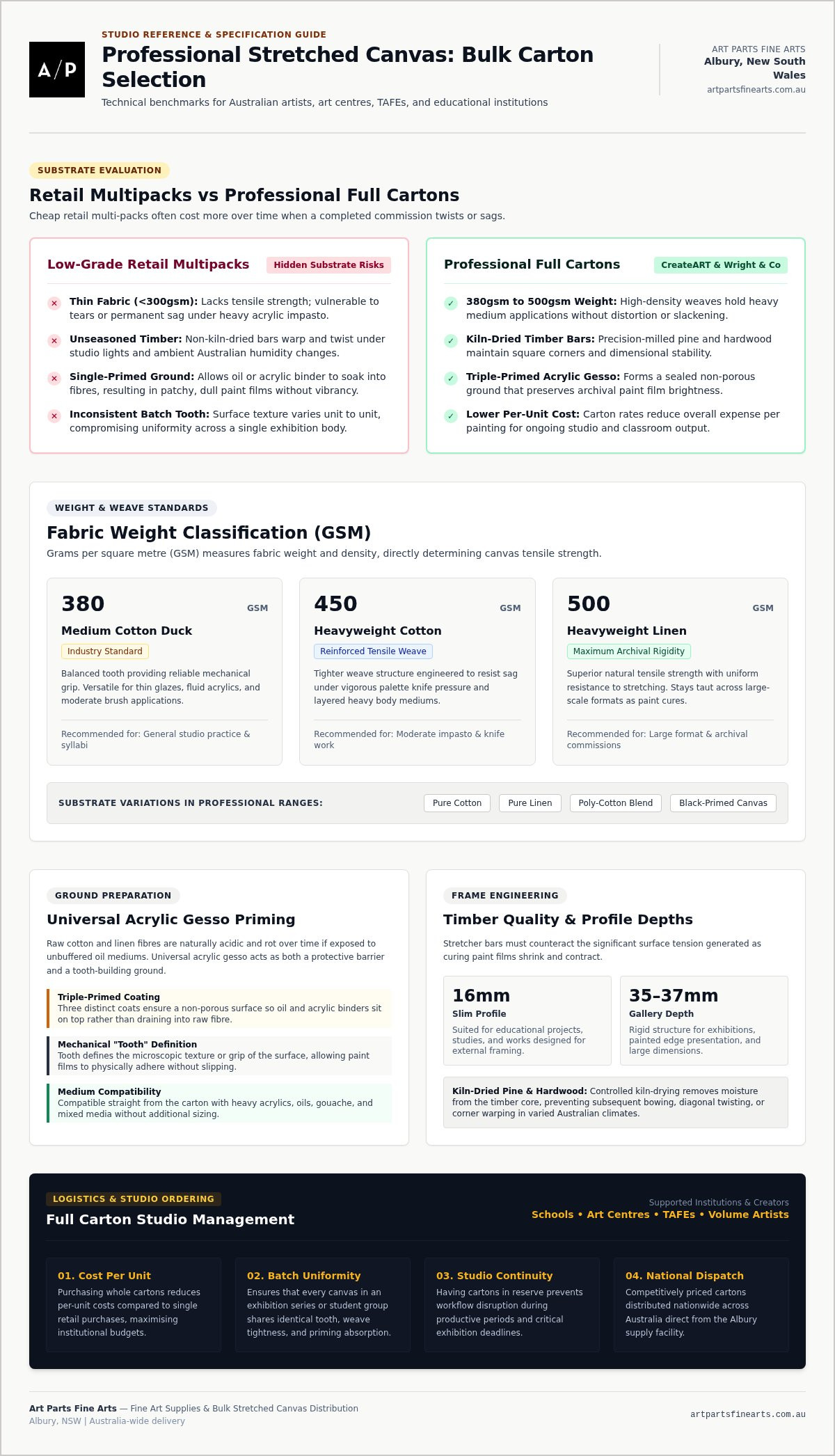
Inferior bulk packs often use unseasoned timber for stretcher bars. These bars are prone to warping when exposed to ambient Australian humidity shifts, which can ruin a completed commission intended for a client. Additionally, thin cotton fabrics below 300gsm lack the structural integrity to support heavy acrylic impasto or vigorous palette knife applications, leading to tears or permanent stretching.
Low-grade surfaces also frequently skimp on the ground. A single-primed surface will absorb the oil or acrylic binder unevenly, resulting in patchy, dull paint films that lack vibrancy. Professional ranges like CreateART and Wright & Co use triple-primed canvas priming with gesso, which is a specialized mixture of binder and pigment that creates a non-porous surface. This ensures your paint sits on top of the fabric rather than soaking into the fibres, preserving the archival quality of your work.
Economy of Scale: Buying Stretched Canvas by the Carton
The most effective way to lower your per-painting cost is to shift from retail single units to full carton purchases. This approach allows you to secure professional-grade 380gsm cotton canvas or 500gsm linen at a significantly lower price per unit. It's a practical studio management strategy that ensures you never run out of stock during a creative flow.
Establishing a routine with full carton canvas orders provides peace of mind for high-volume creators. By ordering in bulk, you ensure that your entire series is painted on the same batch of fabric with the same tooth, which is the texture or "grip" of the canvas. This consistency is what separates a professional studio practice from a hobbyist approach, providing a dependable foundation for every project you undertake.
Key Specifications to Check Before Ordering Bulk Canvas
Understanding the technical specifications of your substrate is the best way to ensure your discount canvas bulk order meets professional standards. While retail craft packs often look identical to professional ranges at a glance, the structural differences are significant. A professional stretched canvas is designed to withstand the physical stresses of drying paint and environmental changes without losing its shape or surface tension.
The weight of the fabric is one of the most reliable indicators of quality. GSM, or grams per square metre, measures the weight and density of the fabric, serving as a direct indicator of the canvas tensile strength and its ability to withstand heavy paint applications. Choosing the correct weight ensures the structural integrity of canvas remains intact throughout the life of the artwork, preventing the fabric from tearing or becoming loose over time.
Fabric Weight and Weave: Why 380gsm to 500gsm Matters
Medium-weight 380gsm cotton duck is the industry standard for a reason. It provides a balanced tooth, which is the surface texture that "grabs" the paint, making it suitable for most techniques from thin glazes to moderate impasto. If you work with vigorous palette knife applications or multi-layered oils, upgrading to a heavyweight 450gsm or 500gsm canvas is a safer choice.
A heavy-duty weave is less likely to sag when wet paint cures. This is particularly important for large-format works where the weight of the medium can cause lighter fabrics to stretch unevenly. Professional ranges like CreateART ensure a tight, even weave that supports the paint film without distorting.
Primer Consistency: Universal Acrylic Gesso Priming
Raw cotton and linen fibres are naturally acidic and will eventually rot if they come into direct contact with oil paint. Triple-priming with a universal acrylic gesso creates a reliable archival barrier that protects these fibres. This priming also ensures that your colours remain vibrant rather than sinking into the fabric and turning muddy.
Quality priming allows for fluid colour washes without the frustration of hydrophobic beading, where the paint rolls off the surface. It provides consistent long-term adhesion for both acrylic and oil paint systems. You can browse our full range of triple-primed cartons to find a surface that matches your specific medium.
Stretcher Bar Timber and Corner Construction
The frame behind the fabric is just as important as the canvas itself. Kiln-dried pine and plantation hardwoods are essential because the drying process removes excess moisture, ensuring the timber resists environmental twisting and bowing. Substantial timber profiles, ranging from 16mm to 37mm, prevent the frame from bending inwards under the structural tension of the stretched fabric.
Professional canvases feature mitred corners with slots for corner keys. These small wooden wedges allow you to manually re-tension the surface if it slackens over changing seasons. This level of construction is what distinguishes a professional substrate from a temporary craft surface.
Selecting the Right Canvas Profile and Surface for Your Work
Choosing the correct profile and surface is a critical decision that dictates how your finished work will be presented. When you browse for a discount canvas bulk deal, it's helpful to consider the final display environment before committing to a specific carton. The depth of the stretcher bar and the texture of the ground will influence both your painting process and the aesthetic appeal of the completed piece.
Traditional 16mm Profiles vs 35mm to 37mm Gallery Depth
Slim 16mm stretcher bars are the traditional choice for artists who plan to frame their work. These profiles fit comfortably into floating timber frames without protruding, providing a classic finished look. They are also lighter and easier to transport, making them a popular choice for student projects and smaller studies where space is a consideration.
Gallery-depth bars, typically ranging from 35mm to 37mm, are designed for contemporary presentation without an external frame. These deeper timber profiles provide the extra rigidity necessary for broad, oversized painting formats, ensuring the frame doesn't bow under tension. Many artists paint the edges of these canvases to create a wrap-around effect that adds a modern feel to any gallery space.
Cotton Duck, Linen, and Black-Primed Ground Options
Cotton duck is the most common surface due to its resilient versatility. It handles oils, acrylics, and mixed media with ease, offering a dependable foundation for most techniques. For those seeking a more refined surface, linen provides a tight, organic grain and superior strength. This makes it a favourite for portrait painters who require a smooth, stable surface for detailed work.
Specialist black-primed grounds are another excellent option for specific creative goals. These canvases establish rich, dark undertones that accelerate dramatic value studies and allow bright colours to pop with intensity. Both CreateART and Wright & Co ranges provide these varied options to satisfy different studio requirements and artistic styles.
Matching Canvas Profiles to Project Demands
High-turnover workshop settings and schools often thrive on robust, uniform mid-profile cotton stretched canvases. These provide a reliable standard for teaching while remaining cost-effective for large groups. In contrast, solo exhibitions often benefit from deep edge canvases that feature neatly folded, staple-free edges for a high-end professional finish.
Securing a discount canvas bulk order for your studio ensures you have the right materials on hand when inspiration strikes. Exploring CreateART canvas full cartons allows you to select the exact profile that suits your upcoming series. Whether you need a slim profile for a framed collection or a heavy-duty gallery edge for a large-scale installation, ordering by the carton ensures your surfaces are consistent across the entire project.
Logistics and Studio Management for Bulk Canvas Orders
Integrating a discount canvas bulk strategy into your studio workflow requires careful planning beyond the initial purchase. Managing the arrival and storage of large cartons ensures that every professional surface remains in peak condition until you're ready to paint. Whether you're running a busy community art centre or preparing for a solo exhibition, a methodical approach to logistics prevents accidental damage and keeps your creative process moving.
Estimating Carton Quantities for Studios and Art Classes
To calculate your needs, audit your painting velocity by reviewing how many canvases you've used over the previous six months. Consolidating your orders across academic terms or exhibition cycles is the most effective way to maximise freight efficiency. This is particularly useful for schools and TAFEs where large groups require a uniform supply of 380gsm cotton canvas. Pairing these orders with professional paint ranges ensures you have a complete working package ready for the first day of class.
Receiving, Inspecting, and Storing Full Cartons
Large art deliveries are bulky and fragile, so it's essential to inspect outer cartons immediately upon arrival. If you notice significant puncture marks or crushed corners, document this before signing off with national freight couriers. Once inside, store your stretched canvases vertically rather than stacking them flat. Using raised timber battening keeps the cartons away from concrete floor moisture, which is a common cause of timber frame distortion in Australian studios.
Avoid leaning unwrapped canvases face-to-face. Even slight pressure can leave permanent impression marks on the triple-primed gesso surface. Keeping canvases in their original carton until they're needed provides an extra layer of protection against dust and accidental scuffs.
Streamlining Ongoing Studio Supplies
Maintain an active inventory log of your most-used dimensions to avoid mid-series project delays. It's helpful to pair your bulk orders with the necessary varnishes and mediums required to finish your work. Having everything on hand allows you to focus entirely on the creative process without the stress of last-minute supply runs. If you have questions about coordinating a large shipment for your specific studio layout, we're always happy to share our experience and help you find the right solution.
Building a Better Studio Practice
Securing a discount canvas bulk rate is a strategic move for any high-volume artist or education provider. By shifting your focus from the lowest upfront price to the long-term reliability of CreateART and Wright & Co ranges, you protect your work from warping and paint delamination. These professional surfaces feature triple-primed gesso and kiln-dried plantation timber stretcher bars, providing an archival foundation that supports everything from fine portraiture to heavy impasto.
Establishing a predictable carton ordering routine also simplifies your studio logistics. Whether you're stocking a classroom or preparing for a solo show, having consistent 380gsm cotton canvas on hand ensures you can focus entirely on your technique. We provide reliable nationwide shipping to studios, schools, and art centres across Australia, ensuring you have the tools you need wherever your creative practice takes you.
We're here to support your creative journey with practical advice and professional-grade supplies that stand the test of time. Please reach out if you need assistance selecting the right profiles or fabric weights for your next project.
Frequently Asked Questions
Can I use oil paint directly onto bulk acrylic-primed stretched canvas?
Yes, you can safely apply oil paint directly onto surfaces that are triple-primed with universal acrylic gesso. Ranges like CreateART and Wright & Co use a universal primer that accepts both acrylic and oil mediums. This ground prevents the oil binder from seeping into the raw fabric fibres, protecting your artwork from rot and ensuring excellent long-term adhesion.
How much weight can a 380gsm stretched cotton canvas safely support?
A professional 380gsm cotton canvas possesses high tensile strength and easily supports heavy multi-layered acrylic applications and moderate oil impasto techniques. However, if you plan to use exceptionally thick palette knife textures or heavy mixed media, upgrading to a 450gsm or 500gsm surface is recommended. This prevents the fabric from sagging under the weight of the heavy medium as it cures.
What is the main difference between 16mm and 38mm canvas profiles?
The primary distinction lies in the structural rigidity and the final presentation style of the artwork. Slim 16mm profiles are designed to be placed into traditional floating timber frames, making them excellent for smaller studio studies. Gallery-depth profiles, ranging from 35mm to 37mm, offer a contemporary look that hangs flush on the wall without an external frame, supplying the extra strength needed for large-format paintings.
What happens if a stretched canvas loosens in changing Australian weather?
Natural timber and cotton fibres expand and contract when exposed to shifting humidity levels across different seasons. If your surface slackens, you can insert wooden corner keys into the pre-cut slots on the inside of the mitred frame. Tapping these wedges gently with a hammer opens the mortise joints slightly, which restores the uniform surface tension of your substrate.
Can schools and community art organisations arrange full carton deliveries?
Yes, educational institutions, TAFEs, and community art groups can easily coordinate full carton shipments to streamline their ongoing studio supplies. Ordering a discount canvas bulk carton ensures that every student works on a uniform surface with identical weight and tooth. This method lowers the individual per-unit cost significantly compared to purchasing single retail units.
Is linen canvas noticeably more durable than cotton duck for bulk buying?
Linen is significantly stronger and more resilient than cotton duck due to its longer, more robust flax fibres. It features a distinct organic grain and resists environmental moisture changes better than cotton, making it the preferred archival choice for professional portraiture and detailed work. While cotton duck offers excellent value for everyday studio practice, linen provides superior longevity for investment pieces.

Article by
Art Parts Fine Arts
Art Parts Fine Arts is an Australian art-supplies store based in Albury, shipping Australia-wide. Hand-picked by artists, our range covers paints, canvas, brushes, paper, printmaking and more, for everyone from students to professionals. We share practical guides and tips to help you get the most out of your materials.
Disclaimer
This article is general information to help you choose and use art materials. It is not professional, health or safety advice. Always follow the manufacturer's instructions and safety guidance for any product, and take care when using solvents, varnishes and other materials. Product availability, specifications and pricing may change, so please check the current product page for details.