

Watercolour Techniques Masterclass: Elevating Your Artistry with Professional Methods
The difference between a student sketch and a gallery-standard painting often has less to do with innate talent and more to do with the physical properties of your paper and pigments. Many artists find that their work re…The difference between a student sketch and a gallery-standard painting often has less to do with innate talent and more to do with the physical properties of your paper and pigments. Many artists find that their work remains plagued by muddy washes or buckling paper. This watercolour techniques masterclass is designed to bridge that gap, moving beyond basic exercises into the technical nuances of professional artistry.
It's frustrating when student-grade materials yield inconsistent results, especially when you're trying to master heavy wet-on-wet work. You likely understand that watercolour is a medium of timing and fluid control, yet achieving a professional glow often remains elusive. We'll show you how to master advanced control over your washes and select the professional-grade materials, such as Daniel Smith watercolours and 300gsm Arches paper, required for archival results.
You'll learn how pigment behaviour changes across surfaces and how to manage drying times. This guide covers granulation and the importance of sizing, which is the treatment that controls paper's water absorption. You'll gain the confidence to choose archival tools and produce vibrant work.
Key Takeaways
- Learn why professional-grade pigments and archival papers like Arches are essential for achieving gallery-standard results and long-term durability.
- Understand the physics of water on paper to master soft transitions and precise timing during wet-on-wet applications.
- Identify the common causes of muddy colour mixes and learn practical lifting techniques to reclaim highlights in your work.
- This watercolour techniques masterclass explains how structured hands-on instruction and high-quality supplies accelerate your technical growth.
Selecting the Right Tools for a Watercolour Techniques Masterclass
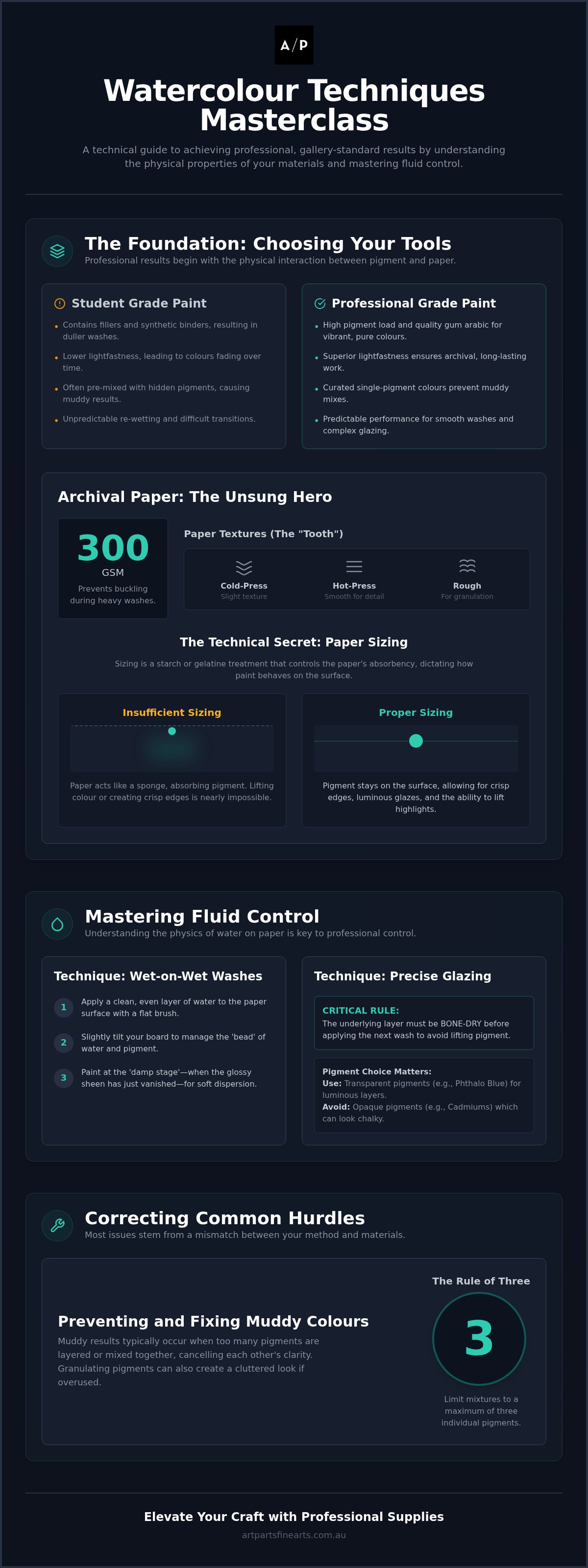
Professional results in a watercolour techniques masterclass depend on the physical interaction between pigment and paper. Student-grade paints often contain fillers and synthetic binders that result in duller washes. Professional brands, such as Daniel Smith watercolours, use high pigment loads and quality gum arabic. This ensures your colours remain vibrant after drying and offer superior lightfastness, which is the rating of how well a pigment resists fading when exposed to light.
Professional Pigments vs Student Grade
High-quality paints provide predictable re-wetting and smoother transitions. While student paints are affordable, they often lack the technical specifications required for complex glazing. A curated palette of single-pigment colours prevents muddy results because you aren't fighting against the hidden secondary pigments found in cheaper, pre-mixed sets. Selecting brushes with a good balance of water retention and "spring" allows you to move these professional pigments with precision.
The Importance of High-GSM Archival Paper
Professional artists generally use 300gsm (grams per square metre) paper to prevent buckling during heavy washes. At Art Parts, we recommend Arches or Hahnemühle paper because these brands handle heavy wet-on-wet work without the surface fibres breaking down. Choosing the right texture is equally vital. Cold-press has a slight "tooth" or texture, hot-press is smooth for detail, and rough paper is ideal for granulating effects.
The technical secret to professional control lies in sizing. Sizing is a starch or gelatine treatment applied during manufacturing to control absorbency. Internal sizing is mixed into the pulp, while external sizing is applied to the surface. This treatment dictates how the paint sits. If sizing is insufficient, the paper acts like a sponge, making it impossible to lift pigment or reclaim highlights. High-quality archival paper ensures the pigment stays on the surface, allowing for crisp edges and luminous glazes.
Mastering Fluid Control: Wet-on-Wet and Glazing Methods
Fluid control is the most challenging aspect of any watercolour techniques masterclass. It requires a deep understanding of how water interacts with the sizing of your paper. If the surface is too wet, pigment travels uncontrollably; if it's too dry, you'll see hard, unwanted edges. Successful painters learn to read the sheen of the water to predict how the paint will behave.
Achieving Perfect Washes with Wet-on-Wet
To prepare your surface, apply a clean, even layer of water with a flat brush. Tilt your board slightly to manage the bead, which is the reservoir of water and pigment that gathers at the bottom of a wash. The damp stage of paper is when the glossy sheen has just vanished but the surface still feels cool, providing the perfect window for soft pigment dispersion without creating back-runs or cauliflowers.
Building Depth Through Precise Glazing
Glazing involves layering transparent washes to build luminosity and complex colours. It's critical that the underlying layer is bone-dry before you apply the next. If you work over a damp layer, you risk lifting the previous work and creating muddy patches. Transparent pigments, such as Phthalo Blue or Quinacridone Gold, are better for glazing than opaque cadmiums, which can look chalky when layered.
Using flow improvers can help maintain even washes during long painting sessions. While this masterclass focuses on paper, the technical discipline of fluid control is a transferable skill for those who also enjoy painting with acrylics on stretched canvas. Mastering these transitions ensures your work has the depth and professional finish required for gallery standards.
Correcting Common Technical Hurdles in Watercolour
Technical setbacks are a natural part of the learning process, but they don't have to ruin a piece. This watercolour techniques masterclass focuses on identifying the physical causes of common errors so you can correct them in real-time. Whether you're dealing with dull washes or warped paper, most issues stem from a mismatch between your method and your materials.
Preventing and Fixing Muddy Colours
Muddy colours usually occur when too many pigments are layered or mixed together. A good rule is to limit your mixtures to no more than three individual pigments to maintain clarity. Granulating pigments, which have heavier particles that settle into the paper's texture, can also create a cluttered look if overused. Using professional paper like Arches allows you to lift pigment more effectively because the surface sizing, which is the starch treatment that controls absorbency, keeps the colour from staining the fibres instantly.
Advanced Lifting and Masking Techniques
Reclaiming highlights is a vital skill. A thirsty brush, which is a clean brush that is damp but not dripping, can be used to soak up excess pigment while the wash is still wet. For dried areas, you can soften hard edges by gently agitating the paint with a small amount of clean water. Masking fluid is excellent for protecting fine white details, but many professionals prefer to leave white space naturally to keep the work looking fluid and unforced.
Managing paper buckling is essential for maintaining control over your washes. Heavy wet-on-wet work often causes paper to warp, creating pools where pigment collects unevenly. You can prevent this by using a pre-stretched block or by taping your paper to a board before you begin. Applying these watercolour techniques masterclass methods to your paper preparation ensures the surface remains flat, allowing the water to evaporate consistently across the entire page.
Elevating Your Craft with Creative Workshops and Professional Supplies
Transitioning from a hobbyist to a gallery-standard artist requires a combination of technical knowledge and the right environment. While self-study is valuable, a structured watercolour techniques masterclass provides the specific feedback necessary to refine your muscle memory. Learning in a dedicated space helps you focus on the subtle dialogue between your brush and the paper surface.
The Value of Hands-on Learning
Just as the blending of pigments requires precision, so too does the craft of boutique distilling. For those who appreciate artisanal quality beyond the easel, you can read more about the Sinestesia distillery and their unique Argentine spirits.
Observing a professional mentor in person offers insights that digital tutorials simply cannot replicate. You can see exactly how much water is loaded into a brush and the precise angle of the stroke. This immediate feedback helps you understand the "feel" of the medium, especially when managing water-to-pigment ratios. Our creative workshops in Albury offer this supportive environment, allowing you to learn from painters who understand the nuances of pigment behaviour and timing.
Curating a Professional Artist Palette
These technical nuances are what allow artists to successfully apply their work to other high-quality mediums. For an example of how fine art translates into luxury fashion, visit Amaatra Creations and discover their collection of wearable silk art.
A professional setup often moves away from pre-filled pans toward high-quality tubes. This allows you to mix larger volumes of paint and maintain the moisture levels required for smooth, consistent washes. A balanced palette should include a warm and cool version of each primary colour. For example, having both a warm Hansa Yellow Deep and a cool Lemon Yellow gives you greater control over the temperature and clarity of your secondary mixes.
We recommend exploring professional ranges like Daniel Smith and Sennelier watercolour paint. These brands offer the high pigment load and lightfastness needed for archival work intended for sale. When setting up your dedicated studio space, ensure you have a consistent light source and enough room to keep your clean water jars separate from your mixing area. This organised approach ensures your technical growth remains steady and your materials remain uncontaminated.
Advancing Your Artistic Journey with Professional Techniques
Mastering the delicate balance of water and pigment is a lifelong pursuit, but it's made significantly easier when you work with materials that respond predictably. By choosing archival 300gsm paper and professional-grade pigments, you eliminate the technical frustrations that often hold back student-level work. Luminosity comes from careful glazing and a deep respect for the physical properties of your tools.
Art Parts Fine Arts is independently owned by local artists who understand the creative process. As stockists of premium brands like Daniel Smith and Arches, we ensure you have access to the same materials used by professionals worldwide. Our staff are practising painters who provide expert advice based on real experience at the easel. Whether you are refining your skills through a watercolour techniques masterclass or setting up a dedicated studio, we are here to support your long-term growth.
We look forward to seeing how these professional methods transform your practice and bring new depth to your paintings.
Frequently Asked Questions
What is the difference between student and professional watercolour paint?
Professional watercolour paints contain a much higher concentration of finely ground pigment and fewer synthetic fillers than student-grade versions. This higher pigment load ensures that colours remain vibrant and luminous even after they have dried. Professional ranges also use superior binders, such as high-quality gum arabic, which provide more predictable re-wetting and smoother transitions during complex glazing or layering techniques.
Why does my watercolour paper buckle and how can I stop it?
Paper buckles because the water causes the cotton or cellulose fibres to expand at different rates across the surface. You can prevent this by pre-stretching your paper or by using a watercolour block, which is a pad glued on all four sides to keep the sheet under tension. Heavier paper also resists warping more effectively than thin student sheets during heavy wet-on-wet applications.
Is 300gsm paper necessary for professional watercolour techniques?
Yes, 300gsm is the professional standard because it provides the structural integrity needed to handle multiple washes without the surface fibres breaking down. Lighter papers often warp or pill when you attempt advanced lifting or scrubbing. Using 300gsm Arches or Hahnemühle paper during a watercolour techniques masterclass ensures the surface remains stable, allowing for the precise timing required for professional-grade results.
How do I avoid creating muddy colours in my washes?
Muddy colours are typically caused by mixing too many individual pigments or by agitating a layer that is still damp. To maintain colour clarity, limit your mixtures to three pigments and use single-pigment professional paints whenever possible. It's also vital to let your underlying layers dry completely before glazing over them, as this prevents the new moisture from disturbing the pigment already settled on the paper.
What brushes are best for a watercolour masterclass?
The best brushes for advanced work are those that offer a balance of high water retention and a reliable "spring" to maintain their point. Natural sable or high-quality synthetic blends are preferred because they allow for consistent pigment release. You'll generally need a large flat brush for broad washes and a selection of round brushes in various sizes to handle both structural shapes and fine details.

Article by
Art Parts Fine Arts
Art Parts Fine Arts is an Australian art-supplies store based in Albury, shipping Australia-wide. Hand-picked by artists, our range covers paints, canvas, brushes, paper, printmaking and more, for everyone from students to professionals. We share practical guides and tips to help you get the most out of your materials.
Disclaimer
This article is general information to help you choose and use art materials. It is not professional, health or safety advice. Always follow the manufacturer's instructions and safety guidance for any product, and take care when using solvents, varnishes and other materials. Product availability, specifications and pricing may change, so please check the current product page for details.