

PanPastel Colours Australia: Guide for Portrait Artists
Most portrait artists assume that achieving a painterly finish requires wet media, but the right dry pigment actually offers more control over delicate skin transitions. If you've struggled with the excessive dust of tra…Most portrait artists assume that achieving a painterly finish requires wet media, but the right dry pigment actually offers more control over delicate skin transitions. If you've struggled with the excessive dust of traditional sticks or the frustration of a broken pastel wasting expensive pigment, you're not alone. Many creators find the heavy cleanup of a small home studio difficult to manage, especially when trying to capture the subtle value shifts required for realistic features. Using panpastel colours australia allows you to apply professional grade pigment like a paint, giving you the ability to blend smooth transitions that traditional sticks simply cannot match.
This guide provides a practical look at mastering this unique medium for your portrait work. You'll learn how to select the right starter sets for diverse skin tones and how to use specialised applicators to reduce waste. We'll also cover the technical aspects of archival quality and how to work with the natural tooth, which is the surface texture of your paper, to build lightfast layers. By the end of this article, you'll have the confidence to create professional portraits with a clean, efficient studio setup.
Key Takeaways
- Learn why the unique cake format of PanPastel colours Australia reduces studio dust while providing the high pigment concentration needed for professional portraiture.
- Master the technique of mixing skin tones on a palette to create the smooth, painterly transitions often difficult to achieve with traditional pastel sticks.
- Evaluate which starter set best fits your needs, ranging from the comprehensive 20-colour Portrait Set to smaller, budget-friendly options for beginners.
- Discover how to use PanPastels in mixed media work, including the use of isopropyl alcohol washes to create permanent, archival underpaintings.
Understanding PanPastel Colours in the Australian Studio
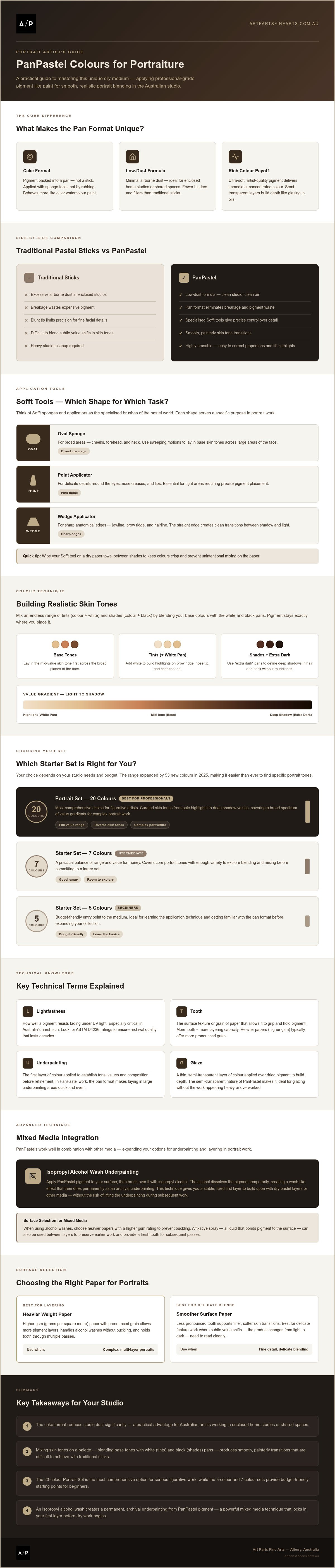
PanPastels represent a shift in how artists interact with pigment. Unlike traditional sticks, these are ultra-soft, artist-quality colours packed into a unique cake-like format. This design allows for a dry painting approach where you apply pigment using specialised sponges, such as Sofft tools, rather than a stick. Because they contain minimal binders and fillers compared to traditional sticks, the colour payoff is incredibly rich and immediate.
For artists working in Australia, the low-dust formula is a significant practical advantage. Many of us work in enclosed home studios or shared spaces where airborne dust is a concern. Using panpastel colours australia ensures your workspace stays cleaner while you focus on the creative process. For a broader overview of the pastel medium, it's helpful to see how these pans fit into the wider history of dry media.
The Importance of Lightfastness and Archival Quality
Lightfastness refers to how well a pigment resists fading when exposed to UV light. Since the Australian sun is notoriously harsh, choosing professional-grade pigments is vital for portraiture. PanPastel colours are formulated to meet high archival standards, ensuring your work remains vibrant for decades. We recommend checking individual pan ratings to ensure they meet ASTM D4236 standards for long-term stability.
How Surface Tooth Affects Application
The term tooth describes the texture or grain of a surface that allows it to hold onto the pigment. You might also use a fixative, which is a liquid spray used to bond pigment to the surface to prevent smudging. When selecting professional paper, consider the weight, often measured in gsm (grams per square metre), and the texture. Heavier papers with a pronounced grain allow for more layering, while smoother surfaces are better for delicate blends.
Why the PanPastel Format Excels for Portraiture and Blending
Portraiture requires a level of nuance that's often hard to reach with the blunt end of a pastel stick. The pan format changes this by allowing you to lift and apply large areas of pigment for the initial underpainting, which is the first layer of colour. When working with panpastel colours australia, you'll notice the pigment stays exactly where you put it, which is essential for detailed figurative work. It's much closer to the experience of oil painting, as you can mix colours directly on a palette or the pan surface before they ever touch your paper.
Because the pigment is semi-transparent, it's ideal for building realistic glazes, or thin layers of colour. You can use a specific layering technique for portraits to create depth without the work looking heavy or overworked. If you find a feature is slightly out of place, the medium is highly erasable, making it simple to correct facial proportions or lift out highlights.
Mastering Soft Transitions with Sofft Tools
Think of Sofft sponges and applicators as the specialised brushes of the pastel world. Different shapes serve specific purposes; use the oval sponge for broad areas like cheeks, the point for delicate details around the eyes, and the wedge for sharp anatomical edges. To keep your colours crisp, simply wipe the tool on a dry paper towel between shades.
Achieving Realistic Skin Tones
You can mix an endless range of tints, which are colours mixed with white, and shades, which are colours mixed with black, by blending your base colours with the white and black pans. Using "extra dark" shades allows you to define deep shadows in the hair or neck without the muddiness often found in traditional sticks. If you're moving from small studies to larger works, we have a great range of bulk stretched canvas options for your studio.
Selecting Your PanPastel Starter Set for Portraits
Choosing your first set of panpastel colours australia depends on your specific studio needs and budget. The 20-colour Portrait Set is the most comprehensive choice for figurative artists. It includes a curated range of skin tones, from pale highlights to deep shadow values, allowing you to capture realistic light and form. This set is particularly useful because it covers a broad spectrum of value gradients, which are the gradual shifts from light to dark within a single colour. The recent expansion of the range by 53 new colours in 2025 has made it even easier to find specific tones for complex portrait work.
For those just beginning, the smaller 5-colour or 7-colour starter sets provide a practical entry point. Even if you prefer to build a custom palette, two individual pans are essential for every portrait kit: Titanium White and Burnt Sienna. Titanium White is vital for lifting highlights and creating soft tints. Burnt Sienna acts as a versatile base for warm skin tones and underpaintings. To handle fine details that sponges might miss, many artists pair their pans with pencils from our professional drawing collection.
Browse our professional PanPastel sets
Essential Accessories for Your First Set
Organising your pans in palette trays is the best way to protect your investment and keep your workspace tidy. These trays allow you to stack and store your colours securely while keeping them accessible during a painting session. Once your portrait is complete, a high-quality fixative spray is necessary to seal the pigment. A fixative is a liquid spray used to bond pigment to the surface to prevent smudging or lifting. Selecting artist-grade accessories ensures your tools last longer and your finished work maintains its archival quality over time.
Advanced Techniques and Mixed Media Integration
PanPastels offer versatility that extends far beyond traditional drawing. Many artists use panpastel colours australia as a soft base layer for charcoal or coloured pencil drawings. This technique allows you to cover large areas of the paper's tooth quickly, providing a mid-tone foundation that makes subsequent detail work much faster. For a more permanent result, try the "wash" technique. By applying 70% isopropyl alcohol over your pastel layer with a brush, you create a permanent underpainting that won't smudge when you work over the top.
This medium also pairs exceptionally well with wet media. You can apply these pastels over dried Matisse acrylics to add soft, atmospheric transitions or to knock back high-contrast areas. For sharp edge control in contemporary portraiture, try using stencils or low-tack masking tape to create crisp boundaries that are typically difficult to achieve with dry pigment.
Underpainting for Oil and Acrylic Portraits
A dry pastel underpainting is a practical way to map out your values before you commit to wet paint. Because the pigment is so fine, it won't interfere with the adhesion of subsequent layers. You can even use panpastel colours australia over oil-primed surfaces once they are dry to the touch, allowing you to refine your composition without the wait times associated with traditional oil glazes.
Continuous Learning Through Workshops
Mastering these advanced techniques often benefits from hands-on guidance. Our creative workshops are designed to accelerate your learning curve by providing expert feedback in a supportive environment. These sessions explore a variety of figurative and landscape techniques, helping you integrate new tools into your existing practice with confidence.
Master Your Portrait Technique
Integrating this medium into your studio practice offers a unique balance between the control of drawing and the fluidity of painting. By using the specialised pan format, you can achieve the subtle value shifts necessary for realistic skin tones while keeping your workspace clean. Whether you're starting with a small selection of individual pans or the comprehensive portrait set, these professional-grade pigments provide the archival quality your work deserves. Finding the right panpastel colours australia for your studio allows you to explore advanced mixed media layering with confidence.
Our team of practising artists at Art Parts Fine Arts is here to help you select the right tools for your specific creative journey. We offer national shipping across Australia, ensuring you have access to high-quality materials no matter where your studio is located. Refining your skills through experimentation or hands-on workshops will help you practise these painterly transitions.
We look forward to seeing how these versatile tools help you reach new levels of realism in your figurative work.
Frequently Asked Questions
How do I stop PanPastels from smudging?
Applying a high-quality fixative spray is the most effective way to prevent smudging. A fixative is a liquid spray used to bond the pigment to your paper surface. You can apply light coats between layers to lock the colour in place, which allows for further detail work without disturbing the underpainting. This is especially helpful for portrait artists who need to maintain crisp edges throughout their creative process.
Can I use PanPastel with traditional soft pastel sticks?
You can certainly use PanPastels alongside traditional soft pastel sticks as they are made from the same professional pigments. Many artists use panpastel colours australia for large underpaintings and soft transitions, then switch to sticks for final sharp highlights or textured details. This mixed media approach provides the speed of dry painting with the tactile control of traditional sticks, ensuring your work has depth and variety.
Do I need special paper for PanPastel portraiture?
While you don't need a specific brand, you do need paper with enough tooth to hold the pigment. Tooth is the texture or grain of the surface that grips the pastel. For professional portraiture, we recommend using heavyweight archival papers like Arches or Hahnemühle. These surfaces allow for multiple layers of pigment without the surface becoming clogged, which is vital for building realistic skin tones and textures.
How long does a single PanPastel pan last?
A single pan lasts significantly longer than a traditional pastel stick because of its high pigment concentration and minimal binders. On average, a round pan contains about 40% more product than a standard pastel stick. Depending on your application style and the size of your portraits, a single pan can often cover the same surface area as four or five sticks, making them a cost-effective choice for professionals.
Are PanPastels suitable for beginners in Australia?
PanPastels are an excellent choice for beginners because the sponge application feels more intuitive than drawing with a stick. The ability to blend skin tones on a palette before applying them to paper reduces the fear of making permanent mistakes. For those starting their journey with panpastel colours australia, the low-dust formula makes it much easier to practise in a home studio or shared creative space without heavy cleanup.
Article by
Art Parts Fine Arts
Art Parts Fine Arts is an Australian art-supplies store based in Albury, shipping Australia-wide. Hand-picked by artists, our range covers paints, canvas, brushes, paper, printmaking and more, for everyone from students to professionals. We share practical guides and tips to help you get the most out of your materials.
Disclaimer
This article is general information to help you choose and use art materials. It is not professional, health or safety advice. Always follow the manufacturer's instructions and safety guidance for any product, and take care when using solvents, varnishes and other materials. Product availability, specifications and pricing may change, so please check the current product page for details.