

Water-Based Printmaking Ink: A Guide to Professional Relief and Intaglio Results
Professional printmaking no longer requires a studio filled with solvent fumes to achieve deep, archival blacks or crisp fine lines. Many artists hesitate to switch to a water based printmaking ink because they've strugg…Professional printmaking no longer requires a studio filled with solvent fumes to achieve deep, archival blacks or crisp fine lines. Many artists hesitate to switch to a water based printmaking ink because they've struggled with poor colour saturation or the medium drying on the block too quickly. It's frustrating when a complex relief carving is ruined because the ink skins over before it even touches the paper.
You don't have to compromise on quality to enjoy the benefits of a water-based workflow. This guide explains how to select high-performance inks that offer extended open time and rich, lightfast results without the need for harsh chemicals. We're here to help you find professional tools that provide the same reliability and depth as traditional oils.
We will cover the best professional-grade options for both relief and intaglio work, including how to prevent beading on plates and ensure easy clean-up with soap and water. You'll learn the practical techniques our staff use in their own studios to achieve consistent, gallery-standard prints every time.
Key Takeaways
- Understand the technical differences between acrylic-based evaporation drying and water-washable oil inks to select the best medium for your specific studio environment.
- Learn how professional water based printmaking ink brands provide high pigment saturation and extended open times, allowing you to work on detailed blocks without the ink drying prematurely.
- Identify the specific ink viscosities required for successful relief printing on lino compared to the wiping techniques needed for intaglio and etching plates.
- Master efficient studio maintenance using water and mild soap to protect your rollers and ensure your finished prints meet professional archival standards.
Defining Water-Based and Water-Washable Printmaking Inks
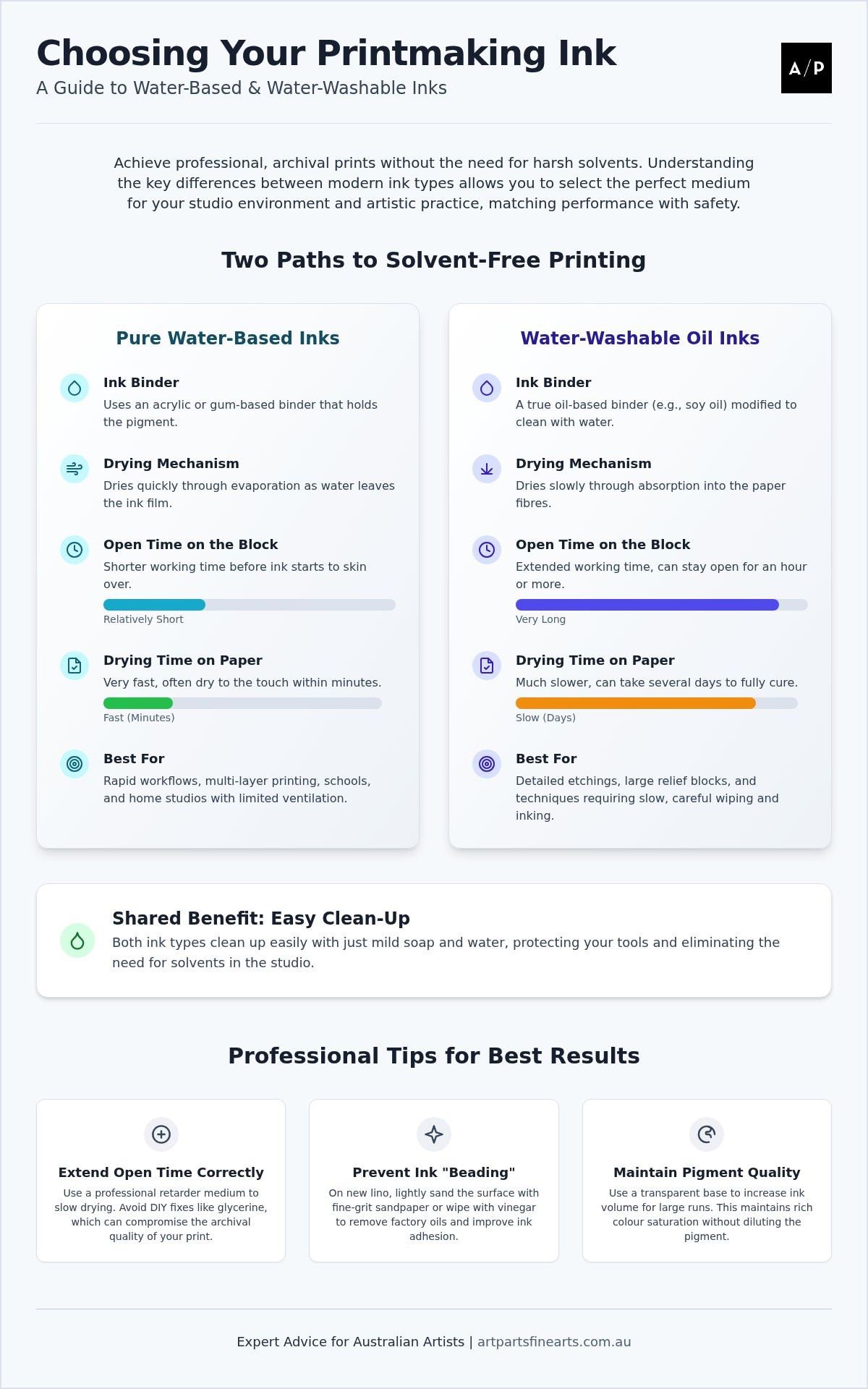
Choosing the right medium starts with understanding the chemistry on your palette. While many products are marketed as easy to clean, there's a significant difference between a pure water based printmaking ink and a water-washable oil ink. Pure water-based options typically use an acrylic or gum-based binder. These dry through evaporation, which means they have a shorter "open time" on your carving block before the ink starts to set.
Water-washable oil inks, often called "Safe Wash" or soy-based inks like Akua, are true oil pigments modified to emulsify with soap and water. Unlike acrylic versions, these don't dry by evaporation but rather by absorption into the paper. This distinction is vital for managing your workflow, especially when applying complex printmaking techniques that require more time to ink the plate. Our staff are practicing artists who understand the importance of viscosity, so we prioritise professional-grade ranges that maintain high pigment saturation even when thinned with transparent base.
When to choose pure water-based media
Pure water-based inks are ideal for rapid workflows where you need to print multiple layers in a single session. Because they dry quickly, you can often overprint a second colour within minutes. They are a practical choice for home studios or shared school spaces where ventilation is limited. High-quality water-based binders are formulated to be lightfast and permanent once dry, ensuring your work remains archival for decades without yellowing or cracking.
The "Safe Wash" alternative for traditionalists
If you prefer the buttery feel and long working time of traditional oil inks, water-washable oils are the better fit. These allow you to spend an hour or more inking a large relief block without the medium skinning over on the slab. Just be aware that the final print will require a longer drying time, often several days, compared to the near-instant drying of pure water-based options. This makes them perfect for detailed etchings that require a slow, careful wiping process.
Evaluating Performance: Drying Times and Pigment Quality
Professional-grade water based printmaking ink from brands like Derivan and Akua is formulated with high pigment loads to ensure intense colour saturation. Unlike student-grade alternatives, these inks don't rely on fillers that can dull the final print. A critical factor for any printer is "open time," which is the duration the ink remains tacky on the slab or block before it begins to skin over. In the Australian climate, particularly during dry summer months, this window can close rapidly. While some online forums suggest adding household items like honey or glycerine to slow drying, these DIY fixes often compromise the archival quality of your work. We recommend using professional retarders specifically designed to extend working time without weakening the ink's binder.
Managing ink tack and viscosity
Maintaining the right consistency is essential for clean results. Using a professional water based printmaking ink alongside a transparent base allows you to increase the volume of your medium for large runs without sacrificing depth. This is particularly useful for complex, multi-colour linocuts where you need the ink to stay open while you register multiple blocks. If you're working on a large scale, perhaps printing onto fabric or bulk canvas options, ensuring you have enough supplies on hand helps keep the workflow steady.
Avoiding the "beading" effect on non-porous plates
Beading occurs when ink fails to grip the surface of a block, often seen on new lino or silk. Cheap inks often lack the necessary surfactants to overcome the surface tension of non-porous materials. To prevent this, lightly sand new lino with fine-grit sandpaper or wipe it with a dash of vinegar to remove any factory oils. This increases the "tooth," or surface texture (the slight roughness that helps the medium adhere), allowing the ink to lay down in a smooth, even film rather than gathering in droplets.
Choosing Inks for Relief, Lino and Etching Techniques
Different techniques demand specific physical properties from your medium. Relief printing, such as lino or woodblock, requires a stiffer water based printmaking ink that sits on the surface of the block without bleeding into the carved channels. If the ink is too fluid, it will fill the fine lines of your design and result in a muddy print. Intaglio and etching, however, need an ink that can be wiped cleanly from the surface while staying deep in the etched grooves.
Akua Liquid Pigment is a versatile option for these varied methods because you can modify its body with a thickening agent for relief work or use it as-is for monotypes. For more specific application tips on achieving professional results at home, refer to our Printmaking Without a Press guide. Our staff often use these modifiers to bridge the gap between different technical requirements in the studio.
Lino and woodblock considerations
Selecting high-tack inks is essential for maintaining crisp edges in detailed relief work. These mediums must resist spreading under the pressure of a press or baren (a hand tool used to burnish the paper). We suggest using a glass slab for rolling out your water based printmaking ink to monitor the "orange peel" texture. This visual cue helps you ensure the ink film is thin enough to avoid flooding the block's recessed areas.
Water-based etching and monotype
Achieving a clean "wiped" look in water-based etching is possible with professional ranges that hold fast in cross-hatched lines. You can achieve monotype painterly effects by using transparent bases to adjust flow and transparency. This flexibility allows you to layer colours without the greasy residue often associated with traditional oils. It's a much more responsive way to work for artists who value a clean studio environment and archival results.
Best Practices for Studio Clean-up and Ink Maintenance
Cleaning your equipment immediately after a session is the best way to maintain your tools. Once the acrylic binder in a water based printmaking ink dries, it becomes water-resistant and much harder to remove from the fine details of a lino block or the surface of a roller. For pigments that tend to stain, such as Phthalo Blue, a mild vegetable-based soap is often more effective than water alone. Using professional printmaking accessories like high-quality rollers ensures you can lift pigment without damaging the rubber surface.
Store your jars in a cool, dry place to prevent the binder from separating. If you notice a layer of liquid on top, a quick stir with a palette knife will usually restore the buttery consistency needed for an even roll-out. Maintaining your ink in this way prevents it from skinning over, ensuring you get the best value from every container. Proper storage is particularly important in the variable Australian climate to ensure the longevity of your materials.
Paper selection for water-based inks
Because water-based media introduce moisture to the sheet, selecting a heavier paper of at least 250gsm helps prevent warping as the print dries. You should also consider the sizing of the paper. Sizing is a treatment applied during manufacturing to control how the paper absorbs liquid. Sized paper keeps the pigment on the surface for a more vibrant finish, while unsized paper allows the medium to sink into the fibres for a softer look. You can find a variety of archival options in our professional paper collection.
Mastering the technique in person
Refining your process often involves troubleshooting specific studio challenges in real-time. If you're finding it difficult to manage drying times or want to explore more complex layering beyond what we've discussed, our artist-led staff can provide practical guidance. We encourage you to join one of our creative workshops to practise these technical applications in a supportive, hands-on environment.
Elevating Your Studio Practice with Professional Inks
Transitioning to a modern, solvent-free studio doesn't mean sacrificing the rich saturation or fine detail you've worked hard to master. By choosing a high-quality water based printmaking ink, you gain the ability to work with professional archival standards while enjoying a significantly safer clean-up process. Understanding the chemistry of your medium, from evaporation-based acrylics to water-washable oils, helps you manage open time and viscosity with confidence.
At Art Parts Fine Arts, we pride ourselves on being an Australian-owned, artist-led team. We curate our range to support professional studios with reliable, high-performance materials. Whether you're carving intricate lino blocks or wiping delicate etching plates, the right modifiers and paper choices will ensure your prints remain durable and vibrant for years to come.
Our team is ready to help you troubleshoot your technique or find the perfect tool for your next project. We look forward to seeing your results and offer national shipping across Australia to get these supplies directly to your door.
Frequently Asked Questions
Do water-based printmaking inks dry lighter than oil-based inks?
Professional water-based inks often experience a slight colour shift as the liquid evaporates during the drying process. While student-grade options may appear significantly lighter, high-quality ranges like Derivan use concentrated pigments to maintain their depth. We recommend performing a test print on your chosen paper to observe the final hue. This allows you to adjust your ink transparency before committing to a full edition of your work.
Can I mix different brands of water-based printmaking ink?
It is generally safe to mix different brands of water based printmaking ink if they share an acrylic or gum-based binder. However, you should avoid mixing these with water-washable oil inks like Akua. Because the chemistries differ, the mediums won't blend into a smooth film. This can result in uneven drying or poor adhesion, potentially ruining your print and making your rollers difficult to clean properly.
How do I stop my water-based ink from drying on the lino block?
The most effective way to prevent premature drying is by adding a professional retarder to your medium. This slows the evaporation rate without weakening the binder's strength. You should also work away from direct heat sources and keep your ink slab in a shaded part of the studio. Using a glass slab helps maintain a consistent temperature, which provides a longer working window for inking complex relief blocks.
What is the best way to clean my rollers after using water-based ink?
Clean your rollers with lukewarm water and a small amount of mild soap as soon as you finish printing. If the pigment is stubborn, a soft cloth or sponge will help lift the ink without scratching the rubber surface. It's essential to dry the rollers completely and store them so the rubber doesn't touch any surface. This prevents flat spots and ensures your equipment remains in professional condition for years.
Are water-based inks as permanent and lightfast as oil inks?
Yes, professional water-based ranges are formulated to meet the same archival standards as traditional oil inks. Lightfastness is determined by the quality of the pigment itself rather than the binder. When using a professional water based printmaking ink, you can expect excellent durability and resistance to fading. Always look for the lightfastness rating on the packaging to ensure the specific colours you select are suitable for long-term gallery display.

Article by
Art Parts Fine Arts
Art Parts Fine Arts is an Australian art-supplies store based in Albury, shipping Australia-wide. Hand-picked by artists, our range covers paints, canvas, brushes, paper, printmaking and more, for everyone from students to professionals. We share practical guides and tips to help you get the most out of your materials.
Disclaimer
This article is general information to help you choose and use art materials. It is not professional, health or safety advice. Always follow the manufacturer's instructions and safety guidance for any product, and take care when using solvents, varnishes and other materials. Product availability, specifications and pricing may change, so please check the current product page for details.