

Canvas Panels vs Stretched Canvas: Which is Right for You?
Choosing the most expensive surface doesn't always lead to the best result for your specific project. While a gallery-wrapped frame looks professional on a wall, it might not be the most stable choice for a thick, palett…Choosing the most expensive surface doesn't always lead to the best result for your specific project. While a gallery-wrapped frame looks professional on a wall, it might not be the most stable choice for a thick, palette-knife application that requires a rigid foundation. It's a common dilemma when weighing up canvas panels vs stretched canvas, especially when you're trying to balance archival quality with practical storage needs in a busy studio.
We know how frustrating it is to see a finished work lose its tension or develop fine cracks because the surface couldn't handle the weight of the paint or the local humidity. This guide explains the technical differences between these two supports so you can choose the right one for your style, whether you're using Matisse Structure acrylics or Langridge oils. We'll compare the structural benefits of kiln-dried pine bars against the rigid stability of boards. You will also find practical advice on which options are easiest to store and ship, ensuring your work stays in gallery condition from the moment the gesso dries until it reaches its new home.
Key Takeaways
- Define the structural differences between fabric tensioned over kiln-dried pine or hardwood bars and canvas mounted to rigid high-density board cores.
- Identify why the rigid surface of a panel is often better for heavy impasto and palette knife techniques than the flexible "bounce" of a stretched frame.
- Compare material weights from 380gsm cotton to 500gsm professional linen to select a support that meets your requirements for archival durability.
- Evaluate the practical benefits of canvas panels vs stretched canvas when it comes to saving storage space in a home studio and reducing shipping risks across Australia.
- Learn how to access consistent quality and bulk savings through full carton orders for schools, art centres, and high-volume professional artists.
Understanding the fundamental differences between canvas panels and stretched canvas
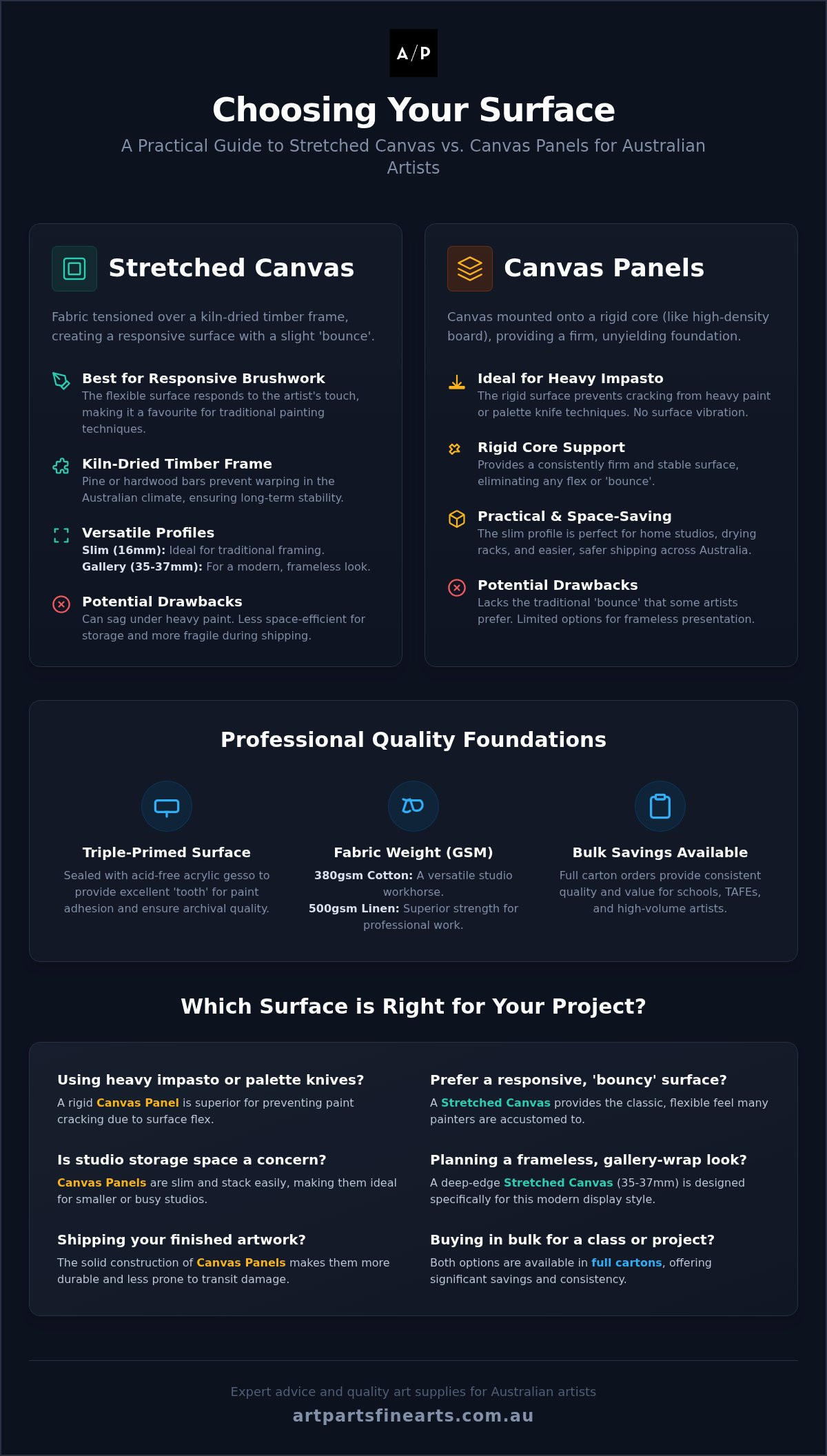
Artists often choose a support based on habit, but the mechanical differences between canvas panels vs stretched canvas significantly impact how paint behaves over time. A stretched canvas consists of fabric, usually cotton or linen, tensioned over a wooden frame known as stretcher bars. This creates a drum-like surface with a slight "bounce" that many find responsive under the brush. In contrast, a canvas panel is created by mounting canvas onto a rigid core, such as high-density MDF or board, providing a firm, unyielding foundation.
The "tooth" of the support refers to the texture or grain of the canvas weave. This texture determines how well the surface grabs paint from the brush and holds it in place. While both supports can use the same fabric, the tension of a stretched canvas can make the tooth feel more prominent, whereas the solid backing of a panel provides a more consistent physical resistance. Selecting archival materials is essential for professional results to ensure the bond between the fabric and the core remains stable for decades. For a deeper look at the construction and history of these supports, you can explore Canvas on Wikipedia.
The anatomy of a professional stretched canvas
High-quality stretched canvases, such as the CreateART and Wright & Co ranges, use kiln-dried pine or hardwood bars. This drying process is vital because it removes moisture from the timber, which prevents the frame from warping or twisting in the Australian climate. You can select profiles based on your intended presentation:
- Slim 16mm profiles are a practical choice if you plan to place the finished work in a traditional frame.
- Gallery-depth profiles of 35mm to 37mm allow the painting to continue around the edges for a modern, frameless look.
Paint adhesion is another critical factor. Professional canvases are triple-primed with acrylic gesso, a primer that seals the fabric fibres and provides a "ground" or surface for the paint to grip effectively. This prevents the oil or acrylic binders from soaking into the raw fabric, which can cause the material to rot over time.
How canvas panels provide a rigid alternative
Canvas panels offer a slim, space-saving profile that is particularly useful for artists working in smaller home studios. Beyond portability, the primary benefit of a rigid support is the lack of surface vibration. Stretched canvas can move or sag under heavy pressure, but a panel remains perfectly still. This rigidity helps prevent the mechanical stress that can lead to paint cracking, especially when applying thick layers of Matisse Structure acrylics.
There is a common misconception that panels are only for students or practice. Professional-quality boards are a reliable choice for finished commissions because they are easy to store in drying racks and simpler to pack for shipping. For those producing a high volume of work, buying full carton canvas in panel form provides a consistent, archival surface that is both durable and easy to manage.
Performance factors: Texture, weight, and archival quality
The durability of your work often comes down to the weight of the fabric used. In the world of canvas panels vs stretched canvas, weight is measured in GSM, or grams per square metre. This figure tells you how dense the weave is and how much paint it can support before the surface begins to distort. Artists often spend years choosing the best support for their specific medium, and understanding weight is the first step toward archival success.
Archival quality is also determined by the ground, or the initial layers of primer applied to the fabric. We recommend using acid-free acrylic gesso to ensure the paint film doesn't become brittle or discoloured over time. This primer acts as a protective barrier between the fabric fibres and the binders in your paint, which is vital for the long-term preservation of your work.
GSM and priming: The foundation of your work
A 380gsm cotton canvas is the versatile workhorse of the studio. It provides enough strength for most acrylic and oil techniques without being overly heavy. For professional commissions or high-value projects, moving up to a 500gsm professional linen offers a tighter weave and superior structural integrity. These heavier weights are less prone to sagging under the weight of thick paint layers.
Every canvas we stock is triple-primed with acrylic gesso. This reduces the absorbency of the fabric, so your paint sits on the surface rather than sinking in and looking dull. For those working with high-contrast compositions, black-primed canvas is an excellent alternative that allows colours to pop against a dark foundation. If you are working through a large series, you can find consistent quality in our full carton canvas range.
Climate considerations for Australian studios
The Australian climate presents unique challenges for stretched supports. Rapid changes in humidity can cause the cotton fibres to expand or contract, leading to a surface that sags in the morning and tightens by the afternoon. This constant movement can put stress on the paint film. Hardwood bars, like those found in the Wright & Co range, offer much better resistance to these environmental shifts than standard pine.
If you find your stretched canvas has become slightly loose, you can use corner keys to fix the issue. These are small wooden wedges that you tap into the slots on the inside corners of the stretcher bars. This gently pushes the bars apart and restores the tension of the fabric. Canvas panels are generally immune to these tension issues because the fabric is glued to a rigid core, making them a reliable choice for artists in more tropical or coastal regions.
Matching your support to your painting technique
The physical feedback you receive from your surface can alter the final look of your brushwork. Every artist develops a preference for how much "give" they want when pressing a brush or palette knife against the canvas. The decision regarding canvas panels vs stretched canvas is often a technical one based on the specific requirements of your chosen medium and the environment where you work.
Framing requirements also differ between these two supports. A gallery-wrapped stretched canvas with a 35mm profile can be hung immediately without a frame. A canvas panel is typically only 3mm to 5mm thick, meaning it requires a frame or a dedicated display mount to be presented professionally on a wall.
Why panels excel for detail and plein air
Precise brushwork requires a surface that doesn't move. Panels provide a rigid foundation that allows for fine lines and intricate details that might be difficult to achieve on a bouncy stretched surface. This stability is particularly helpful for those using Matisse Acrylic Paint Structure, as the firm board supports the weight of heavy body paints without sagging.
Plein air artists often prefer panels for their portability and weather resistance. A stretched canvas can act like a sail in the wind, making it difficult to control your marks while working outdoors. Panels are slim, easy to slot into a pochade box, and far less likely to be punctured during transport from the field back to your studio.
Stretched canvas for expressive impasto and large scale
The characteristic "bounce" of a stretched canvas is a benefit for artists who use expressive, gestural movements. This flexibility provides a rhythmic response to the brush that many painters find essential for their creative flow. While panels are great for smaller works, large-scale paintings are almost always stretched. A timber-framed canvas is significantly lighter than a solid MDF board of the same size, making it easier to move and hang.
For those who love heavy impasto, using a high-weight support is a necessity. Applying thick layers of paint with a palette knife creates physical weight that can cause lower-grade canvases to ripple. We recommend using a 500gsm linen or a heavy 380gsm cotton canvas on professional stretcher bars to ensure the surface remains taut under the pressure of your technique.
Practical considerations: Storage, shipping, and bulk buying
Deciding between canvas panels vs stretched canvas often involves looking at your long-term storage capacity and how you intend to get your work to collectors. While the aesthetic of a deep gallery-depth profile is appealing, the physical footprint of multiple stretched frames can quickly overwhelm a small studio. Selecting the right material is the first step. Cotton is a dependable all-rounder, while linen is the premium choice for professional commissions due to its archival strength. Poly-cotton blends offer a smoother finish for realism. Once you have chosen your material, you must consider how to house and transport the finished results.
Shipping and storing your finished artwork
Managing a home studio requires smart organisation. Stretched canvases take up significant volume, whereas panels can be stacked tightly in a drying rack or cupboard. If you are struggling with a crowded work area, choosing the Best Studio Easel for Small Spaces can help clear floor space for your inventory. When comparing canvas panels vs stretched canvas for logistics, panels are easier and cheaper to ship across Australia. They are less prone to being punctured and their slim profile reduces courier costs.
Follow this checklist to ensure your work arrives safely:
- Place a sheet of glassine paper over the painted surface to prevent sticking.
- Wrap the entire piece in at least two layers of bubble wrap.
- Use double-walled cardboard for external protection.
- Ensure the corners are reinforced with extra padding.
The value of full carton canvas for high-volume artists
For schools, art centres, TAFEs, and professional artists working on large series, buying full carton canvas is a practical choice. Purchasing in bulk ensures you have a consistent surface across every work in a collection, avoiding variations in tooth or priming between batches. It also provides significant savings, allowing you to focus your budget on premium paints and brushes.
Art Parts ships Australia-wide from our Albury warehouse, making it easy to get professional supplies like CreateART and Wright & Co canvases delivered directly to your door. Whether you need a single 380gsm cotton canvas or a bulk order for a classroom, we ensure your supports are packed carefully to survive the journey.
Selecting the best foundation for your next series
Finding the right balance between canvas panels vs stretched canvas comes down to your personal technique and studio environment. Stretched frames provide the responsive feedback many artists need for expressive work, while rigid panels offer the stability required for fine detail and heavy impasto. Both options are built to last when you choose triple-primed surfaces and kiln-dried supports that withstand the Australian climate.
Our team at Art Parts consists of local artists who understand the technical needs of your craft. We take pride in selecting professional ranges like CreateART and Wright & Co to ensure your work remains stable for years to come. Whether you're a student starting out or a professional artist ordering full cartons for a new series, we provide reliable tools and expert advice from our Albury warehouse. We ship Australia-wide and offer bulk savings for schools and high-volume creators who need consistent quality.
We're here to help you find the right tools for your creative journey. If you need assistance choosing the right GSM or profile depth for your next project, reach out to us or visit us in-store for a chat.
Frequently Asked Questions
Do canvas panels need to be framed before hanging?
Canvas panels generally require a frame or a dedicated display mount before they can be hung on a wall. Because they are typically only 3mm to 5mm thick, they don't have the depth or the internal structure to support a hanging wire or d-ring on their own. Framing provides a secure way to display the work and adds structural support to prevent the board from bowing over time.
Can I use oil paints on a canvas panel primed for acrylics?
You can safely use oil paints on any canvas panel that has been triple-primed with acrylic gesso. This type of primer is a universal ground designed to accept both acrylic and oil-based mediums. The gesso creates a non-porous barrier that prevents the oil binders from soaking into the core material. This seals the surface and ensures the longevity of your paint film by preventing the underlying support from rotting.
How do I tighten a stretched canvas that has gone saggy?
The most effective way to tighten a saggy stretched canvas is by using corner keys. These are small wooden wedges that you tap into the slots on the inside corners of the stretcher bars to gently push the joints apart. This increases the tension of the fabric across the frame. If the sagging is minor, you can also lightly mist the back of the canvas with clean water to help the cotton fibres contract as they dry.
Are canvas panels considered professional grade for galleries?
High-quality canvas panels are absolutely considered professional grade and are widely used for gallery-standard work. When choosing between canvas panels vs stretched canvas for professional commissions, the choice depends on your technique. Panels mounted on archival board provide a stable, rigid surface that is often preferred for detailed realism and heavy impasto. They are also much easier to ship and store, making them a practical choice for artists who produce a high volume of work for exhibitions.
What is the best way to store large stretched canvases in a humid climate?
Large stretched canvases should be stored vertically on a raised rack to keep them off the floor and ensure consistent airflow. In humid climates, avoid leaning canvases directly against one another, as trapped moisture can lead to mould growth or surface sticking. Using kiln-dried hardwood bars from ranges like Wright & Co provides extra stability against warping. If you have limited space, consider using canvas panels for larger works as they are less affected by environmental shifts.
Is linen canvas really worth the extra cost over cotton?
Linen is worth the extra cost for professional artists who require superior strength and archival durability. While 380gsm cotton canvas is a dependable all-rounder, linen features longer fibres and a more distinctive tooth that many painters find more responsive. Linen is also less prone to expanding and contracting with temperature changes. This makes it a more stable support for high-value commissions that need to maintain their tension and structural integrity for many decades.

Article by
Art Parts Fine Arts
Art Parts Fine Arts is an Australian art-supplies store based in Albury, shipping Australia-wide. Hand-picked by artists, our range covers paints, canvas, brushes, paper, printmaking and more, for everyone from students to professionals. We share practical guides and tips to help you get the most out of your materials.
Disclaimer
This article is general information to help you choose and use art materials. It is not professional, health or safety advice. Always follow the manufacturer's instructions and safety guidance for any product, and take care when using solvents, varnishes and other materials. Product availability, specifications and pricing may change, so please check the current product page for details.