

How to Use Cold Wax Medium for Oil Painting: A Studio Guide
Traditional oil painting is often a slow process of waiting, where you wait weeks for thick impasto layers to cure while struggling with a finish that's often too glossy for your vision. Many artists find that their pain…Traditional oil painting is often a slow process of waiting, where you wait weeks for thick impasto layers to cure while struggling with a finish that's often too glossy for your vision. Many artists find that their paint feels too slippery on the canvas; it's difficult to hold a crisp edge or create deep, sculptural marks without the fear of structural failure or cracking. Using cold wax medium for oil painting changes this dynamic by turning your paint into a thick, paste-like consistency that holds its shape and dries to a non-reflective matt finish.
In this studio guide, you'll learn how to master the technical essentials of this versatile medium to create rich textures and professional layers with confidence. We'll explore the correct mixing ratios for professional pigments like Langridge, why a rigid support like a 500gsm triple-primed canvas is vital for heavy applications, and the tools you need to carve into your work safely. You'll gain the practical knowledge to speed up your studio workflow and build complex surfaces that maintain archival longevity.
Key Takeaways
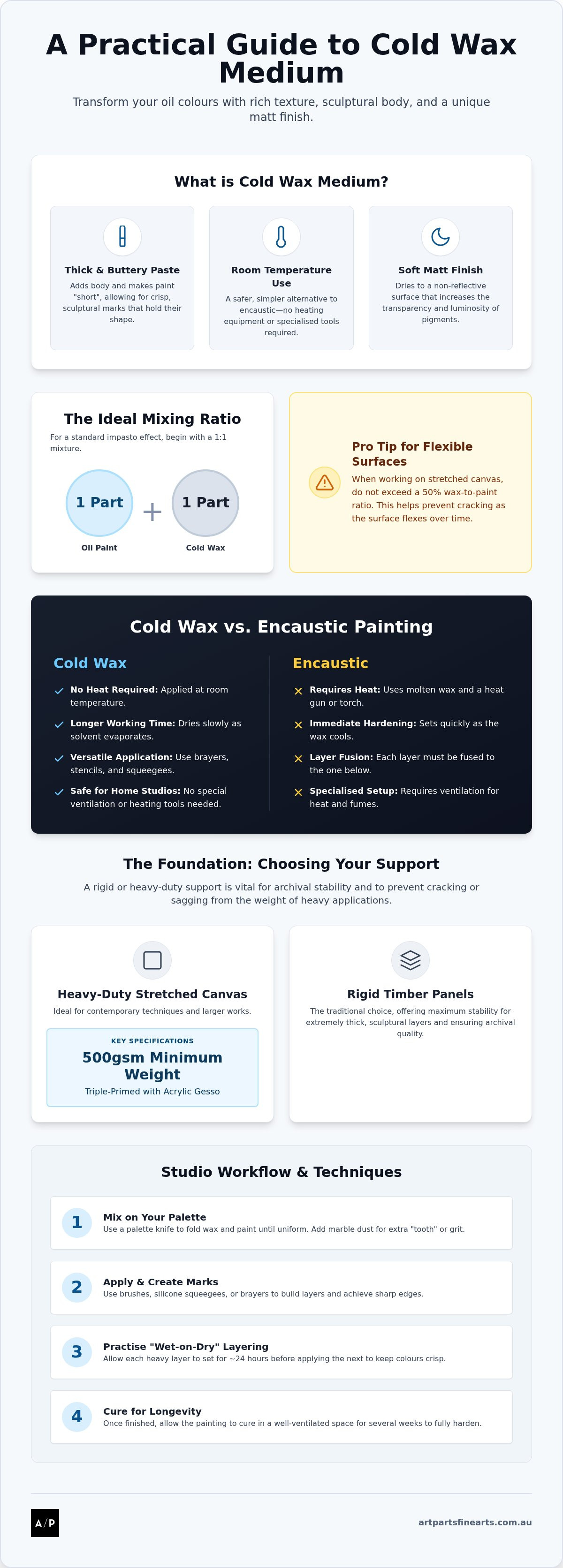
- Learn the ideal 1:1 mixing ratio for cold wax medium for oil painting to achieve a stiff, impasto consistency that holds sculptural marks.
- Discover why this room-temperature medium is a safer, more accessible alternative to encaustic painting that requires no heat or specialised tools.
- Understand how to select rigid supports or heavy-duty 500gsm canvases to prevent structural cracking and ensure the archival stability of your work.
- Master the curing process and essential studio safety to ensure your buttery, matt surfaces harden correctly over several weeks.
What is Cold Wax Medium and How Does it Work?
A cold wax medium for oil painting is a thick, buttery paste that transforms the physical nature of your oil colours. It's crafted from a blend of natural beeswax, a small amount of solvent, and often a touch of resin. Unlike many other additives, it's designed to be used at room temperature without the need for specialised heating equipment. This makes it a practical choice for artists working in home studios or shared spaces where safety and simplicity are priorities.
One of the most satisfying aspects for the painter is how it changes the "shortness" of the paint. In technical terms, a "short" paint breaks cleanly off your palette knife or brush. It won't form those long, stringy drips or "tails" that fluid oils often produce. This allows you to build up crisp, sculptural edges and deep textures that stay exactly where you put them. It's a tactile experience that feels more like spreading cold butter than applying traditional liquid paint.
Beyond texture, adding wax creates a soft, non-reflective matt finish. It also increases the transparency of your pigments. This is particularly effective when working with high-quality paints like Langridge, as it allows you to build complex optical glazes. Light travels through these translucent layers to hit the support below, creating a depth that is difficult to achieve with standard mediums.
Cold Wax vs Encaustic: Key Differences
While both use beeswax, the application methods are completely different. Encaustic painting involves molten wax and requires you to "fuse" every layer with a heat gun or torch to ensure they bond. Cold wax is much simpler; it dries as the solvent evaporates into the air. This lack of heat gives you more time to work. It also allows for modern techniques like using brayers and stencils, or even carving back into the surface with drawing tools once the wax has begun to set.
Mixing and Applying Cold Wax with Oil Paints
Getting the right consistency starts on your palette. For a standard impasto effect, begin with a 1:1 ratio of oil paint to cold wax medium for oil painting. Use a sturdy palette knife to fold the wax into the paint until the colour is completely uniform and the texture feels stiff. You can also incorporate dry materials like marble dust or sand to increase the "tooth", which is the gritty surface texture that helps subsequent paint layers grab onto each other effectively.
Be mindful of your support when mixing your batches. If you're working on a flexible surface, don't exceed a 50% wax-to-paint mixture. Going beyond this limit can lead to potential cracking as the painting moves or expands over time. For those planning heavy, sculptural applications, it's often more economical to work on bulk stretched canvas that offers the necessary tension and surface area for thick layers.
Layering and Mark-Making Techniques
Successful wax painting relies on "wet-on-dry" layering. Practise this by allowing the solvent in your first application to evaporate for roughly 24 hours before you add the next heavy layer. This prevents the fresh paint from "picking up" the layer underneath and keeps your colours crisp. While brushes work, non-traditional tools like silicone squeegees or brayers are excellent for achieving flat, architectural planes of colour and sharp edges.
Working with Professional Pigments
High-pigment loads are essential when using a cold wax medium for oil painting. We recommend using Langridge oil paints because their intense saturation stays vibrant even when heavily diluted with wax. Transparent earth colours are particularly stunning in this medium; they become luminous when suspended in the wax, glowing as light passes through the semi-opaque surface. This depth is what gives cold wax paintings their unique, stone-like quality.
Selecting the Right Support for Wax Layers
Choosing the right surface is just as important as the paint itself. Heavy applications of cold wax medium for oil painting add significant physical weight to your work. If your support is too flimsy, the layers can sag or even crack as the material dries. While rigid timber panels are the traditional choice, professional-grade, heavy-duty stretched canvases are excellent for contemporary techniques.
Look for a canvas with a weight of at least 500gsm. This ensures the fabric can support the tension of thick, impasto layers without losing its shape over time. You also need to ensure the surface is triple-primed with acrylic gesso. This primer acts as a vital seal for the fabric; without it, the oil and wax mixture would seep into the fibres and eventually cause them to rot. Using a high-quality primer ensures your work remains archivally sound for decades.
The Benefits of Bulk Canvas for Studio Practice
Serious wax painters often work in a series to explore specific textures or colour palettes. In these cases, buying full carton canvas ensures total consistency across your entire body of work. It eliminates the variables of different weaves or priming qualities that can occur between individual purchases. Having uniform supports means you can focus entirely on the behaviour of the cold wax medium for oil painting.
Bulk cartons also offer the lowest price per unit. This is a practical advantage for high-volume users like professional studios or art centres. Having a steady supply of high-quality supports allows you to experiment freely with heavy wax layering without worrying about the cost of each individual piece. It’s a resource-heavy technique, so managing your overheads with bulk purchases makes professional studio practice more sustainable.
Curing, Safety, and Final Finishes
In our varied Australian climate, you might find your work feels dry to the touch quite quickly. However, a cold wax medium for oil painting requires a significant amount of time to fully cure and harden. This process can take several weeks or even months depending on the thickness of your applications. It’s a slow chemical change where the solvents evaporate and the wax structure stabilises; patience is key for archival results.
Maintain a well-ventilated studio during this initial drying phase. As the solvents leave the paint film, they need to move freely into the air. Avoid framing wax paintings under glass too early in this process. Trapped solvents can condense against the surface, causing a permanent, cloudy film to form on the inside of the glass. We recommend waiting at least six months before sealing a heavy wax piece behind a frame.
Once fully cured, the wax provides a natural, protective seal that is remarkably durable. If you require extra protection for a professional commission, a specialised varnish like Gamvar can be applied once the surface is firm. This adds a layer of resistance against dust and handling without ruining the unique, non-reflective matt quality that makes cold wax so appealing to the eye.
Studio Safety with Solvents
Practise safe studio habits by keeping your medium jars capped tightly whenever they aren't in use. This simple step significantly reduces the volume of solvent fumes in your workspace. You might also consider using solvent-free oil painting supplies for cleaning your brushes and palette knives. Switching to these alternatives helps reduce the overall chemical load in your studio while still keeping your equipment in top condition for your next session.
Elevate Your Studio Practice with Cold Wax
Mastering cold wax medium for oil painting allows you to move beyond fluid strokes into a world of tactile, matt textures and architectural layers. Success comes down to the technical details: maintaining a stable 1:1 mix, allowing for long curing times, and choosing a support that won't fail under pressure. By prioritising triple-primed, 500gsm surfaces, you ensure your sculptural marks remain secure and archivally sound.
The team at Art Parts Fine Arts is always here to support your creative journey with expert advice and high-quality supplies. Whether you're a professional studio or just starting out, bulk carton savings make it easier to experiment with these heavy impasto techniques. We're excited to see the rich, carved surfaces you create in your own studio.
Frequently Asked Questions
Can I use cold wax medium with acrylic paints?
No, cold wax medium is designed specifically for oil-based materials and cannot be mixed with acrylic paints. Because cold wax contains solvents and beeswax, it won't bond with the water-based chemistry of acrylics. If you try to mix them, the paint will likely separate or fail to adhere to your support. Always use acrylic-specific thickeners if you want to achieve similar impasto effects with water-based colours.
How long does a cold wax and oil painting take to dry completely?
A cold wax and oil painting typically feels dry to the touch within a few days, but it takes several weeks or months to cure fully. This curing process depends on the thickness of your layers and the local humidity. In the Australian climate, the solvent evaporates relatively quickly, but the wax structure needs time to stabilise. Avoid sealing or framing your work behind glass until this hardening process is finished.
Do I need to varnish a cold wax painting?
Varnishing isn't strictly necessary because the wax itself acts as a protective seal once it has cured. Many artists prefer the natural, matt finish that cold wax medium for oil painting provides without any additional coating. However, if your work will be in a high-traffic area, you can apply a specialised varnish like Gamvar. This provides extra durability against dust and handling while maintaining the surface's non-reflective quality.
Is cold wax medium toxic to use in a home studio?
Cold wax is safe for home studio use provided you maintain good ventilation to manage solvent evaporation. Most brands use odourless mineral spirits, which are less harsh than traditional turpentine, but the fumes still need to escape. Keep your jars capped when you aren't actively mixing paint. If you have high sensitivity to chemicals, consider using a solvent-free brush cleaner to reduce the total chemical load in your workspace.
Can I mix cold wax with other mediums like linseed oil?
Yes, you can mix cold wax with other oil mediums like linseed oil or stand oil to adjust the handling properties. Adding a small amount of oil will make the paste more fluid and increase the gloss level of the final finish. However, be careful not to add too much oil, as it can counteract the "short" characteristic of the cold wax medium for oil painting, making the mixture feel greasy rather than buttery.

Article by
Art Parts Fine Arts
Art Parts Fine Arts is an Australian art-supplies store based in Albury, shipping Australia-wide. Hand-picked by artists, our range covers paints, canvas, brushes, paper, printmaking and more, for everyone from students to professionals. We share practical guides and tips to help you get the most out of your materials.
Disclaimer
This article is general information to help you choose and use art materials. It is not professional, health or safety advice. Always follow the manufacturer's instructions and safety guidance for any product, and take care when using solvents, varnishes and other materials. Product availability, specifications and pricing may change, so please check the current product page for details.