

Matisse Acrylic Paint Guide: Choosing the Right Professional Formula
Selecting the wrong viscosity for your painting style often leads to wasted materials and lost momentum at the easel. You might find yourself fighting to smooth out a heavy-body paint or struggling to build height with a…Selecting the wrong viscosity for your painting style often leads to wasted materials and lost momentum at the easel. You might find yourself fighting to smooth out a heavy-body paint or struggling to build height with a fluid formula that keeps levelling out. This matisse acrylic paint guide simplifies the selection process by matching the specific properties of the Matisse range to your unique artistic goals.
It's common to feel confused by the series pricing system or unsure how to achieve a thick impasto finish without the risk of the paint cracking as it cures. You deserve to feel confident that the professional tools you choose will behave exactly as you expect on the canvas. This guide explains how to identify the right formula for your brushwork, how to build a versatile palette within a set budget, and which mediums will enhance your chosen paint for archival results. We also look at how these Australian-made paints interact with different surfaces like 380gsm cotton canvas to ensure your work stands the test of time.
Key Takeaways
- Distinguish between the heavy-bodied Structure formula for impasto work and the low-viscosity Flow formula for smooth, detailed layers.
- Navigate the pigment series system to build a professional palette that balances high-quality colour with your project budget.
- Identify the essential mediums and canvas grounds, such as 380gsm cotton, required to achieve specific textures and ensure archival durability.
- Use this matisse acrylic paint guide to match your physical application style with the correct paint viscosity and drying time.
- Learn practical studio habits for preparing surfaces and managing acrylic drying times in the Australian climate to prevent cracking.
Understanding the Matisse Acrylic Range: Structure vs Flow
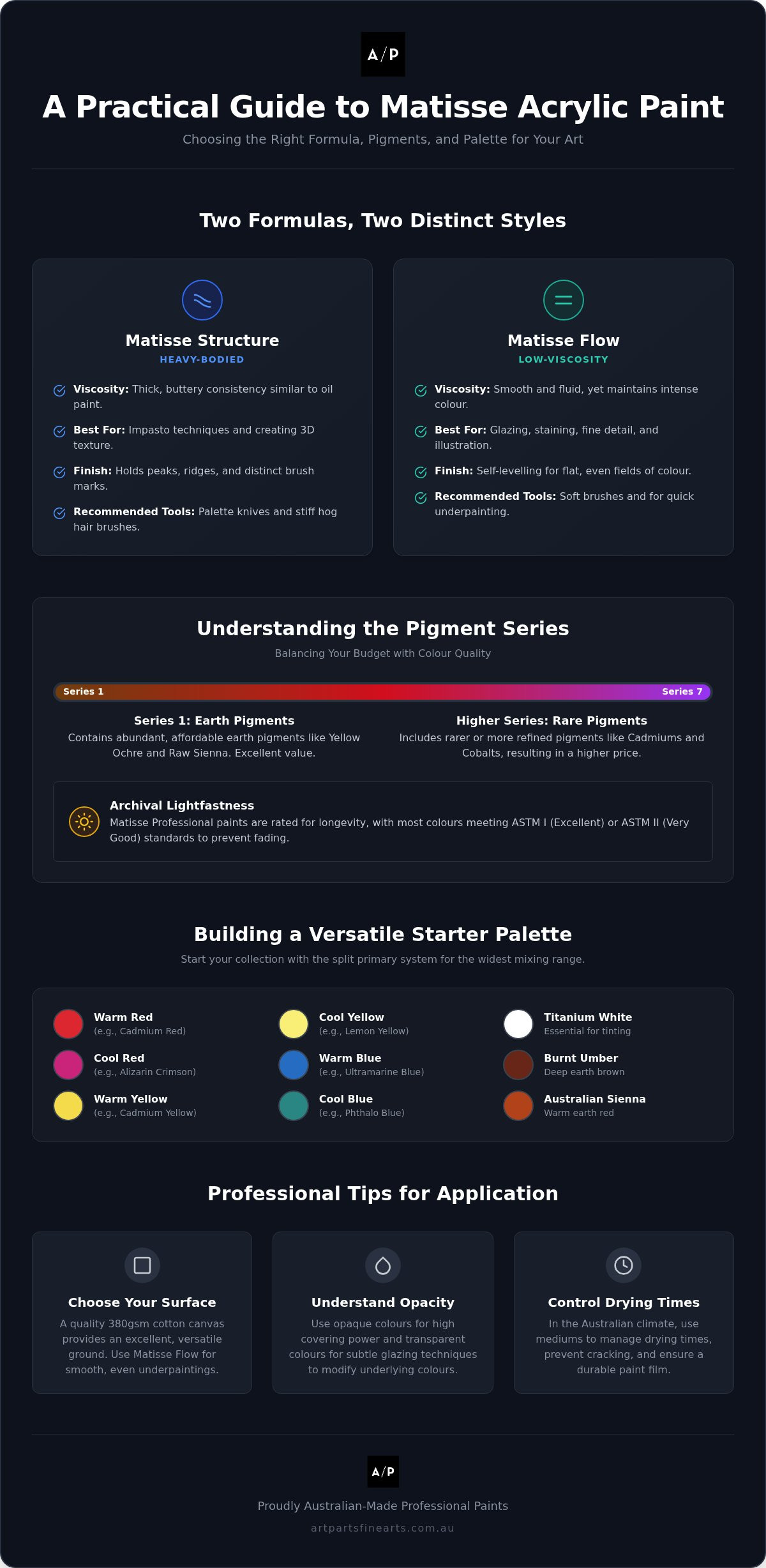
The Matisse range is built on two primary formulas designed to meet different physical handling requirements. While both options offer professional-grade pigment loads and archival lightfastness, their viscosity, or thickness, is vastly different. Understanding these differences is the first step in our matisse acrylic paint guide to help you build a kit that works for your specific style. You can find both formulas in our acrylic paint section.
Matisse Structure is the heavy-bodied option in the range. It has a thick, buttery consistency similar to traditional oil paint. If you enjoy seeing the physical trail of your brush or the sharp ridges left by a palette knife, this is the formula for you. Because it doesn't level out as it dries, it's the standard choice for impasto techniques. You can learn more about how this compares to other professional options in our article on heavy body acrylic paint brands.
In contrast, Matisse Flow is a low-viscosity formula. It's much thinner than Structure but maintains the same intense colour. It's designed to move easily off the brush, making it ideal for fine illustrative work or covering large areas with flat, even colour. Since acrylic paint is valued for its versatility, many artists keep both formulas on their palette to handle different stages of a painting.
When to choose Matisse Structure
Choose the Structure formula when your work relies on three-dimensional texture. It holds peaks and valleys perfectly, ensuring that the light hits the surface of your finished piece to create natural shadows. It's particularly effective when used with stiff hog hair brushes or palette knives. Artists who are transitioning from oils often find this formula the most comfortable because of its resistance and drag on the canvas.
When to choose Matisse Flow
The Flow formula is the better choice for glazing, staining, and detailed line work. It spreads across the surface without the need for heavy dilution, which helps maintain the integrity of the paint film. If you're working on a smooth project that requires hard edges or precise graphic elements, Flow will give you the control you need. It's also excellent for underpainting on a 380gsm cotton canvas where you want to cover the white of the ground quickly without creating unwanted lumps.
Selecting Your Pigments and Navigating the Series System
When you look at a rack of Matisse paints, you'll notice the prices vary between different tubes of the same size. This is because Matisse categorises their colours into a series system, usually ranging from Series 1 to Series 7. This matisse acrylic paint guide point is vital for managing your studio budget. Series 1 contains abundant earth pigments like Yellow Ochre and Raw Sienna. As the series number increases, you're paying for rarer or more difficult-to-refine pigments like Cadmiums and Cobalts.
Professional artists prioritise lightfastness to ensure their work does not fade over decades. Matisse uses the ASTM standard, with most colours in the professional range rated as ASTM I (Excellent) or ASTM II (Very Good). For a deep dive into specific pigment behaviours and chemical compositions, read our Matisse acrylic paint structure heavy body guide. Understanding these technical specifications is a core part of any academic guide to acrylic techniques, helping you choose colours that offer both visual impact and archival longevity.
Building a versatile starter palette
Building a kit from scratch doesn't require every tube on the shelf. We recommend starting with a split primary system. This includes a warm and cool version of red, blue, and yellow. Adding a few Series 1 earth tones like Burnt Umber and Australian Sienna provides a solid foundation for both landscape and portrait work. Since you'll likely go through a lot of paint while experimenting with these mixes, many high-volume artists choose to stock up on bulk stretched canvas to keep their overall costs manageable.
Understanding transparency and opacity
Every tube of Matisse paint features a symbol indicating its opacity. Opaque colours have high covering power and are perfect for blocking in large shapes or correcting mistakes. Transparent colours are essential for glazing, where you apply thin layers to change the tone of the layer beneath without hiding it. Mixing these properties effectively allows you to create depth and luminosity that a flat, opaque-only palette cannot achieve. Always check the tube before buying to ensure the pigment's physical behaviour matches your intended technique.
Essential Mediums and Professional Canvas Grounds
Professional results depend on more than just the paint in your tubes. While our matisse acrylic paint guide has focused on colour and viscosity, the mediums you mix with your paint and the surface you apply it to are equally important. Mediums give you the power to change the drying time, sheen, and physical texture of your work without compromising the archival bond of the paint film. You can find a specific solution for every technique in our range of professional art mediums.
The surface you choose acts as the foundation for your entire practice. A high-quality ground ensures the paint is absorbed correctly, preventing issues like delamination or uneven sheen. Understanding the long-term durability of acrylics requires looking at the interaction between the paint and the substrate. If you use heavy applications of paint on a flimsy surface, the canvas may sag or the paint may crack as the moisture leaves the film.
Texture and impasto mediums
Matisse Impasto Medium is a staple for artists who use the Structure formula. It increases the bulk of your paint without changing the colour, allowing you to stretch your pigments further while maintaining thick, visible brushstrokes. Gel mediums offer a similar benefit but allow you to choose between gloss or matte finishes. If you want to create extreme 3D effects, modelling paste is the best tool for the job. It dries to a hard, stone-like finish that can be carved or sanded once it is fully set.
Choosing the right canvas for acrylics
We stock CreateART and Wright & Co canvases because they provide the stability professional work requires. For general studio work and daily practice, a 380gsm cotton canvas is a reliable choice. It offers enough tooth (the surface texture) to grab the paint while remaining affordable. If you are working on large-scale professional commissions, we recommend a heavyweight 500gsm linen. The extra weight and strength of linen prevent the canvas from stretching or warping under the weight of heavy paint layers. High-volume artists often choose a full carton canvas to ensure they have a consistent surface across a whole series of works.
Professional Tips for Application and Studio Longevity
Proper surface preparation is the foundation of a durable painting. While professional canvases like those from CreateART come triple-primed with acrylic gesso, adding an extra layer of ground can help control the absorbency of the surface. This matisse acrylic paint guide emphasises that a well-prepared substrate allows the paint to bond permanently, preventing the film from peeling or flaking over time.
Managing drying times in the studio
Managing drying times is the biggest challenge for acrylic artists in Australia, particularly during summer. You can manage this by keeping a fine mist spray bottle at your station to lightly dampen the paint on your palette. For more control, incorporate Matisse Retarder Medium into your mixes to slow down the evaporation process. This is particularly helpful when blending large areas of colour or working in high temperatures.
Working in thin, successive layers also prevents the skinning over effect where the surface dries while the paint underneath remains wet. If you apply thick impasto layers with Matisse Structure, allow each layer time to set. This methodical approach ensures the entire paint film cures evenly, maintaining the structural integrity of your work.
Finishing and protecting your artwork
Varnishing is a critical final step in our matisse acrylic paint guide to protect your painting from environmental factors like dust and UV light. You must wait at least 72 hours for thick acrylic paint to cure fully before applying any finish. If the paint is still releasing moisture, the varnish may trap it, leading to a cloudy or bloomed appearance that is difficult to fix.
Choose between gloss, satin, or matte varnishes based on the final look you want to achieve. Gloss finishes often make colours appear more saturated and deep, while matte options reduce glare in brightly lit rooms. Apply your chosen varnish in thin, even coats using a soft, wide brush. Avoid pooling in the textures of your impasto work, as thick patches of varnish can dry unevenly and obscure your fine details.
Don't neglect your tools once the painting is complete. Clean your brushes immediately with cool water and a mild soap. Proper care for your professional tools ensures your brushes maintain their shape and spring for years of studio use.
Elevate Your Artistic Practice with Matisse
Choosing the right professional materials is a significant step in developing a consistent and reliable artistic practice. This matisse acrylic paint guide has detailed how to match paint viscosity to your specific technique and select the correct archival ground for your work. By understanding the series system and the role of specialised mediums, you can build a versatile palette that is both high-performing and cost-effective for your studio.
Our team consists of active artists who use these professional materials in their own creative work every day. We take pride in offering expert advice and supplying professional-grade pigments to creators across the country. Whether you're working on a small personal study or a large-scale commission, our Australia-wide shipping ensures you have access to the right tools exactly when you need them.
We look forward to seeing the textures and colours you create with these professional tools. Please get in touch if you have any questions about which Matisse formula is the best fit for your next project.
Frequently Asked Questions
What is the difference between Matisse Structure and Matisse Flow?
Matisse Structure is a thick, heavy-bodied paint that retains brushstrokes and palette knife marks, making it ideal for textured impasto work. Matisse Flow has a lower viscosity, allowing it to spread easily for fine detail, glazing, and flat areas of colour. Both formulas share the same professional pigment load. Choosing the right consistency depends on your physical application style and whether you prefer a buttery feel or a more fluid movement on the canvas.
How do the series numbers affect the price of Matisse acrylics?
Series numbers categorise paints based on the market cost of the raw pigments used in each colour. Series 1 typically includes abundant earth pigments like ochres and siennas, while higher series numbers contain more expensive or rare pigments like cadmiums and cobalts. This system allows you to build a professional kit while balancing your budget. This matisse acrylic paint guide recommends using a mix of series to achieve a full spectrum without overspending on every tube.
Can I mix Matisse acrylics with other brands of paint?
You can generally mix Matisse acrylics with other professional brands of acrylic paint, as most use a compatible acrylic polymer emulsion. However, mixing different brands can sometimes result in slight changes to the sheen or drying rate of the paint film. For the most predictable results and archival stability, we recommend staying within the Matisse system or testing a small batch first. Always ensure the other brand is also a professional-grade acrylic to maintain the quality of your work.
What is the best canvas weight for heavy impasto painting?
For heavy impasto painting, we recommend a heavyweight canvas such as a 380gsm cotton or a 500gsm linen. These weights provide the structural strength needed to support thick layers of paint without sagging or warping. A lighter canvas may struggle under the weight of heavy-bodied Matisse Structure applications. This matisse acrylic paint guide suggests using professional grounds from ranges like CreateART to ensure the paint bonds correctly and remains durable as it cures.
Do I need to prime my canvas before using Matisse Structure?
Most professional canvases, including the CreateART and Wright & Co ranges, come triple-primed with acrylic gesso and are ready for immediate use. You don't strictly need to add more primer, but many artists apply an extra layer of gesso to customise the surface texture or reduce absorbency. This extra step can be helpful when using Matisse Structure for thick applications, as it ensures the paint doesn't lose too much moisture into the substrate too quickly.
How long do Matisse acrylic paints take to dry completely?
Matisse acrylics are touch dry within minutes to a few hours depending on the application thickness and local humidity. However, thick impasto layers can take several days or even weeks to cure completely through the entire paint film. We recommend waiting at least 72 hours before applying any varnish to ensure all moisture has evaporated. This patience prevents issues like cloudiness or blooming, ensuring the archival longevity and professional finish of your completed artwork.

Article by
Art Parts Fine Arts
Art Parts Fine Arts is an Australian art-supplies store based in Albury, shipping Australia-wide. Hand-picked by artists, our range covers paints, canvas, brushes, paper, printmaking and more, for everyone from students to professionals. We share practical guides and tips to help you get the most out of your materials.
Disclaimer
This article is general information to help you choose and use art materials. It is not professional, health or safety advice. Always follow the manufacturer's instructions and safety guidance for any product, and take care when using solvents, varnishes and other materials. Product availability, specifications and pricing may change, so please check the current product page for details.