

Round Canvas in Australia: Guide to the Tondo Format
Stepping away from the traditional rectangle can feel like a breath of fresh air, but finding a high-quality round canvas for painting Australia brings a unique set of technical demands. You likely know the frustration o…Stepping away from the traditional rectangle can feel like a breath of fresh air, but finding a high-quality round canvas for painting Australia brings a unique set of technical demands. You likely know the frustration of seeing fabric pucker at the curved edges or the frame warp in the humidity. These structural issues often stem from poor construction, and they can make even an experienced artist hesitate before trying a new shape.
We believe every artist deserves a surface that stays taut and true. This guide explains how to select a professional-grade circular support, ensuring you get a surface that won't let you down. You'll learn how to handle radial composition and how to prepare your surface with gesso, a primer that helps paint stick to the fabric. We also explore practical ways to manage supplies, such as sourcing bulk cartons to keep costs down for larger projects. By the end, you'll have the confidence to master the tondo format and elevate your practice.
Key Takeaways
- Understand the historical significance of the tondo format and how its circular shape changes the way viewers engage with your work.
- Identify the technical specifications of a professional-grade surface, such as triple-primed acrylic gesso and kiln-dried timber frames.
- Learn how to adapt traditional composition rules, like the Rule of Thirds, to successfully anchor your design on a radial field.
- Find out how to select the right round canvas for painting Australia while securing the best value through bulk carton options for schools and art centres.
The Rise of the Tondo: Why Choose a Round Canvas?
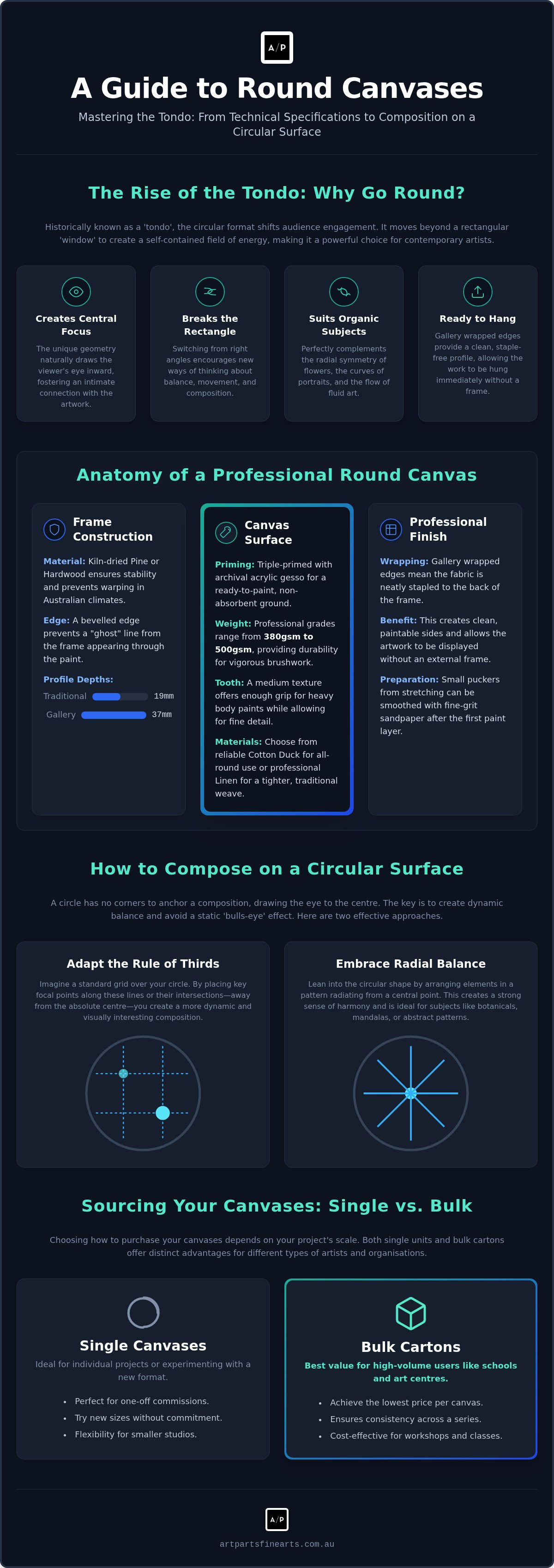
Choosing a circular surface represents a deliberate shift in how you engage with your audience. Historically, this format is known as a tondo, a Renaissance term for a circular work of art that gained prominence in 15th-century Italy. While traditional rectangular frames act as a "window" into a scene, a circle removes those sharp corners, creating a self-contained field of energy. This unique geometry forces a central focus, making it a powerful tool for artists looking to create an intimate connection with the viewer.
In contemporary Australian galleries and interiors, the circular format has seen a significant resurgence. Many artists use a round canvas for painting Australia to complement the fluid, organic lines of modern architecture. It offers a point of difference in a world dominated by right angles. For creators, switching to a circle can be a practical way to break through a creative block. The lack of a horizontal or vertical axis encourages you to think about balance and movement in entirely new ways.
Breaking the Rectangular Habit
The circular shape is naturally suited to organic subjects that don't fit comfortably within a square. You might find it particularly effective for:
- Botanical studies: The radial symmetry of flowers or native Australian flora.
- Portraits: Focusing on the face without the distraction of background corners.
- Fluid art: Allowing acrylic pours to move naturally toward the edges.
Most professional round canvases feature "gallery wrapped" edges. This means the fabric is stretched around the back of the frame, leaving a clean, staple-free side profile. This aesthetic choice allows the work to be hung immediately without the need for an external frame, keeping the focus entirely on your art. It's a clean, professional look that suits both minimalist studios and busy gallery walls.
Technical Specs: What Makes a Professional Round Canvas?
Selecting a high-quality round canvas for painting Australia requires looking beneath the surface. In our varied climate, standard timber can easily warp or twist. Professional frames from brands like CreateART use kiln-dried pine or hardwood to ensure the circular shape remains perfectly flat over time. This structural stability is the foundation of long-term conservation of paintings, protecting your work from the stresses of humidity and temperature shifts.
Professional-grade weights generally sit between 380gsm and 500gsm. This thickness provides the durability needed for vigorous brushwork or heavy applications on a round canvas for painting Australia. To ensure the paint doesn't soak into the fibres, professional surfaces are triple-primed with acrylic gesso. This archival ground is perfect for heavy body acrylic paint brands, supporting thick impasto textures without sagging.
Understanding Priming and Tooth
The "tooth" refers to the texture of the weave. A medium tooth provides enough grip for thick, textured paints or heavy body acrylics while remaining smooth enough for finer details. While cotton duck is a reliable all-rounder for most projects, professional linen offers a tighter, more traditional feel that many oil painters prefer for its archival qualities.
Frame Construction and Profiles
A well-made stretcher bar features a bevelled edge. This slight angle ensures the fabric only touches the very outer rim, preventing a "ghost" line of wood from appearing through your paint as you work. Profile depths generally range from a traditional 19mm to a bold 37mm gallery profile. If you are preparing for a large exhibition or teaching a class, choosing bulk cartons of professional canvases ensures consistency across your entire series while offering the best value.
How to Compose and Paint on a Circular Surface
Working on a circular field requires a shift in visual logic. Unlike a rectangle where the corners provide natural boundaries, a circle draws the eye inward toward the centre. Finding this geometric centre is your first step to anchor the work. While symmetry is a natural choice, many artists struggle with the challenges of a circular composition when trying to avoid a static "bulls-eye" effect. You can still apply the Rule of Thirds by imagining a grid over the circle, but try shifting your focal points away from the absolute midpoint to create movement.
Because the fabric must be folded around a curve, you might notice small puckers on the side of a round canvas for painting Australia. You can smooth these out using fine-grit sandpaper after your first layer of primer. If you find the factory finish isn't quite smooth enough for your style, consider choosing the right gesso for your canvas to build up a thicker, more even base. This ensures your brush glides across the surface without catching on the weave.
Handling the Curved Edge
Wrapping your painting around the sides gives a three-dimensional feel that works well for gallery displays. This technique turns the artwork into a sculptural object rather than just a flat image. It's best to continue your background colours or main motifs onto the edge to maintain a seamless transition when viewed from the side.
Drafting Your Design
Don't guess the curves when sketching out your initial design. Use a large compass or the string-and-pencil method to mark out concentric circles or radial guides. This ensures your geometry stays true to the frame, which is vital for mandala work or precise geometric abstracts on a round canvas for painting Australia.
Sourcing Round Canvases: Single Units vs Bulk Cartons
While buying a single unit is perfect for testing a new idea, professional studios and art centres often find that the financial logic of buying full cartons is far more practical. When you source a round canvas for painting Australia in bulk, you aren't just saving on the price per unit. You're also ensuring that every piece in a series shares the same gesso tooth and frame profile. This consistency is vital for creating a cohesive body of work for exhibition.
High standards are non-negotiable for work intended for sale. We suggest investing in high-quality art supplies to provide a stable, archival foundation for your paintings. Professional-grade surfaces from CreateART or Wright & Co offer the structural integrity needed to prevent warping in our varied climate. Using a reliable support means you can focus on your creative process without worrying about the longevity of the finished piece.
Managing a large inventory in a studio requires a bit of planning. You can easily organise art supplies in a small space by storing your cartons flat rather than upright. This simple trick prevents the fabric from sagging under its own weight during long-term storage, keeping the tension perfect for when you're ready to paint.
Bulk Buying for Australian Studios
Ordering full cartons of CreateART or Wright & Co canvases provides the best value for high-volume users like schools or community centres. We handle shipping for these large cartons across Australia with a focus on protection. Whether you're in a capital city or a regional area, we ensure your round canvas for painting Australia arrives in the same professional condition it left our warehouse. You can explore our range of bulk stretched canvas to find the right fit for your next project.
Elevate Your Art with the Tondo Format
Embracing the tondo format allows you to break free from traditional boundaries and experiment with radial balance in your work. Choosing a professional-grade round canvas for painting Australia ensures your art remains stable and archival for years to come. You should always look for technical specifications like 380-500gsm weights and kiln-dried pine frames to resist warping in our unique climate. These specific details are why our range is trusted by leading Australian art schools and professional studios. Whether you're painting a single detailed portrait or starting a large abstract series, the right surface provides the confidence you need to push your practice further. Buying in bulk remains the most cost-effective way to maintain high standards while managing your studio or classroom budget.
We're always happy to help you select the right tools for your creative journey. Don't hesitate to contact us if you need advice on which profile depth or weight suits your specific technique.
Frequently Asked Questions
Do I need to prime a round canvas before painting?
Most professional canvases come triple-primed with acrylic gesso, so they're ready for immediate use. If you want a smoother surface with less tooth, which is the texture of the weave, you can add another layer. Sanding lightly between coats will create a professional finish for fine detail work. This extra prep ensures your paint glides on without catching on the fabric.
How do I hang a round canvas without a frame?
You can hang these works by attaching D-rings and a picture wire to the back of the kiln-dried pine frame. Position the rings about a third of the way down from the top to ensure the canvas sits flat against the wall. Since most are gallery-wrapped with clean edges, you won't need an external frame to achieve a polished, professional look in a gallery setting.
Can I use oil paints on a round cotton canvas?
You can certainly use oil paints on a cotton round canvas for painting Australia as long as it's properly primed. The gesso creates a non-porous surface that protects the cotton fibres from the oil. For heavy applications or palette knife work, we recommend choosing a canvas with a weight of 380gsm to 500gsm. This provides the structural strength needed to support thicker paint layers without sagging.
What is the best way to sketch a design on a circular surface?
Using a large compass or a string-and-pencil method is the most reliable way to draft your design. First, find the exact centre point of the circle to anchor your guides. This allows you to create symmetrical patterns or radial grids with ease. It's much more effective than sketching by hand, as it ensures your composition remains perfectly balanced within the circular format of the tondo.
Why do some round canvases have wrinkles on the side?
Puckering happens because the flat fabric has to be tucked and folded to fit the circular frame. On a high-quality round canvas for painting Australia, these folds are kept to a minimum by the manufacturer. If they bother you, try applying a few coats of thick gesso or heavy body paint to the sides. This fills in the small gaps and creates a much smoother, professional edge for your artwork.

Article by
Art Parts Fine Arts
Art Parts Fine Arts is an Australian art-supplies store based in Albury, shipping Australia-wide. Hand-picked by artists, our range covers paints, canvas, brushes, paper, printmaking and more, for everyone from students to professionals. We share practical guides and tips to help you get the most out of your materials.
Disclaimer
This article is general information to help you choose and use art materials. It is not professional, health or safety advice. Always follow the manufacturer's instructions and safety guidance for any product, and take care when using solvents, varnishes and other materials. Product availability, specifications and pricing may change, so please check the current product page for details.