

Artist Paint Types: Professional Guide for Australians
The difference between a painting that glows and one that looks flat often has nothing to do with your skill and everything to do with the chemical makeup of your pigments. Understanding the various types of artist paint…The difference between a painting that glows and one that looks flat often has nothing to do with your skill and everything to do with the chemical makeup of your pigments. Understanding the various types of artist paint is about more than just picking a favourite shade; it’s about knowing how binders and pigment loads interact with your surface.
It’s frustrating to invest in professional colours only to find they don't behave the way you expected, especially when you’re trying to master a specific technique like impasto, which is thick and textured, or delicate glazing with thin, transparent layers. We know how it feels to waste money on pigments that fade or mediums that aren't compatible with your current setup.
This guide will help you identify the ideal medium for your creative process by breaking down the technical differences between acrylics, oils, watercolours, and specialised pigments. We’ll explore why pigment density matters for archival quality, clarify the confusion between heavy body and flow acrylics, and ensure your studio setup works for your style.
Key Takeaways
- Learn how the relationship between pigment and binder defines the drying time and finished texture of different types of artist paint.
- Understand why professional-grade pigments offer superior archival quality compared to student ranges that often rely on fillers and synthetic 'hues'.
- Discover how to incorporate specialised mediums like PanPastel or professional printmaking inks to expand your creative practice.
- Match your medium to your preferred application technique, whether you require the thick texture of impasto or the fluid transparency of glazing.
- Evaluate how your studio environment and ventilation needs should inform your choice of medium for a safe and productive workspace.
Understanding the Core Paint Mediums for Artists
Every tube or jar of paint starts with the same foundation: dry pigment. These fine powders provide the colour, but they can't stick to a surface on their own. To create the various types of artist paint we use in the studio, these pigments are mixed with a binder. This binder is the substance that holds the pigment together and allows it to adhere to your canvas or paper once dry.
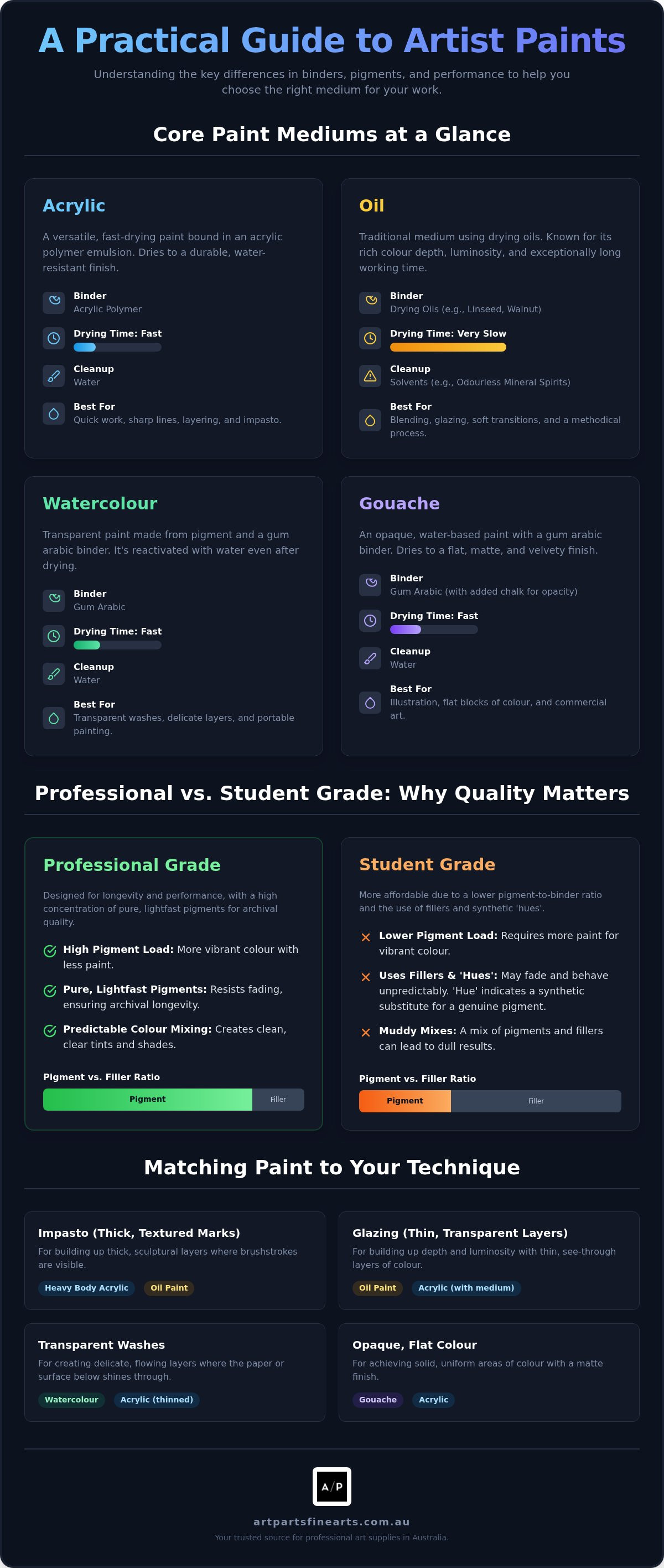
Looking at the core paint mediums, the binder dictates almost everything about how the paint behaves. It determines the drying time, the final sheen, and whether the paint remains water-soluble after it has set. Most professional artists work within the four primary pillars of fine art: acrylic, oil, watercolour, and gouache. While watercolour and gouache both use gum arabic as a binder, gouache is designed for an opaque, matte finish, whereas watercolour is prized for its transparency.
Longevity is another critical factor when selecting your materials. Professional-grade paints prioritise lightfast pigments, which are rated for their ability to resist fading when exposed to light. Using high-quality pigments ensures your work maintains its vibrance for decades, fulfilling the archival standards expected by galleries and collectors. Choosing the right paint involves balancing these technical properties with your personal creative goals.
Acrylic Paint: The Modern Versatile Standard
Acrylics are a water-based polymer emulsion that dries rapidly to form a tough, flexible film. Because the binder is a plastic resin, the paint becomes water-resistant once dry, allowing you to layer colours without disturbing the paint underneath. This medium is incredibly adaptable; you can thin it with water for transparent washes or use it straight from the tube for thick, sculptural marks. It's a reliable choice for artists who want to work quickly and avoid the use of harsh chemicals.
The versatility of acrylics is often expanded through specialised painting mediums and varnishes. These additives allow you to adjust the drying time, increase transparency, or change the finish from matte to high-gloss. Brands like Matisse offer different viscosities, such as structure or flow, to suit your specific application style without compromising the pigment load.
Oil Paint: The Traditional Choice for Depth
Oil paint consists of pigment suspended in drying oils, most commonly linseed, walnut, or safflower oil. These oils dry through oxidation rather than evaporation, which is a much slower process. This extended working time is the primary reason many artists choose oils, as it allows for hours or even days of blending and soft transitions on the canvas. It's the ideal medium for those who enjoy a methodical, layered approach to their work.
Oils provide a unique depth of colour and a luminous quality that is difficult to replicate with water-based alternatives. However, they require more careful studio management. You'll need to use solvents like odourless mineral spirits or specialised oil-based cleaners to wash your brushes and thin your paint. For those prioritising archival quality and traditional craftsmanship, hand-crafted options like Langridge oil paints offer exceptionally high pigment loads without unnecessary fillers.
Professional Grade vs Student Grade: Why Quality Matters
The choice between student and professional series is the most significant decision you'll make when comparing different types of artist paint. Student paints are designed for affordability, which means manufacturers replace a high percentage of pigment with inexpensive fillers like calcium carbonate or clay. This dilution fundamentally changes the professional grade paint composition that serious artists rely on for archival results.
When you see the word 'hue' on a label, it indicates that a synthetic mixture has been used to mimic an expensive, genuine pigment like Cadmium or Cobalt. While these are safer and cheaper, they rarely possess the same tinting strength or mixing clarity as the real thing. Professional paints might cost more upfront, but their high pigment load means you use much less paint to achieve the same coverage and vibrancy. Mixing professional colours is also more predictable; student paints often turn to "mud" because they contain a cocktail of different pigments and fillers in every tube.
Matisse Acrylic Paint Structure: Heavy Body Excellence
For artists who want their brushwork to stand out, the Matisse Acrylic Paint Structure range is a professional benchmark. This is a "heavy body" acrylic, meaning it has a thick, buttery consistency that holds peaks and textures perfectly. Unlike thinner student acrylics that level out as they dry, Structure paints allow for dramatic impasto techniques. The high pigment concentration ensures that even when you dilute the paint with water or mediums, the colour remains intense and clean.
Langridge Oil Paints: Hand-Crafted Pigments
If you prefer the traditional route, Langridge oil paints represent the pinnacle of Australian hand-crafted quality. These paints are made with a single-pigment focus and contain no unnecessary extenders or opacifiers. This purity allows the unique personality of each pigment to shine through, whether it's the natural transparency of an earth colour or the punchy opacity of a modern synthetic. Because they are free from fillers, they respond predictably to traditional mediums, giving you total control over the final finish.
Investing in quality paint is only half the battle; the surface you choose is just as vital. If you're working through a large series, consider buying canvas in full cartons to ensure your professional pigments are matched by a professional-grade ground.
Specialised Mediums: Beyond the Traditional Tube
While standard tubes of oil and acrylic dominate many studios, exploring alternative types of artist paint can unlock new textures and working methods. Gouache is a prime example. It is essentially an opaque watercolour that uses a high pigment-to-binder ratio to achieve a flat, velvety finish. It is a favourite for illustrators and designers because it can be reworked with water like a traditional watercolour, yet it offers the covering power usually associated with acrylics. This opacity allows you to paint light colours over dark ones, a technique that is impossible with transparent watercolours.
Working with specialised mediums often requires a different approach to your foundation. Whether you are using wet or dry pigments, the surface needs to be prepared to handle the specific weight and moisture of the medium. For those working in mixed media, it is vital to ensure that each layer is compatible with the one beneath it to prevent peeling or archival failure later on.
PanPastel: Professional Soft Pastels in a Pan
For artists who want the immediacy of drawing with the blending capabilities of paint, PanPastel assorted colours offer a unique solution. These are professional-grade soft pastels packed into a shallow pan, applied using specialised Sofft foam tools. They contain significantly less binder and filler than traditional pastel sticks. This results in a rich, concentrated colour that generates almost no dust and adheres beautifully to the tooth of your paper. The tooth refers to the surface texture of the paper that grabs the pigment. Using these in a pan format allows you to lift and apply colour just like you would with a brush.
Fine Art Printmaking Inks and Specialised Pigments
Fine art printmaking involves specialised inks designed for specific transfer methods. Relief inks are used for linocuts and woodblocks, sitting on the surface of the block. Intaglio inks are wiped into the grooves of an etched plate. For the home studio, water-based relief inks offer easy cleanup and lower VOC (Volatile Organic Compound) levels. Oil-based inks provide a longer working time and a more traditional finish for complex plates that require intricate wiping techniques.
Your choice of paper is critical here. Printmaking inks require absorbent, high gsm surfaces to hold the pigment without buckling under the pressure of a press. Gsm stands for grams per square metre, which indicates the weight and thickness of the sheet. When mixing these with other mediums, always ensure your ground is stable. A high-quality acrylic gesso, which is a primer used to seal the surface and provide a base for the paint, provides a reliable foundation for most mixed-media applications.
How to Choose the Right Paint for Your Project
Selecting from the different types of artist paint involves balancing your creative technique with the practicalities of your workspace. If you enjoy building thick, sculptural layers, a heavy-body acrylic or oil is necessary to hold those peaks. Conversely, if your style relies on thin, atmospheric washes, watercolours or fluid acrylics will serve you better. Consider your studio environment as well; oils require adequate ventilation for solvents, while acrylics dry quickly, which can be a challenge in the dry Australian heat.
Many artists find that investing in a limited palette of professional-grade colours is more cost-effective than buying large sets of student paint. Starting with just a warm and cool version of each primary colour allows you to mix almost any shade while maintaining high pigment density. This approach ensures your work remains vibrant and archival without the muddiness often found in cheaper sets. It is a more sustainable way to build a professional kit that grows with your skill level.
Selecting the Right Surface and Ground
Professional paints perform best when paired with a high-quality stretched canvas from reliable ranges like CreateART or Wright & Co. A 380gsm cotton canvas is a versatile choice for most acrylic and oil projects, while a 500gsm linen provides a stiffer, more durable foundation for heavy applications. These canvases are triple-primed with acrylic gesso and stretched over kiln-dried pine or hardwood bars to prevent warping over time.
The profile of the stretcher bar also affects the final presentation of your work. You can choose from a slim 16mm profile for traditional framing or a gallery-depth 35 to 37mm profile for a more contemporary look where the painting continues around the edges. Matching the weight and depth of your canvas to your specific medium ensures that the surface can support the physical demands of your painting style without sagging or losing tension.
Common Mistakes to Avoid When Buying Paint
- Buying large sets of student-grade paint instead of a few professional tubes. The lower pigment load in student ranges makes it difficult to achieve clean colour mixes, often leading to frustration for beginners.
- Ignoring the transparency and opacity ratings on the label. Knowing whether a colour is transparent or opaque is essential for effective glazing and layering, regardless of the medium you choose.
- Forgetting to check the lightfastness rating. This is a measure of how well a pigment resists fading over time. For any work intended for sale or exhibition, always choose pigments with a high lightfastness rating to ensure your art lasts for decades.
Elevate Your Practice with Professional Materials
Choosing from the various types of artist paint is a technical decision that directly affects the archival life and visual impact of your work. Whether you prefer the thick texture of Matisse Structure or the blending time of Langridge oils, the quality of your pigment matters more than the number of tubes in your kit. By investing in professional materials, you ensure your creative vision is supported by reliable chemistry.
Our team at Art Parts Fine Arts consists of practising artists who use these materials in our own studios. We take pride in stocking professional brands and providing the specific technical advice you need to avoid wasting money on incompatible mediums. We ship our entire range Australia-wide from our Albury warehouse, ensuring you have access to the best tools regardless of your location.
We are always happy to discuss your project and help you find the right supplies for your specific style. Feel free to reach out if you need guidance on pigment loads or surface preparation for your next piece.
Frequently Asked Questions
What is the difference between professional and student grade paint?
The primary difference between professional and student grade versions of various types of artist paint lies in the pigment-to-binder ratio. Professional paints contain a high concentration of genuine pigments, offering superior tinting strength and archival stability. Student grade paints use inexpensive fillers and synthetic 'hues' to reduce costs. This often results in weaker colours and muddy mixes. Investing in professional ranges ensures your work maintains its vibrancy and structural integrity over time.
Is acrylic paint better than oil paint for beginners?
Acrylic paint is generally recommended for beginners due to its fast drying time and water-based cleanup. You don't need harsh solvents or specialised mediums to get started. However, oil paint is better if you prefer slow blending and soft transitions. While exploring different types of artist paint, consider your patience for drying times. Acrylics allow you to finish a piece in one session, while oils require a methodical, multi-day approach.
What does 'heavy body' mean in acrylic painting?
Heavy body refers to the viscosity or thickness of the paint. It has a buttery, stiff consistency that retains brush strokes and palette knife peaks, making it the standard choice for impasto techniques. This differs from 'flow' or 'fluid' acrylics, which are thinner and designed for smooth, level applications. Matisse Structure is a prime example of a professional heavy body acrylic that offers excellent texture without the need for additional thickening mediums.
Can I use oil paint and acrylic paint on the same canvas?
You can use both on the same canvas, but only if you apply the acrylic layers first. Because oil paint is 'fat' and acrylic is 'lean', acrylic will not adhere to an oily surface and will eventually peel or crack. Always ensure your acrylic underpainting is completely dry before applying oil colours on top. This sequence is a fundamental rule for ensuring the archival longevity and durability of mixed-media works.
Why are some paint colours more expensive than others in the same range?
Professional paint ranges are typically organised into 'series' based on the cost of the raw pigment. Earth colours like Yellow Ochre are abundant and inexpensive to process, placing them in Series 1. Rarer pigments like genuine Cobalt or Cadmium require complex extraction and refining, which increases the production cost. These are categorised into higher series numbers. This pricing structure reflects the genuine cost of the raw materials rather than a flat markup.
How do I know if a paint is archival and lightfast?
You can verify a paint’s quality by checking the lightfastness rating on the tube, usually indicated by ASTM codes. A rating of ASTM I is Excellent, while ASTM II is Very Good. Professional brands also list the specific pigment codes, such as PW6 for Titanium White. These ratings tell you how well the colour will resist fading when exposed to light, which is essential for creating archival works that will last for decades.

Article by
Art Parts Fine Arts
Art Parts Fine Arts is an Australian art-supplies store based in Albury, shipping Australia-wide. Hand-picked by artists, our range covers paints, canvas, brushes, paper, printmaking and more, for everyone from students to professionals. We share practical guides and tips to help you get the most out of your materials.
Disclaimer
This article is general information to help you choose and use art materials. It is not professional, health or safety advice. Always follow the manufacturer's instructions and safety guidance for any product, and take care when using solvents, varnishes and other materials. Product availability, specifications and pricing may change, so please check the current product page for details.